For decades, we’ve treated Alzheimer’s disease like an inevitable consequence of aging—something to manage, to slow down, but never truly prevent. But what if we’ve been looking at it all wrong? What if the vast majority of Alzheimer’s cases aren’t just random bad luck, but the result of a single genetic factor we could actually change?
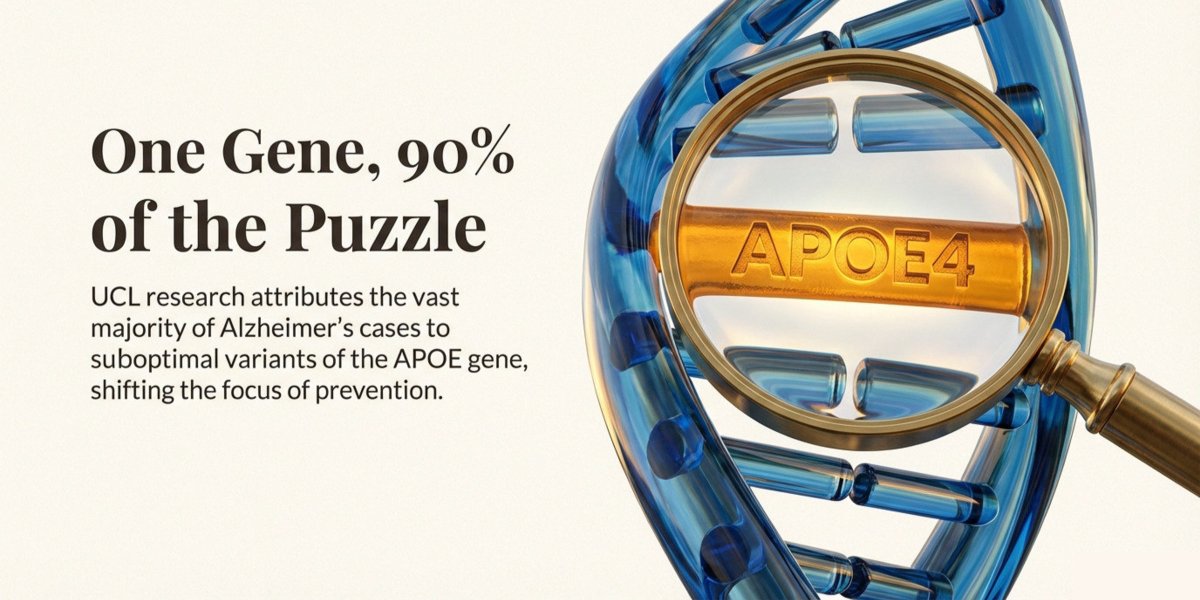
A groundbreaking study from University College London, published in the journal npj Dementia, analyzed data from approximately 470,000 participants across four large cohorts and found that the proportion of Alzheimer’s cases attributable to specific variants of the APOE gene ranged from 71.5% to an astounding 92.7%.
Let me put that in perspective: up to nine out of every ten Alzheimer’s cases may be linked to which version of this one gene you carry.
The APOE gene comes in three main variants: epsilon 2, epsilon 3, and epsilon 4. Think of them as different software versions running the same program—but with dramatically different outcomes.
APOE2, the rarest variant, confers significant protection against Alzheimer’s. APOE3 is the most widespread and is usually considered neutral—neither protective nor risk-associated. But APOE4? APOE4 is expressed in 40% to 65% of all Alzheimer’s diagnoses and is considered one of the most important risk factors for developing the disease.
Individuals carrying two copies of the epsilon 4 variant have a 12-fold higher risk of developing Alzheimer’s compared to those with the epsilon 3 variant.
Here’s where it gets revolutionary. Traditional medicine has treated APOE3—the common variant—as the baseline, the “good enough” standard. Only APOE4 was seen as problematic.
But this new study flips that thinking entirely. The researchers chose APOE2, the protective variant, as their baseline. And suddenly, the picture changes. Dr. Dylan Williams, the study’s lead author, explains it this way: we have long underestimated how much the APOE gene contributes to the burden of Alzheimer’s disease, and much disease would not occur without the additional impact of the common epsilon 3 allele, which has been typically misperceived as neutral in terms of Alzheimer’s risk.
This isn’t just semantics—it’s a fundamental shift from asking “what’s abnormal?” to asking “what’s optimal?”
And here’s where it gets really exciting. Gene editing technology has shown great potential for clinical translation in Alzheimer’s disease, and early clinical applications of the CRISPR/Cas9 system have brought a ray of hope for treating early Alzheimer’s or for preventive genetic intervention.
Multiple research teams are already making progress. Scientists at Duke University developed an epigenome therapy platform that can robustly reduce the levels of APOE-e4 in both human induced pluripotent stem cell derived miniature brains and humanized mouse models, without changing levels of other APOE variants.
A study published in Nature Neuroscience found that editing the high-risk APOE4 gene with its lower-risk counterpart in mice resulted in fewer Alzheimer’s-related brain changes such as amyloid plaque buildup and inflammation, and stronger performance on memory tests. Even more remarkably, switching the gene later in life improved multiple aspects of Alzheimer’s pathology at once.
Dr. Williams emphasizes the enormous potential: intervening on the APOE gene specifically, or the molecular pathway between the gene and the disease, could have great, and probably under-appreciated, potential for preventing or treating a large majority of Alzheimer’s disease.
Dr. Lance Johnson from the University of Kentucky puts it even more directly: in theory, we could prevent millions of Alzheimer’s disease cases from ever happening in the first place.
Now, before we get too carried away—this isn’t happening tomorrow. Gene editing in humans faces significant technical hurdles, safety concerns, and ethical questions that need careful consideration. And Alzheimer’s remains a complex disease influenced by lifestyle, environment, and multiple genetic factors.
Worldwide, 45% of dementia cases are linked to modifiable risk factors, and research has found that lifestyle changes can significantly reduce the risk of cognitive decline. Diet, exercise, sleep, social engagement—these still matter enormously.
But what’s changed is the ceiling of what’s possible. We’re no longer just talking about slowing decline or managing symptoms. We’re talking about addressing the root genetic cause in the majority of cases.
For decades, we’ve accepted that your genes are your destiny. But increasingly, science is proving that genes aren’t a fixed sentence—they’re code that can be rewritten.
The question is no longer whether we can prevent Alzheimer’s through genetic intervention. The question is how soon we can do it safely, efficiently, and at scale.
And for the 80,000 Kentuckians, the millions of Americans, and tens of millions worldwide living with or at risk for Alzheimer’s—that shift from “managing decline” to “preventing disease” isn’t just a scientific breakthrough.
It’s a revolution in hope.
This topic was covered in Great News Podcast episode 28
Source: Lifespan Research Institute