


A podcast for People Who Want to See the Good in the World.
Please Follow or Subscribe
 Apple Podcasts
 Spotify
We believe that by sharing good news, we can make a real difference in the world. When we focus on the positive, we are more likely to feel hopeful and optimistic about the future. We are also more likely to take action to create positive change in our own lives and in the world around us.
Also available here:





Support the Show ➡ Buy Me a Coffee ☕
Most recent episode:

The Great News Podcast is your source for positive news, inspiring stories, and good news from around the world. We skip the doom and gloom of mainstream media to focus on scientific breakthroughs, environmental wins, and the inspiring news that proves the world is getting better. Join Andrew McGivern for a dose of optimism and uplifting stories that will change your perspective on human progress.
It is easy to find the
Keep looking for the good in the world, because it is not only there – its everywhere.
Today, we are celebrating everyone’s favourite bean with a special ”Coffee Edition.”
First up, our lead story: a scientific discovery that explains exactly why coffee is such a powerhouse for your health. Researchers at Texas A&M University have finally uncovered a hidden cellular switch that helps protect your cells from stress, inflammation, and damage. This finding provides a long-awaited biological mechanism for why coffee drinkers tend to live longer.
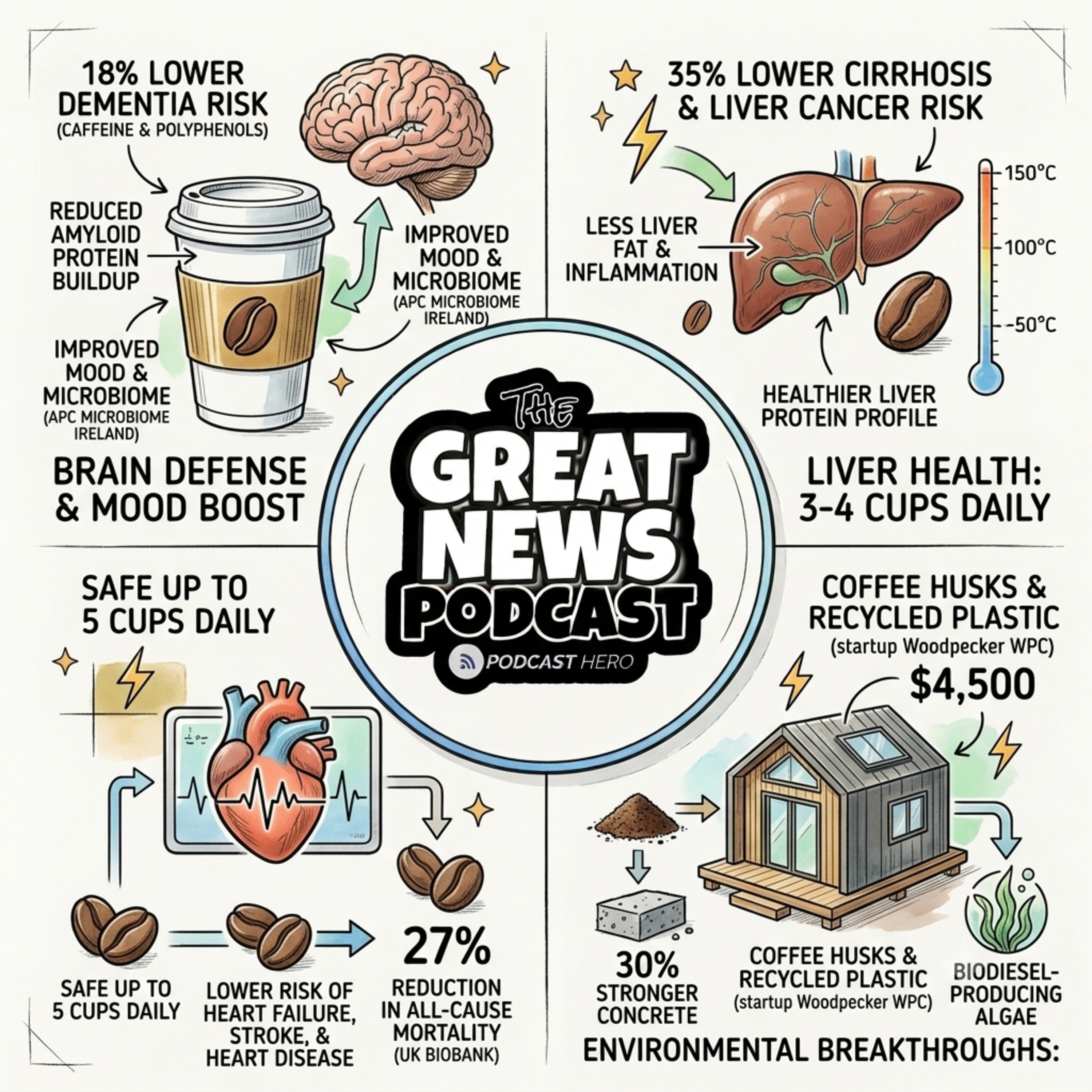
New research from APC Microbiome Ireland has revealed that coffee reshapes your microbiome in ways that significantly improve mood and lower perceived stress, regardless of whether you drink caffeinated or decaf.
Evidence from a massive study of more than 130,000 people, led by investigators from Harvard and Mass General Brigham, suggests that drinking two to three cups of coffee a day can reduce dementia risk and slow cognitive decline.
A large-scale study involving over 350,000 participants in the U.K. Biobank has linked regular coffee consumption to significantly lower rates of liver disease and cancer.
While coffee was once viewed as a cardiovascular risk, the American Heart Association now states that consuming up to five cups a day is generally safe for most adults and may actually lower the risk of heart failure, stroke, and heart disease. Furthermore, data from the UK Biobank shows that drinkers of ground coffee see a 27% reduction in all-cause mortality.
Now, if you like the Great News Podcast, you’ll love the Great News Letter, because the Great News Podcast is great, but the Great News Letter is greater. The link is in the show notes.
All right, let’s race through the latest improvements in coffee’s environmental impact:
- Colombian startup Woodpecker WPC is turning coffee husks and recycled plastic into sustainable housing kits that cost just $4,500 and can be built in a week.
- Researchers in Australia found that replacing 15% of sand in concrete with waste coffee grounds makes the material 30% stronger.
- A study from Aston University shows that spent coffee grounds can be used to grow biodiesel-producing algae, offering a sustainable alternative to palm oil.
- Ford and McDonald’s are teaming up to turn coffee ”chaff” into car parts like headlamp housings that are 20% lighter.
- Swiss company CoffeeB has launched compostable ”Coffee Balls” encased in a seaweed layer that breaks down in just four weeks.
- Designer Uyen Tran is recycling coffee grounds and shellfish waste into a biodegradable leather alternative called Tômtex.
- Seven Cafe is now using hydrogen roasting to cut CO2 emissions while creating a smoother, less bitter flavour.
- Czech platform Coffee!Up is turning office waste into a ”cascade” of products including premium skincare oil and carbon-negative biochar.
- The International Center for Circular Economy in Coffee (C4CEC) launched in Italy to eliminate waste across the entire industry, reminding us that coffee is a fruit and we currently waste 95% of it.
- The upcycled coffee fruit extract market is projected to reach $865 million by 2036, as brands like KonaRed turn cherry pulp into high-value antioxidants.
- Nescafé has already surpassed its 2025 goal, sourcing 32% of its coffee from farmers practicing regenerative methods to improve soil health.
- As of 2026, the industry is moving toward ”de-aluminumization,” with traditional foil bags being replaced by recyclable mono-materials and nano-barrier paper.
- 2026 Coffee Barometer: This milestone 20th-anniversary report is pushing the industry for unified collective action to ensure coffee remains a thriving, sustainable sector.
And finally, my favourite quote of the day from the Daily Quote podcast this week comes from punk legend and coffee enthusiast Henry Rollins, who once said: “What goes best with a cup of coffee? Another cup.”
Now we know that advice isn’t just rock and roll, it’s backed by life-saving science!
Bad things are happening around the world. Tune into mainstream media to hear all about it.
But there are GREAT things happening too. And that is all you’ll hear on the GEAT NEWS Podcast.
More Great Episodes

The Great News Podcast is your source for positive news, inspiring stories, and good news from around the world. We skip the doom and gloom of mainstream media to focus on scientific breakthroughs, environmental wins, and the inspiring news that proves the world is getting better. Join Andrew McGivern for a dose of optimism and uplifting stories that will change your perspective on human progress.
It is easy to find the
Keep looking for the good in the world, because it is not only there – its everywhere.
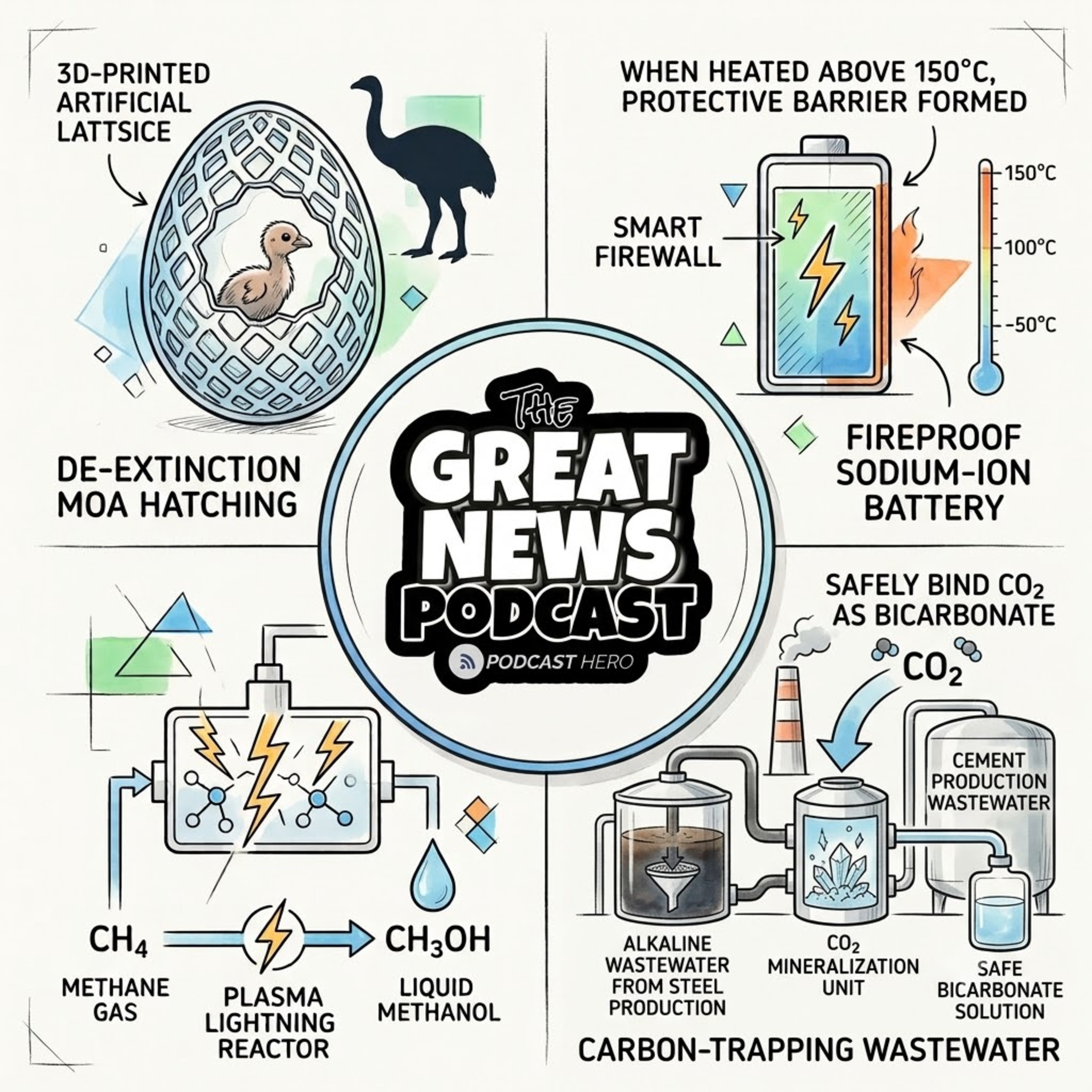
A massive step forward for de-extinction. A biotech company called Colossal Biosciences (the one bringing back the Wooly Mammoth) has successfully hatched 26 live chicks using an artificial environment.
These chicks were born from a 3D-printed lattice structure designed to mimic a natural eggshell, including a membrane that allows for oxygen exchange. While currently using chicken embryos, the ultimate goal is to scale this technology to resurrect the South Island giant moa, an extinct 12-foot bird from New Zealand.
Because a moa egg is 80 times the size of a chicken egg, no modern bird could safely lay one, making these artificial shells a necessary gateway for bringing the species back.
Next, we look at a breakthrough in safety in our electrified future. Researchers from the Chinese Academy of Sciences have developed ”fireproof” sodium-ion batteries that features an internal ”smart firewall”. Traditional lithium ion batteries can suffer from thermal runaway, a chain reaction where temperatures skyrocket and lead to explosions.
This new design uses a liquid electrolyte that solidifies into a physical barrier when internal heat exceeds 150°C (302°F), effectively cutting off the reaction before a fire can start. In tests, these cells maintained their integrity even during nail penetration and external heating up to 300°C.
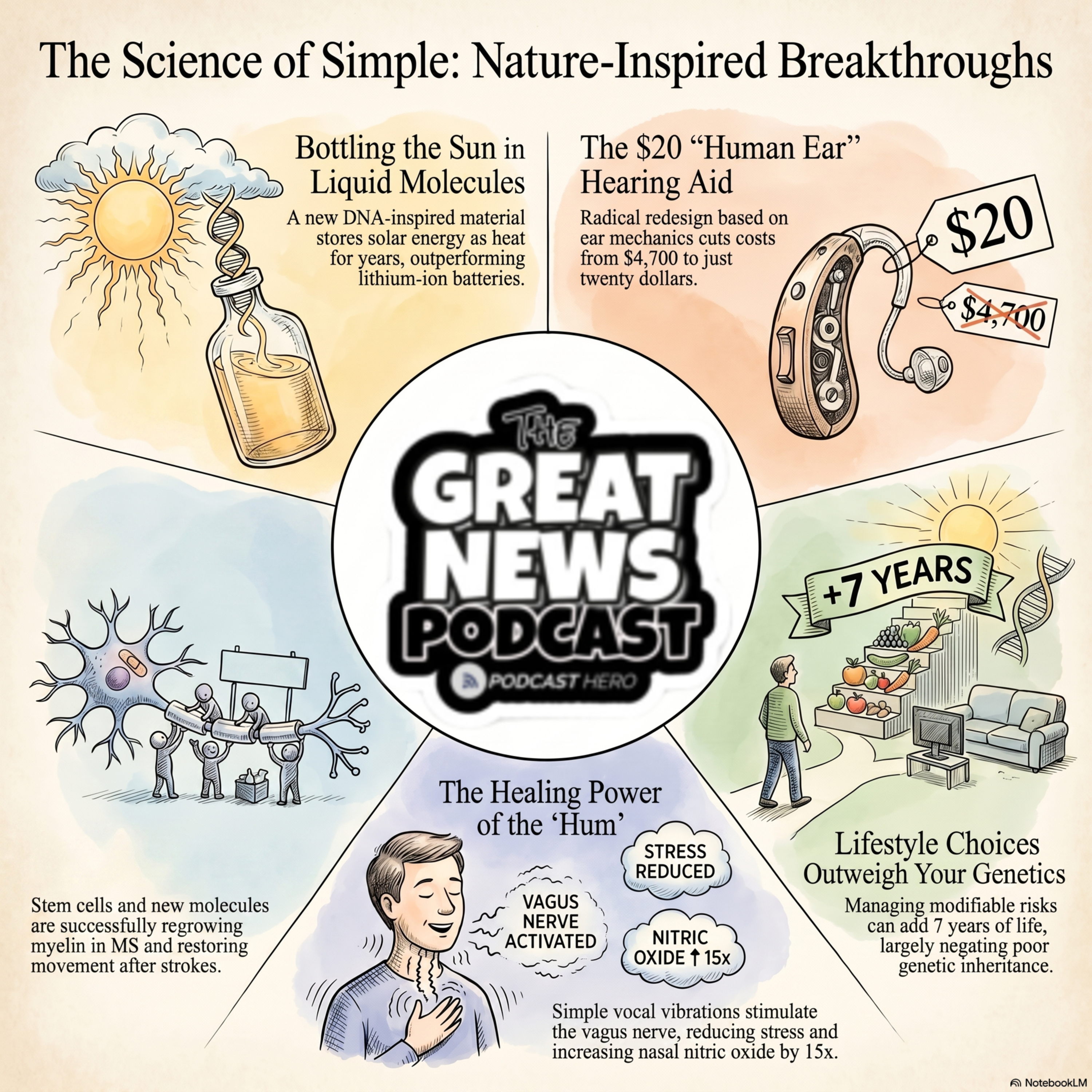
Scientists at Stanford have discovered a way to regrow articular cartilage in joints. Cartilage has almost zero regenerative potential in adults, leading to chronic pain and arthritis for millions. The team found they could trigger the body’s own skeletal stem cells by creating a slight injury, similar to a microfracture, and then using specific chemical signals to ”steer” those cells.
Chemists at Northwestern University have found a way to turn natural gas into liquid methanol in a single step. Current industrial methods require extreme heat and pressure, emitting millions of tons of CO2 annually. This new process uses pulses of high-voltage electricity to create tiny ”lightning bolts” of plasma inside a reactor. These bursts break methane’s bonds at low temperatures, allowing it to recombine into methanol, a versatile chemical used in everything from plastics to cleaner-burning fuels for ships.
Carbon-Trapping Wastewater:
Scientists found that alkaline wastewater from steel and cement production can safely bind CO2 as bicarbonate, potentially removing 30 million tons of greenhouse gas every year.
Ultralight Survival Straw:
Lifestraw has released its lightest filter ever, the Sip Essential, which weighs less than one ounce and can filter up to 1,000 litres of water.
Brain-Activating Electronics:
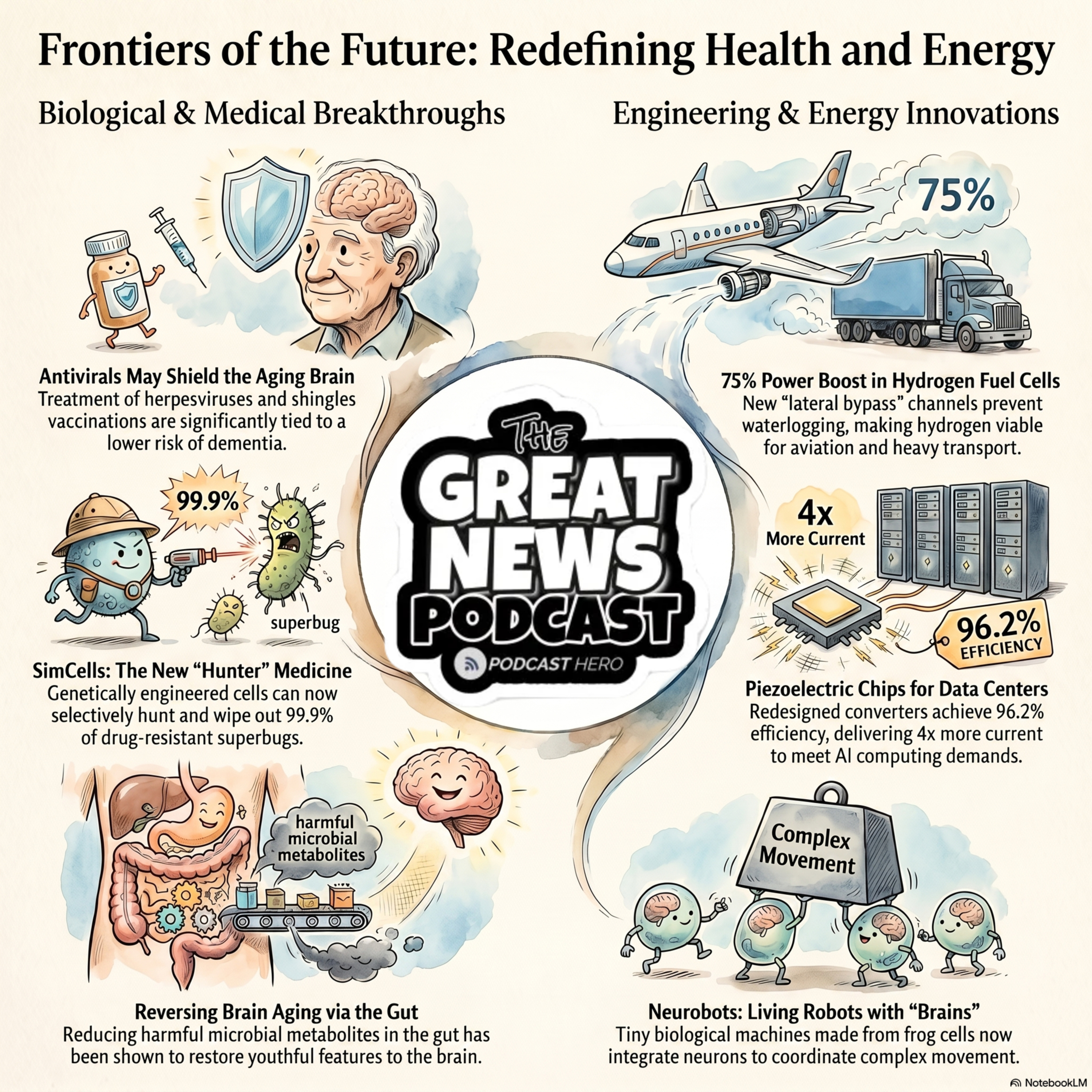
Researchers created flexible, printed artificial neurons that can generate electrical spikes identical to biological ones, successfully activating real brain cells in lab tests.
Sweaters for Houses:
A new photothermal ”skin” made of coated fabric panels can be attached to exterior walls, absorbing sunlight to raise indoor temperatures and potentially cutting heating bills by 15%.
Solar Power After Dark:
By stripping balsa wood down to its cellular scaffolding and filling it with a ”phase-change” material, scientists created a heat-absorbing sponge that can drive a generator even after the sun goes down.
Plastic to Gasoline:
A new technique uses molten salts to break down common plastic waste into high-grade gasoline and diesel at relatively low temperatures, making recycling much less energy-intensive.
The World’s Largest Flow Battery:
In Switzerland, a billion-dollar project is excavating a pit deep enough to house a 2.1 GWh redox flow battery, capable of powering 210,000 households for an entire day.
And my favorite quote of the day from the Daily Quote podcast is from Robert Louis Stevenson, who said: ”Don't judge each day by the harvest you reap but by the seeds that you plant”.
You can follow the Daily Quote in your favorite podcast app.
That is it for this episode of Great News.
Support the Show ➡ Buy Me a Coffee ☕