
Delhi summers are brutal. Nighttime temperatures in the Indian capital have been creeping past 95°F — a reality that would have been almost unthinkable a generation ago. For millions of residents, air conditioning isn’t a luxury; it’s a lifeline. But as the city cools itself, it also heats the planet, locking us into a vicious cycle that engineers and architects are racing to break.
Architect Monish Siripurapu thinks the answer might be hiding in the past.
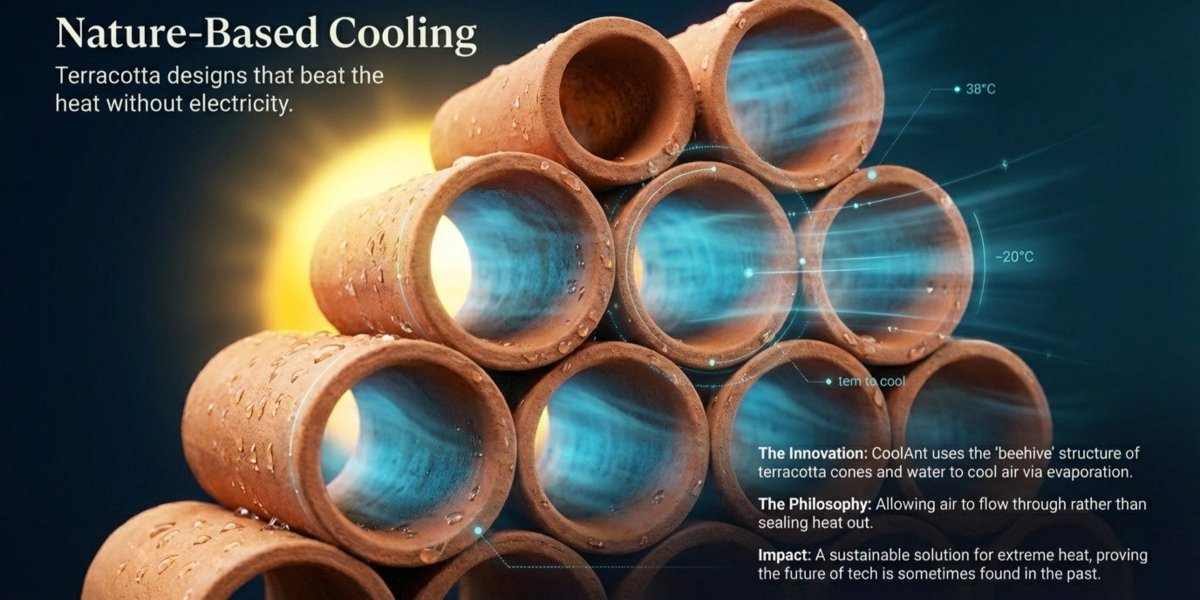
His company, CoolAnt, has developed a cooling system built around something humans have used for millennia: terracotta. Inspired by the elegant geometry of a beehive, CoolAnt’s design uses hollow earthen cones arranged in modular panels that can be fitted into windows or mounted as entire building facades. The concept is as simple as it is clever — pour water over the pots, and nature takes care of the rest.
Old Physics, New Purpose
The science behind it is evaporative cooling, one of the oldest tricks in the book. As water evaporates from the porous surface of the terracotta, it draws heat away from the surrounding air, lowering the temperature noticeably. Paired with natural ventilation — the same principle that made ancient Middle Eastern wind towers so effective — the system can significantly reduce the load on mechanical air conditioning, slashing energy consumption without sacrificing comfort.
Terracotta, it turns out, is the perfect material for this. It’s breathable, locally abundant, inexpensive, and has been used across South Asia and the Mediterranean for thousands of years to keep water and spaces cool. Siripurapu hasn’t invented something new so much as he’s rediscovered something we forgot.
Why This Matters
The timing couldn’t be more urgent. Air conditioning currently accounts for roughly 10% of global electricity consumption, and demand is projected to triple by 2050 as temperatures rise and more of the developing world gains access to cooling. The vast majority of that growth will happen in places like India — hot, densely populated, and already straining under the weight of energy demand.
CoolAnt’s approach points toward a different path: passive, low-energy cooling that works with local climate rather than bulldozing through it. It’s also beautiful. The honeycomb facades have a textured, sculptural quality that makes buildings feel alive rather than sealed off from the world around them.
The Bigger Picture
What Siripurapu is doing is part of a growing movement to look backward in order to move forward — drawing on vernacular architecture, indigenous materials, and time-tested climate wisdom to solve 21st-century problems. From the wind catchers of Yazd to the courtyard homes of Rajasthan, traditional builders understood their environments intimately. We’re only now remembering to ask them for advice.
As cities like Delhi face summers that would have seemed apocalyptic to previous generations, solutions like CoolAnt offer something rare: genuine hope. Not a silver bullet, but a reminder that sometimes the most innovative thing you can do is reach for a clay pot.
This topic was featured in Great News podcast episode 30.

Because good news should be heard…
Today, we are exploring how artificial intelligence is moving medicine from a game of chance to a masterwork of design. Plus, we’ll look at a cooling system inspired by ancient beehives, a non-invasive nasal drop that could tackle the deadliest brain cancers, and a backup power system that ensures you’ll never even notice a blackout.
How AI Is Reinventing the AntibodyClay, Cool Air, and a 5,000-Year-Old IdeaNasal Nanodrops: A Promising New Weapon Against the Deadliest Brain CancerNever Get Caught in the Dark Again
And stay tuned for our speed round, where we’ll cover everything from quantum biological sensors to the ”switch” that might repair the human liver.

Source: The World News Radio