
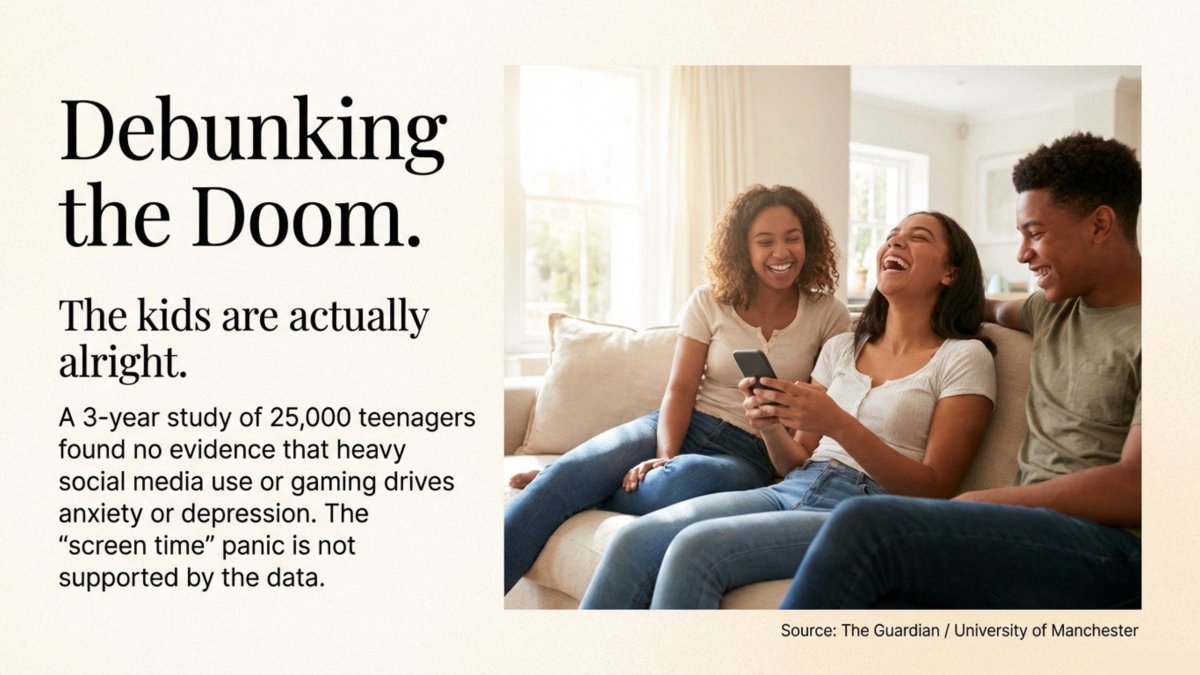
For the past decade, the narrative has been near-universal: teenagers are on their phones too much, social media is making them anxious and depressed, and the solution is to restrict access. Books have been written, laws proposed, and parents left feeling guilty every time they see their child scrolling. The story feels intuitive — and yet a major new study suggests we may have been asking the wrong question all along.
Researchers at the University of Manchester followed 25,000 young people aged 11 to 14 across three school years, tracking their self-reported social media habits, gaming frequency, and emotional difficulties to find out whether technology use genuinely predicted later mental health difficulties. The study found no evidence for boys or girls that heavier social media use or more frequent gaming increased their symptoms of anxiety or depression over the following year.
What makes this study particularly credible is its methodology. Rather than simply comparing anxious teenagers with calm ones and noting who used their phones more — the approach that has generated much of the alarming correlation data cited in public debate — the researchers used a longitudinal approach, observing the same young people over an extended period and separating “between-person” effects from “within-person” effects. In plain language: they looked at whether a specific teenager’s mental health worsened when they personally started spending more time on social media than usual. When this more rigorous method was applied, the supposed link between digital technology use and later internalizing symptoms — worry, low mood — largely vanished.
Even when researchers distinguished between active use (posting, chatting) and passive use (scrolling), neither type of social media behaviour was a significant driver of later mental health problems in the sample.
None of this means the digital world is without risk. The researchers are careful to point out that their study examined year-on-year trends and doesn’t rule out shorter-term effects immediately after use. And there is a crucial distinction between screen time and screen experience. Researchers stress that harms stem from toxic interactions and experiences online, not duration X — a distinction that gets lost almost entirely in the public conversation, which tends to fixate on hours per day as if the number itself is the problem.
Co-author Neil Humphrey put it this way: young people’s choices around social media and gaming may be shaped by how they’re feeling, but not necessarily the other way around. In other words, a struggling teenager may turn to social media for connection or distraction — but the social media didn’t create the struggle.
This matters enormously for policy. Governments across the world, including the UK, are actively considering age restrictions and bans. Those discussions should absolutely continue — there are legitimate concerns about specific content, algorithmic manipulation, and the commercial exploitation of young people’s attention. But if we frame the entire problem as “too much screen time,” we risk designing interventions that are both ineffective and a distraction from the real drivers of adolescent distress: school pressure, family instability, social isolation, economic anxiety.
The screens are not innocent. But they may also not be the villain we’ve been looking for. The truth, as with most things involving human wellbeing, turns out to be considerably more complicated.
Source: The Guardian