
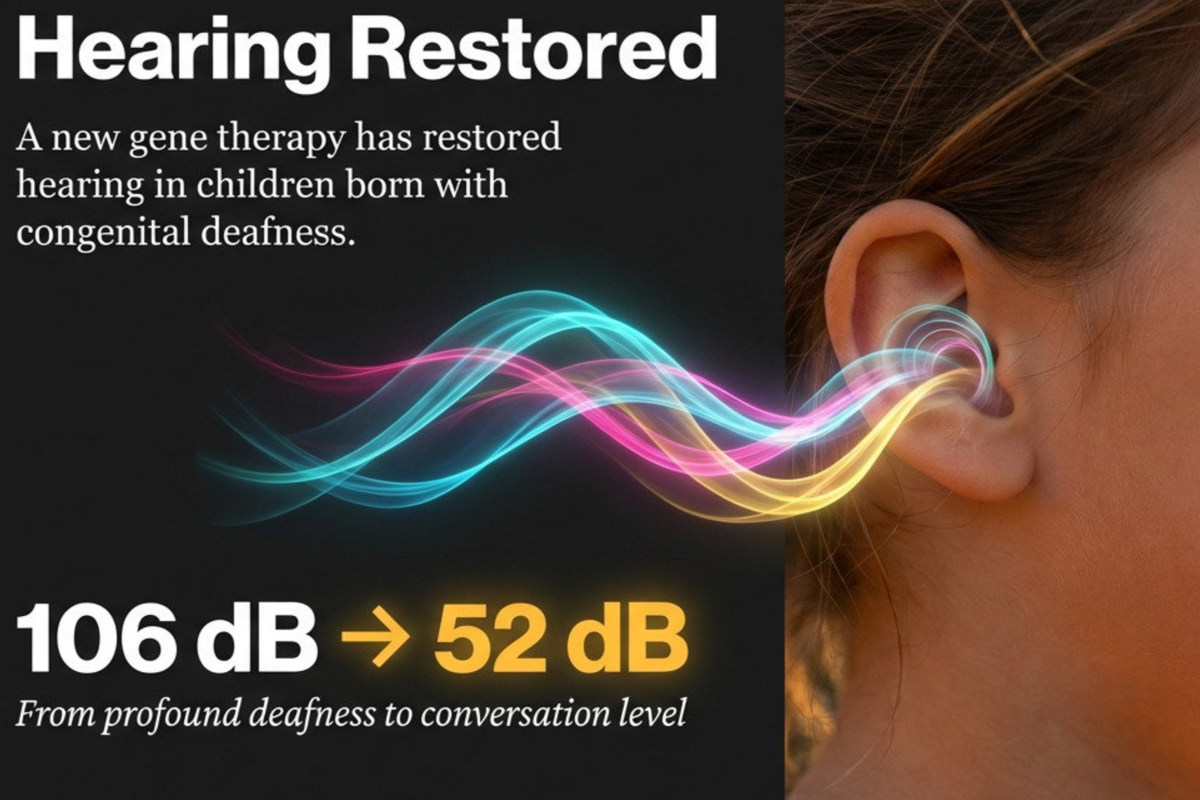
A study published in Nature Medicine demonstrated that a single-injection gene therapy can restore hearing in patients with genetic hearing loss caused by OTOF gene mutations.
- Efficacy: The trial involved ten patients (ages 1 to 24), all of whom showed improvement. On average, auditory thresholds moved from 106 decibels (profound deafness) to 52 decibels (near normal conversation levels).
- Methodology: The therapy targets affected cells via the round window membrane, utilizing a trans-mastoid facial recess approach to minimize invasiveness.
This topic was covered in Great News podcast episode 25

The Great News Podcast is your source for positive news, inspiring stories, and good news from around the world. We skip the doom and gloom of mainstream media to focus on scientific breakthroughs, environmental wins, and the inspiring news that proves the world is getting better. Join Andrew McGivern for a dose of optimism and uplifting stories that will change your perspective on human progress.
It is easy to find the
Keep looking for the good in the world, because it is not only there – its everywhere.
Today, we’re diving into some truly groundbreaking advancements in medicine, environmental protection, and global justice. What if we could ensure every child is born free of a life-altering virus? That is our lead story today. Plus, we have a gene therapy that restores hearing, internet cables that can sense earthquakes, and a new way to store energy using a fluid that looks like a giant protein shake. And don’t forget to stick around for the speed round, where we’ll dive into even more great news
This gene therapy breakthrough represents a fundamental shift from managing disability to curing genetic disease. But what does this mean?
Rewriting Biological Destiny OTOF gene mutations cause auditory neuropathy—a condition where the inner ear can detect sound but can’t transmit it to the brain because the otoferlin protein (essential for neurotransmitter release in hair cells) is absent or dysfunctional. Until now, this was permanent and irreversible. This therapy doesn’t accommodate the condition; it corrects the underlying genetic cause, allowing the auditory system to function as it would have without the mutation.
A Single Intervention, Lifetime Impact Unlike cochlear implants (which require lifelong device management, battery replacements, upgrades, and maintenance) or hearing aids (which amplify but don’t restore function), this is a one-time biological correction. The treated cells now produce functional otoferlin protein. This fundamentally changes the patient experience—from managing a chronic condition to being cured.
The Power of Precision Medicine This therapy works because it targets a specific genetic cause of deafness. OTOF mutations represent only about 2-8% of congenital hearing loss cases, but this success demonstrates that genetic heterogeneity isn’t an obstacle—it’s a roadmap. Each identified mutation becomes a potential therapeutic target.
Dramatic Functional Recovery Moving from 106 dB (can’t hear a jackhammer standing next to it) to 52 dB (can hear normal conversation) isn’t incremental improvement—it’s life transformation. Patients can now participate in conversations, hear music, detect environmental sounds for safety, and engage with the world in ways previously impossible without technological assistance.
How the World Improves When We Work on Problems Like This
1. Disability Models Evolve This creates productive tension in disability discourse. The social model rightly argues that society disables people through inaccessible design and ableist attitudes. But gene therapy adds a medical dimension: some conditions can be biologically corrected, and that’s also liberation. The world improves when we simultaneously make society more accessible AND expand curative options, letting individuals choose what’s right for them.
2. Early Intervention Becomes Transformative The trial included children as young as one year old. Treating hearing loss before language acquisition milestones means these children can develop speech and auditory processing naturally, without the critical period disadvantages that affect later intervention. The earlier we treat genetic conditions, the more typical developmental trajectories become possible.
3. Gene Therapy Infrastructure Scales Every successful gene therapy—whether for hearing loss, sickle cell disease, or inherited blindness—strengthens the broader therapeutic platform. Manufacturing processes improve, regulatory pathways become clearer, delivery mechanisms get refined, and costs eventually decrease. We’re building a technological foundation that will accelerate treatments for thousands of rare genetic diseases.
4. Precision Diagnostics Become Essential This therapy only works if you know the genetic cause of hearing loss. Success creates pressure for universal newborn genetic screening, better diagnostic tools, and comprehensive genetic counseling. The existence of cures makes diagnosis urgent rather than academic.
Critical Lessons for Medical Innovation
Minimally Invasive Delivery Matters The trans-mastoid facial recess approach—threading through existing anatomical passages to reach the round window membrane—shows that effective gene therapy doesn’t require radical surgical intervention. This is crucial for pediatric applications and for treating bilateral hearing loss (both ears can be safely accessed). The route of administration is as important as the therapeutic payload.
Small Numbers, Big Signal Ten patients is a small trial, but the effect size is dramatic and consistent. When every patient improves and the average gain is 54 decibels, you don’t need hundreds of participants to see clinical significance. This demonstrates that for genetic diseases with clear mechanisms, precision therapies can show unambiguous efficacy in small populations.
Age Range Reveals Plasticity Windows The trial included patients up to age 24, and all showed improvement. This suggests the auditory system retains therapeutic potential even after the traditional “critical period” for auditory development. However, the functional outcomes likely differ—a one-year-old will develop language normally; a 24-year-old gains hearing but may have different integration challenges. Efficacy isn’t binary; it’s developmentally contextualized.
What Still Needs Examination
Durability Questions How long does the therapeutic effect last? Do treated cells continue producing otoferlin for decades, or will patients need re-treatment? Gene therapies for other conditions have shown both sustained expression and gradual decline—long-term follow-up is essential.
Bilateral Treatment Protocols The methodology describes treating the affected ear, but many patients have bilateral hearing loss. Can both ears be safely treated simultaneously, or must they be done sequentially? What’s the optimal timing between treatments?
Immune Response Considerations Gene therapies can trigger immune responses to the viral vector (typically AAV viruses) or the newly produced protein. If the body develops antibodies to the otoferlin protein or the AAV capsid, it could limit effectiveness or prevent re-treatment. Immunological monitoring will be critical.
Access and Equity Architecture Early gene therapies are extraordinarily expensive (some exceed $2 million per treatment). Who gets access? How do healthcare systems prioritize? Do we risk creating a genetic inequality where only wealthy nations or individuals can access cures while others rely on older assistive technologies?
Deaf Culture and Identity Considerations Many in the Deaf community view deafness as cultural and linguistic identity, not a disability requiring cure. This therapy will reignite complex questions: Should parents decide for prelingual deaf infants? How do we respect Deaf identity while offering medical options? The world improves not by forcing one perspective but by creating space for pluralistic choices.
The Broader Imperative
This hearing loss gene therapy exemplifies a therapeutic paradigm shift that’s accelerating across medicine. We’re moving from:
- Symptomatic treatment → Root cause correction
- Chronic management → One-time cure
- Population-level protocols → Genetically personalized interventions
- Compensatory devices → Biological restoration
But this shift creates new challenges:
The Diagnostic Imperative: Genetic cures require genetic diagnosis. This demands universal access to sequencing, genetic counseling infrastructure, and databases linking genotypes to phenotypes.
The Equity Crisis: If these therapies remain expensive, we create a two-tier medical system where genetic privilege compounds economic privilege.
The Consent Complexity: When should parents make irreversible genetic decisions for children? How do we balance medical best practices with respect for disability culture and individual autonomy?
The Long-Term Surveillance Need: Gene therapy patients become lifelong research participants. We need robust, ethical frameworks for monitoring outcomes, adverse events, and transgenerational effects.
What Success Really Means
The Nature Medicine study proves that restoring sensory function through genetic correction is medically feasible. But translating this from research triumph to global health impact requires:
- Manufacturing scale: Moving from hand-crafted research doses to industrial-scale production
- Delivery infrastructure: Training surgeons worldwide in the trans-mastoid approach
- Diagnostic access: Making genetic testing available where hearing loss is detected
- Payment models: Creating insurance, public health, or value-based frameworks that don’t limit access to the wealthy
- Cultural navigation: Engaging Deaf communities respectfully in conversations about choice, identity, and medical options
The world improves when we recognize that scientific breakthroughs are only the first step. The harder work is building systems that make miracles available to everyone who wants them, while respecting the autonomy of those who don’t.
This isn’t just about hearing loss. It’s about whether we can build a future where genetic diseases are curable and equitably treated, where innovation serves justice, and where medical capability is matched by moral commitment to universal access.
The question isn’t whether gene therapy can work—this study proves it can. The question is whether we’ll build a world where it works for everyone.