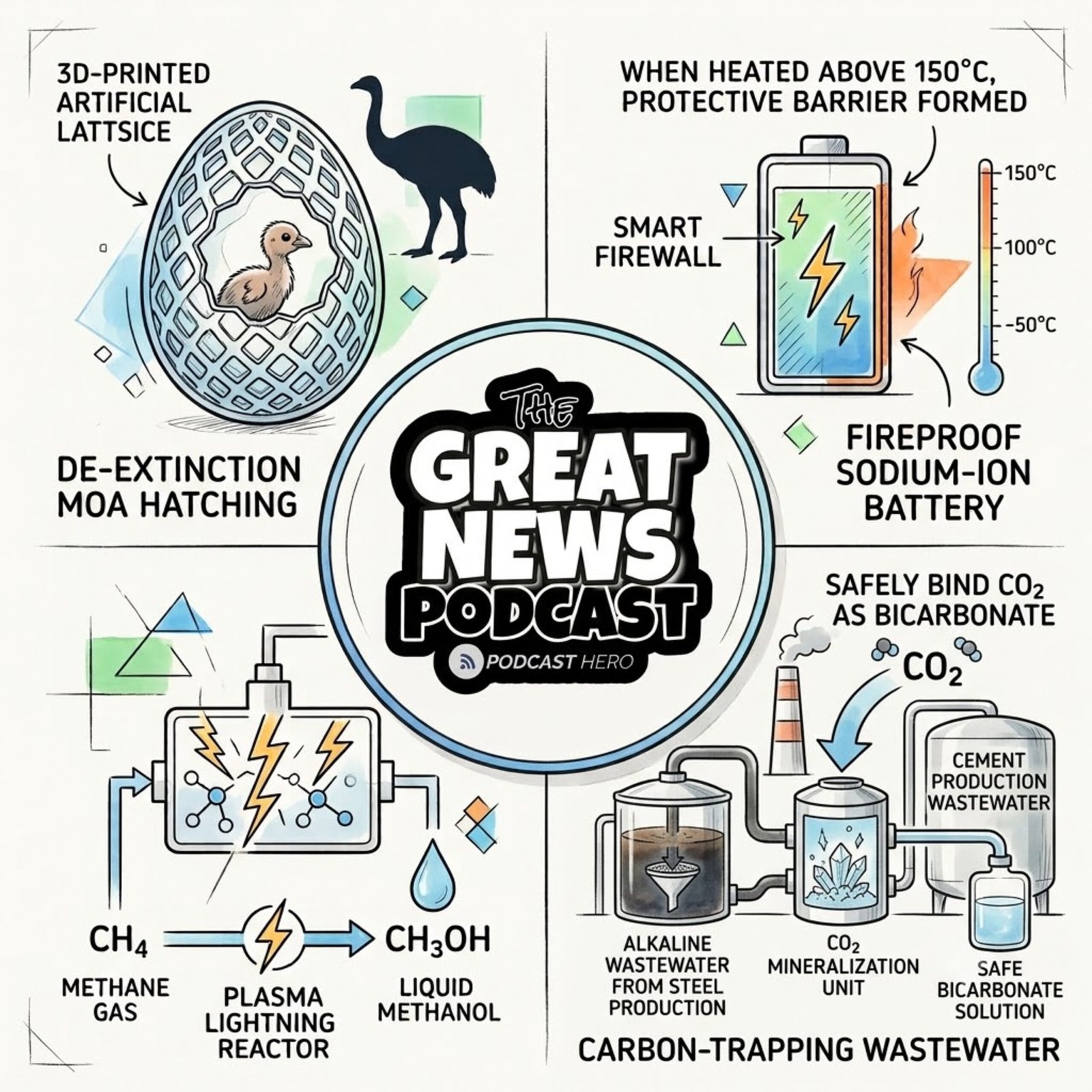

A massive step forward for de-extinction. A biotech company called Colossal Biosciences (the one bringing back the Wooly Mammoth) has successfully hatched 26 live chicks using an artificial environment.
These chicks were born from a 3D-printed lattice structure designed to mimic a natural eggshell, including a membrane that allows for oxygen exchange. While currently using chicken embryos, the ultimate goal is to scale this technology to resurrect the South Island giant moa, an extinct 12-foot bird from New Zealand.
Because a moa egg is 80 times the size of a chicken egg, no modern bird could safely lay one, making these artificial shells a necessary gateway for bringing the species back.
Next, we look at a breakthrough in safety in our electrified future. Researchers from the Chinese Academy of Sciences have developed ”fireproof” sodium-ion batteries that features an internal ”smart firewall”. Traditional lithium ion batteries can suffer from thermal runaway, a chain reaction where temperatures skyrocket and lead to explosions.
This new design uses a liquid electrolyte that solidifies into a physical barrier when internal heat exceeds 150°C (302°F), effectively cutting off the reaction before a fire can start. In tests, these cells maintained their integrity even during nail penetration and external heating up to 300°C.
Scientists at Stanford have discovered a way to regrow articular cartilage in joints. Cartilage has almost zero regenerative potential in adults, leading to chronic pain and arthritis for millions. The team found they could trigger the body’s own skeletal stem cells by creating a slight injury, similar to a microfracture, and then using specific chemical signals to ”steer” those cells.
Chemists at Northwestern University have found a way to turn natural gas into liquid methanol in a single step. Current industrial methods require extreme heat and pressure, emitting millions of tons of CO2 annually. This new process uses pulses of high-voltage electricity to create tiny ”lightning bolts” of plasma inside a reactor. These bursts break methane’s bonds at low temperatures, allowing it to recombine into methanol, a versatile chemical used in everything from plastics to cleaner-burning fuels for ships.
Carbon-Trapping Wastewater:
Scientists found that alkaline wastewater from steel and cement production can safely bind CO2 as bicarbonate, potentially removing 30 million tons of greenhouse gas every year.
Ultralight Survival Straw:
Lifestraw has released its lightest filter ever, the Sip Essential, which weighs less than one ounce and can filter up to 1,000 litres of water.
Brain-Activating Electronics:
Researchers created flexible, printed artificial neurons that can generate electrical spikes identical to biological ones, successfully activating real brain cells in lab tests.
Sweaters for Houses:
A new photothermal ”skin” made of coated fabric panels can be attached to exterior walls, absorbing sunlight to raise indoor temperatures and potentially cutting heating bills by 15%.
Solar Power After Dark:
By stripping balsa wood down to its cellular scaffolding and filling it with a ”phase-change” material, scientists created a heat-absorbing sponge that can drive a generator even after the sun goes down.
Plastic to Gasoline:
A new technique uses molten salts to break down common plastic waste into high-grade gasoline and diesel at relatively low temperatures, making recycling much less energy-intensive.
The World’s Largest Flow Battery:
In Switzerland, a billion-dollar project is excavating a pit deep enough to house a 2.1 GWh redox flow battery, capable of powering 210,000 households for an entire day.
And my favorite quote of the day from the Daily Quote podcast is from Robert Louis Stevenson, who said: ”Don't judge each day by the harvest you reap but by the seeds that you plant”.
You can follow the Daily Quote in your favorite podcast app.
That is it for this episode of Great News.