Forever Chemicals Don’t Break Down… or do they?
They’re in your non-stick pan, your waterproof jacket, your lipstick — and quite possibly your bloodstream. PFAS, or per- and polyfluoroalkyl substances, have earned their nickname “forever chemicals” for good reason: they don’t break down. They accumulate in water, soil, the food chain, and the human body, and some studies have linked certain PFAS to increased cancer risk. For decades, getting rid of them has meant expensive, energy-intensive industrial processes — if it was possible at all.
That may be about to change, thanks to a surprisingly elegant solution: sunlight.
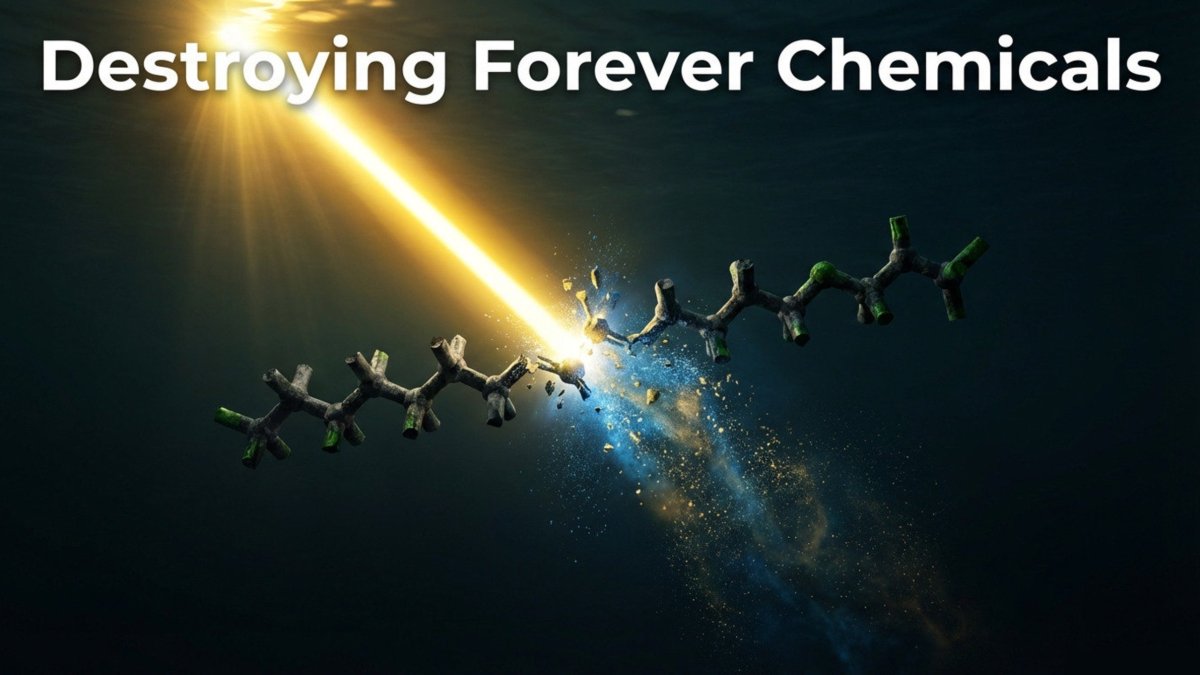
Researchers at the University of Bath, working with scientists from the universities of São Paulo, Edinburgh, and Swansea, have developed a carbon-based photocatalyst that can break PFAS down into far less harmful byproducts using nothing more than light. The catalyst combines carbon nitride with a rigid microporous polymer called PIM-1, which acts like a molecular trap — pulling PFAS molecules close to the catalyst surface so that light energy can do its work. The end products are carbon dioxide and fluoride, the latter being the same benign compound found in toothpaste.
What makes this particularly promising is that the catalyst is designed to operate at neutral pH — the kind found naturally in rivers, lakes, and groundwater — meaning it could potentially work in the real environments where contamination actually occurs, not just in a controlled lab setting.
There’s also an unexpected bonus: because fluoride is released as PFAS breaks down, the same technology could be adapted into a portable sensor for detecting contamination in the field. Right now, testing for PFAS requires specialist laboratory equipment that puts monitoring out of reach for most communities. A lightweight, affordable detection tool could change that entirely.
The technology is still at the prototype stage, and the team is looking for industrial partners to help scale it up. But the core idea — using sunlight, a cheap carbon-based catalyst, and a clever polymer to destroy one of the most stubborn classes of chemicals ever created — feels like exactly the kind of low-tech ingenuity the PFAS problem has been waiting for.
The study was published in RSC Advances.
This topic was featured in Great News podcast episode 33.

The Great News Podcast is your source for positive news, inspiring stories, and good news from around the world. We skip the doom and gloom of mainstream media to focus on scientific breakthroughs, environmental wins, and the inspiring news that proves the world is getting better. Join Andrew McGivern for a dose of optimism and uplifting stories that will change your perspective on human progress.
It is easy to find the
Keep looking for the good in the world, because it is not only there – its everywhere.
Today we are diving into some truly groundbreaking developments in public safety, medicine, and clean energy.
What if I told you that despite what you see on social media, we are living in one of the safest times in history? That’s our lead story today.
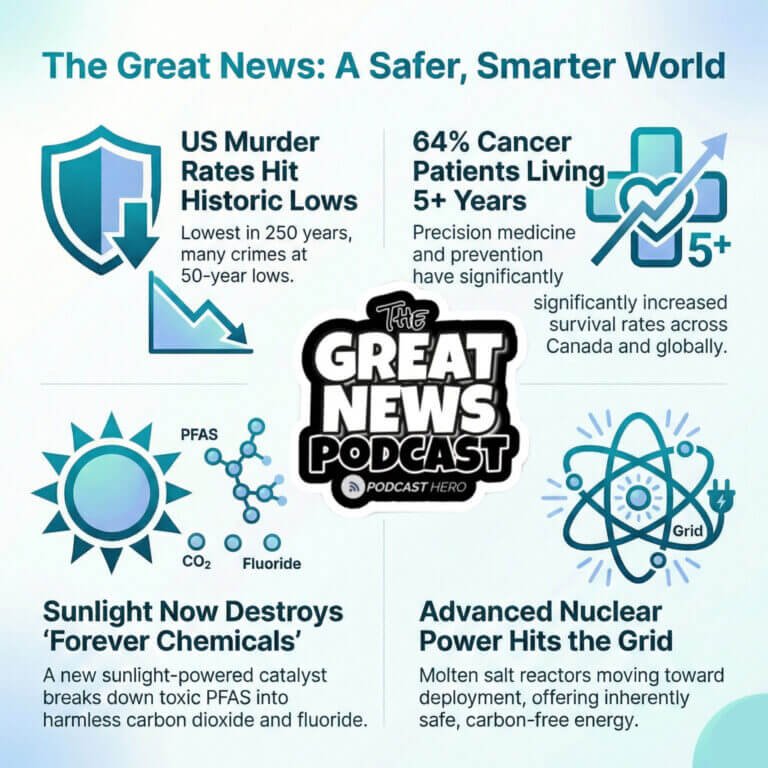
Plus, we have a major update on the fight against cancer, a way to destroy ”forever chemicals” using nothing but sunlight, and a partnership that’s bringing advanced nuclear power to the grid.
America’s Crime Drop Is Real — And That’s Worth Celebrating
Canada’s Improved Cancer Survival Rate
Could Sunlight Be the Answer to “Forever Chemicals”The Next Generation of Nuclear Power Is Getting Closer to Reality
And don't forget to stick around for the speed round, where we'll dive into even more great news.70 People, 3,000 Cars: What Waymo Just Revealed About the Future of Self-Driving
The Battery Breakthrough Hidden in Plain Sight, Water
The Macrophages that could help fight Type 2 Diabetes
Making Hydrogen with Sun and Water?
And don't forget to follow the Daily Quote podcast. Kickstart Your Day in a Positive Way!
Source: Interesting Engineering