Military personnel face an invisible threat that doesn’t make headlines: higher infertility rates than the general public. The culprit? Potassium perchlorate, a chemical used in explosives and fireworks that service members encounter repeatedly throughout their careers.
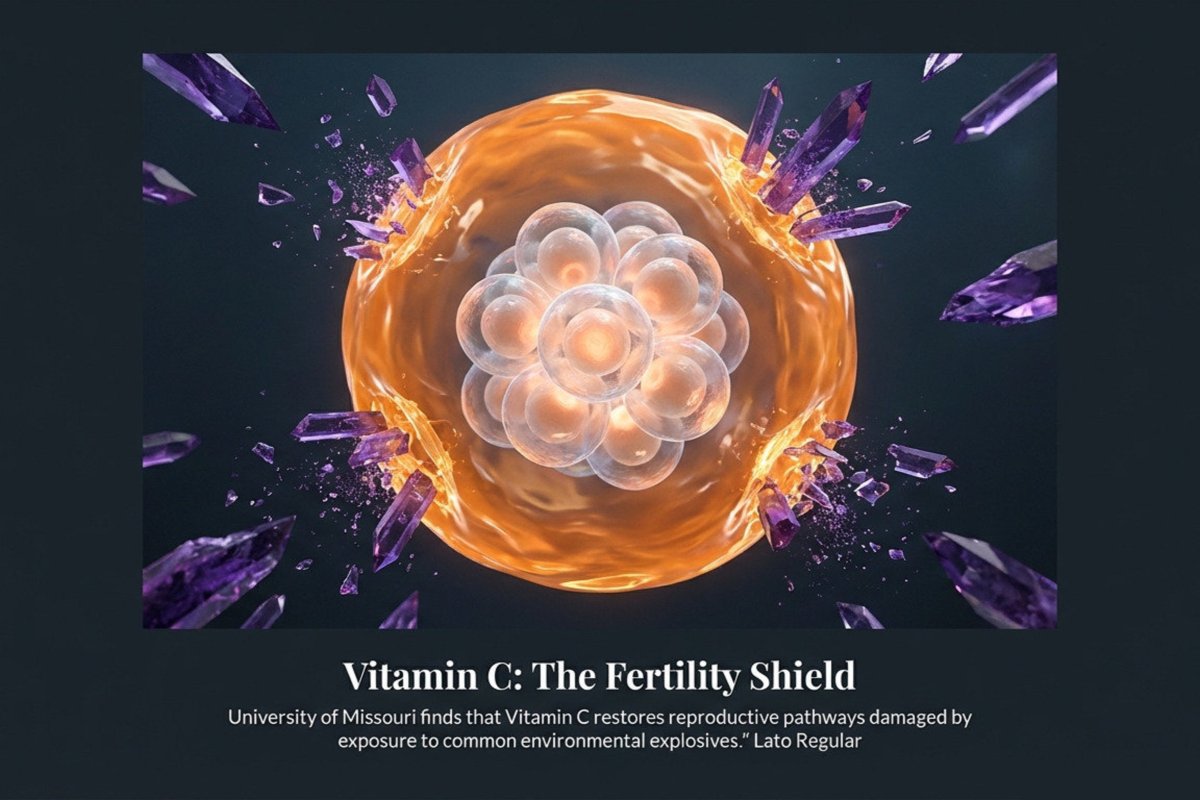
But new research from the University of Missouri offers an unexpectedly simple solution: vitamin C.
The Chemical Threat
Evidence shows some service members have higher levels of potassium perchlorate in their blood due to their repeated close proximity to explosives. The chemical is also used in industrial settings and fireworks manufacturing, putting workers in these environments at similar risk.
Researchers found that exposure to potassium perchlorate causes oxidative stress, which interferes with genes and pathways involved in the sperm production process. In fish studies, male fish exposed to potassium perchlorate alone experienced a dramatic drop in fertility and clear damage to their testes.
The Vitamin C Solution
The breakthrough came when researchers tested whether vitamin C could counter this damage. Fish exposed to vitamin C and the chemical at the same time showed improved fertility and less damage to their testes.
According to Ramji Bhandari, the lead researcher and associate professor at the University of Missouri, vitamin C can successfully protect the sperm production process against oxidative stress by restoring molecular pathways involved in male fertility.
Why This Matters
Fish are good models for studying reproductive health because their reproductive genes and processes are similar to human, making these findings potentially translatable to people.
The implications are particularly significant for high-exposure populations: military personnel handling explosives, industrial workers in chemical manufacturing, and anyone regularly exposed to fireworks production. While more research is needed to confirm these effects in humans, the findings suggest that something as simple and accessible as vitamin C supplementation could provide meaningful protection.
Beyond the Battlefield
Potassium perchlorate is considered an emerging environmental contaminant, meaning exposure isn’t limited to occupational settings. The chemical can contaminate water supplies and persist in the environment, making this research relevant to broader public health.
Bhandari’s work underscores both the potential reproductive risks of this chemical and the promising potential of vitamin C as a protective intervention—offering hope that we might shield fertility with one of the most accessible and affordable supplements available.
For those in high-risk occupations, the message is clear: while more research is needed, ensuring adequate vitamin C intake could be a simple, cost-effective strategy to protect reproductive health against environmental threats that come with the job.
This topic was featured in Great News podcast episode 28.

The Great News Podcast is your source for positive news, inspiring stories, and good news from around the world. We skip the doom and gloom of mainstream media to focus on scientific breakthroughs, environmental wins, and the inspiring news that proves the world is getting better. Join Andrew McGivern for a dose of optimism and uplifting stories that will change your perspective on human progress.
It is easy to find the
Keep looking for the good in the world, because it is not only there – its everywhere.
Today we’re diving into some truly groundbreaking advancements in medicine, space technology, and sustainable engineering. What if we could reset the human body’s cells to a “biological age of zero” to cure incurable diseases?
Plus, we have a student-led team that just deployed the world’s first free-flying light sail, a new cancer therapy that turns tumor-protecting cells into killers, and a self-healing material that could make aircraft last for five centuries.
- Turning Tumors’ Own Defenses Against Them
- Could “Biological Age Zero” Cells Cure the Incurable?
- Surfing the Solar Wind
- Self Healing Wind Turbines, Plane Wings and Spacecraft
First up, our lead story: a radical shift in regenerative medicine. South Korea-based biotech Clonell Therapeutics has launched a platform that aims to rewind cellular aging to treat diseases like Alzheimer’s, ALS, and heart failure.
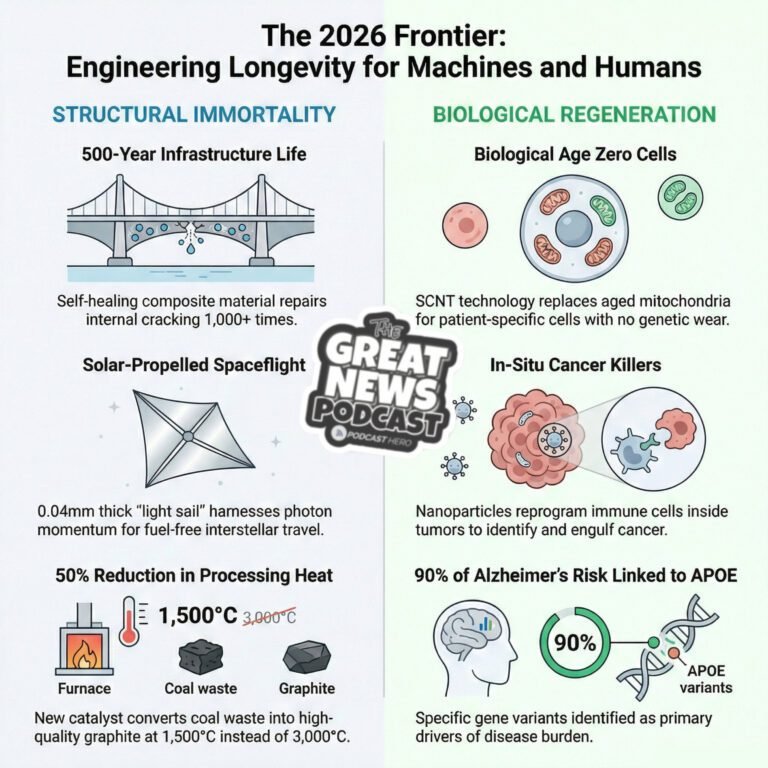
While previous methods often used “old” or stressed cells, Clonell uses Somatic Cell Nuclear Transfer (SCNT) to transfer a patient’s DNA into a donor egg. This creates stem cells that carry none of the accumulated wear of age, effectively replacing aged mitochondria and organelles. By rebuilding cells before disease has even left a mark, this technology seeks functional restoration rather than just symptom relief. Restoring youth to your cells.
If you like the great news podcast you’ll love the great news letter because the great news podcast is great but the great news letter is greater.
https://greatnewspodcast.com/dailyquote
Moving on to the stars! A student-led group at Cornell University has successfully deployed the world’s first free-flying light sail.
This tiny spacecraft, called Alpha CubeSat, weighs only 0.2 pounds and is just 0.04 millimeters thick. Instead of using fuel, it is propelled by the momentum of photons—particles of light—bouncing off its super-reflective surface.
This successful mission proves that small, low-cost probes could eventually use sunlight to travel far beyond our solar system.
Next, a breakthrough in oncology from researchers at KAIST. They have developed a way to turn immune cells trapped inside tumors into active cancer fighters using a direct injection. Solid tumors are often dense and hard to penetrate, but this new method uses lipid nanoparticles to deliver mRNA instructions directly to the cells already present at the tumor site.
These cells are converted into “CAR-macrophages” that can engulf cancer cells and stimulate the rest of the body’s immune system to join the fight.
In animal studies, this approach significantly reduced tumor growth and even provided body-wide immune protection.
Finally, let’s talk about building things to last. Researchers at North Carolina State University have developed a self-healing composite material that can repair itself over 1,000 times. By 3D-printing a thermoplastic healing agent into fiber-reinforced polymers, they’ve created a material that can melt and rebond its own cracks when an electrical current is applied.
This innovation could extend the lifespan of aircraft wings, wind turbines, and spacecraft from decades to 500 years, drastically reducing industrial waste and energy consumption.
Speed Round:
• A Paradigm Shift in Alzheimer’s
And my favorite quote of the day from the Daily Quote podcast this week comes from Elbert Hubbard, who once said, “Do not take life too seriously. You will never get out of it alive.”
Listen to an inspiring quote every single day by following The Daily Quote in your podcast app of choice.
https://greatnewspodcast.com/dailyquote
That’s it for today’s episode of Great News. From resetting cells to “age zero” and sailing through space on beams of light to turning tumors against themselves, the future is looking brighter than ever. And the great news is that these aren’t distant possibilities these developments are happening right now.
Source: Futurity