
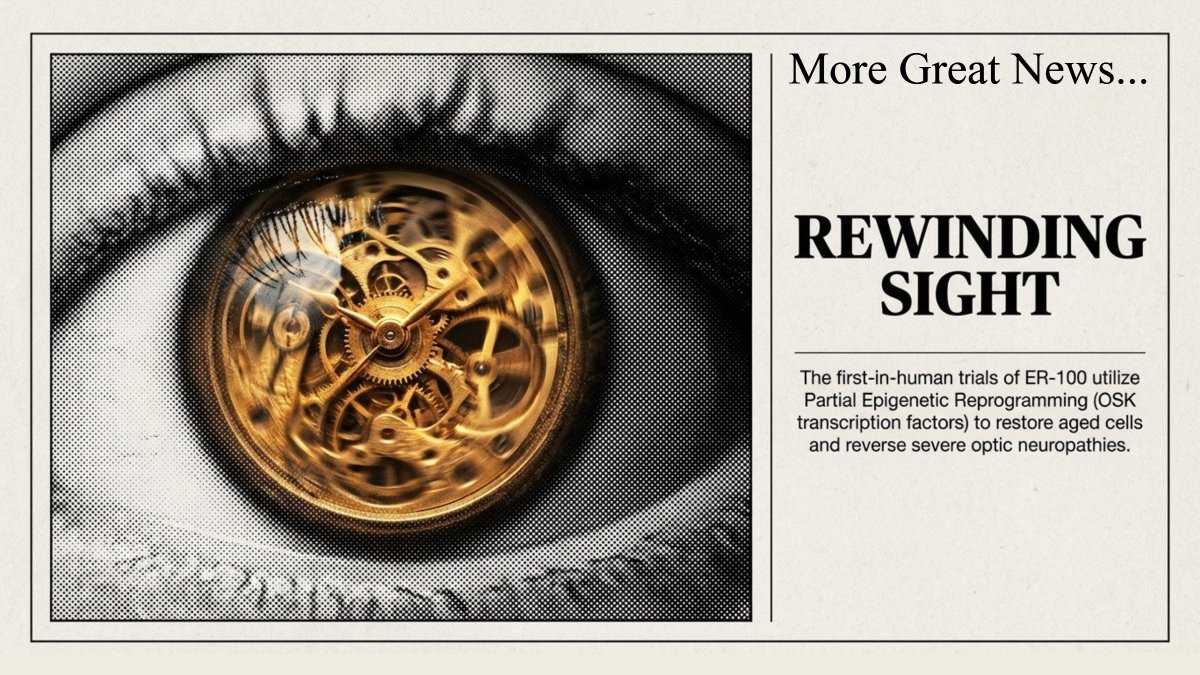
A Historic Step for Eye Health:
For decades, a diagnosis of glaucoma or optic neuropathy has carried a sobering truth: once the nerves connecting your eye to your brain are damaged, they don’t grow back. But a landmark announcement from Life Biosciences may signal the beginning of a new chapter in how we approach age-related vision loss — and aging itself.
In January 2026, the U.S. FDA cleared Life Biosciences’ Investigational New Drug (IND) application for ER-100, making it the first ever cellular rejuvenation therapy using epigenetic reprogramming to receive FDA clearance to enter human clinical trials. That’s not just a milestone for the company — it’s a milestone for medicine.
What Is ER-100, and How Does It Work?
ER-100 was developed using Life Biosciences’ Partial Epigenetic Reprogramming (PER) platform, which aims to restore aged or injured cells to a younger state by modifying the epigenome — the biochemical markers that regulate gene expression without altering the underlying DNA sequence. In plain terms: rather than editing your genes, this therapy essentially tells your cells to behave like younger, healthier versions of themselves.
The approach centers on three so-called Yamanaka factors, OCT-4, SOX-2, and KLF-4, proteins known to play a key role in cellular “youthfulness.” Delivered by injection directly into the eye, ER-100 has shown promising safety and efficacy results in preclinical animal studies.
Why Optic Neuropathies?
Optic neuropathies are a group of disorders characterized by the irreversible death of retinal ganglion cells (RGCs), the primary neurons connecting the eye to the brain. Because RGCs cannot naturally regenerate, their loss results in permanent vision impairment.
Two conditions are the focus of the upcoming Phase 1 trial: open-angle glaucoma, a leading cause of blindness worldwide, and non-arteritic anterior ischemic optic neuropathy (NAION) — often called “stroke of the eye,” the most common acute optic neuropathy in adults over fifty, involving sudden, painless vision loss due to insufficient blood flow, for which there are currently no approved treatments.
Current standards of care fail to address the underlying neuronal degeneration, leaving a significant unmet medical need for disease-modifying therapies that can directly protect or regenerate RGCs. ER-100 is designed to do exactly that.
What Comes Next?
The Phase 1 trial will enroll patients with both conditions to evaluate safety, tolerability, immune responses, and effects on vision. While this is still an early-stage study, and a long road remains before any therapy reaches patients broadly, the FDA clearance is a meaningful validation of the science behind cellular rejuvenation.
As Life Biosciences’ Chief Scientific Officer Sharon Rosenzweig-Lipson noted, years of research and rigorous primate studies demonstrating controlled gene expression, restoration of methylation patterns, and improved visual function laid the foundation for this moment. The goal, ultimately, is straightforward even if the biology is complex: to give people back their sight, and to chip away at the diseases that rob us of our health as we age.
This is one to watch.
This topic is featured in Great News podcast episode 37.
Source: Life Biosciences