A mini heart on a chip…
Every year, cardiovascular disease claims more lives than any other condition on the planet. It’s a problem that has humbled medicine for generations, partly because testing how a human heart responds to a drug or disease, without putting a real patient at risk, has always been extraordinarily difficult. A remarkable new development out of Canada suggests that may be about to change.
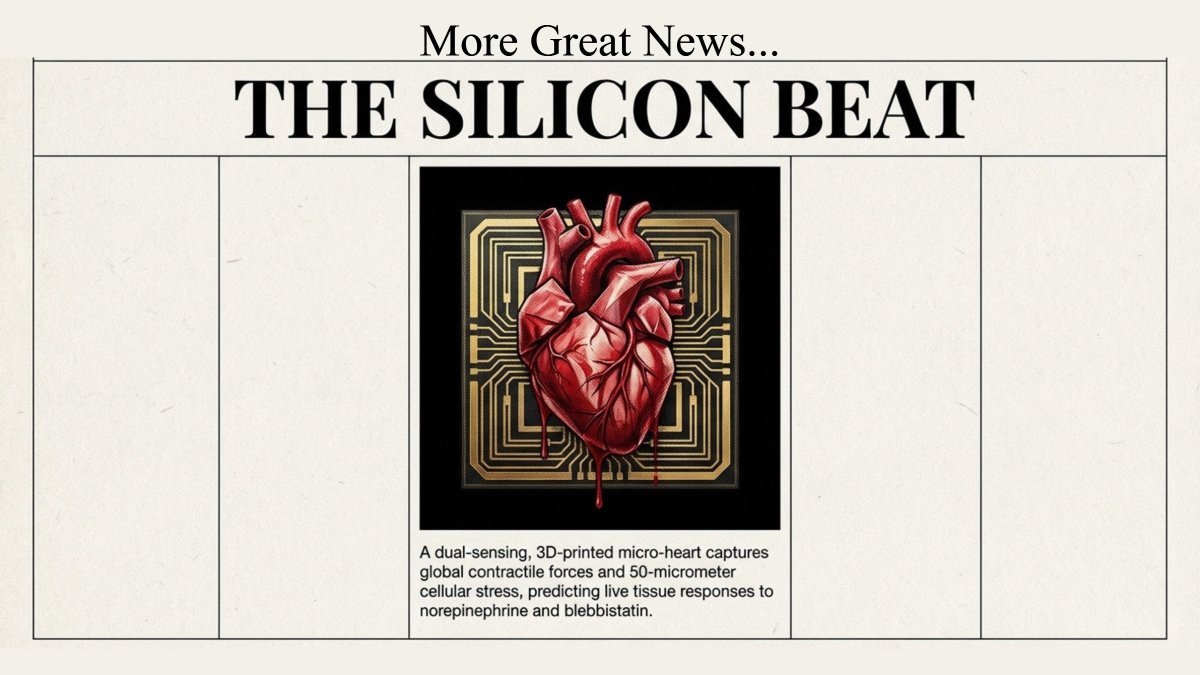
Scientists have engineered a three-dimensional “heart-on-a-chip” (HOC), a small device containing living cardiac tissue that beats on its own, mobilizes calcium to trigger muscular activity, and responds predictably to common drugs. What makes this version especially significant is that it’s the first to incorporate a dual-sensing platform that provides real-time tracking of activity throughout the heart tissue down to the cellular level.
How Does It Work?
The researchers harvested cardiac muscle cells and cardiac connective tissue cells from rats, inserting them into a gel-like matrix rich in fibrous proteins and nutrients to stimulate growth, then seeded them on tiny, flexible silicon-based chips. Science Alert
To capture what’s happening inside the tissue at two different scales, the team embedded two types of sensors. To measure large-scale forces, they sandwiched the engineered heart tissue between two elastic pillars that deform with each heartbeat, the amount of deformation corresponding to the contractile strength throughout the tissue. For finer detail, flexible, hydrogel-based microsensors, averaging just 50 micrometers in size, were immersed within the tissue to capture local mechanical stresses at the cellular level.
This cellular resolution matters enormously, because many cardiovascular diseases are associated with dysfunction in cardiomyocytes, the individual contractile cells that form heart muscle tissue.
Putting It to the Test
To see whether the chip could reliably predict drug responses, the researchers applied two well-studied compounds. One was norepinephrine, which increases heart activity, and the other was blebbistatin, which suppresses it. Both drugs worked as predicted, demonstrating that the HOCs can forecast how cardiac force generation and heart rhythms respond to common compounds.
As lead author Ali Mousavi put it, “the ability to observe the tissue’s response to different compounds in real time represents a major advantage for preclinical development and translational research.”
What Comes Next?
The team’s ambitions go well beyond the lab bench. They plan to simulate specific disorders by building heart tissues using cells from patients living with various cardiac conditions, including dilated cardiomyopathy and arrhythmias.
The longer-term vision is one of true personalized medicine. Senior author Houman Savoji describes the goal as “giving us the ability to identify the most effective medication for each person before treatment is even administered.”
In other words, rather than prescribing a heart medication and hoping it works, a doctor might one day run the trial first, on a chip grown from the patient’s own cells. It’s a future worth beating for.
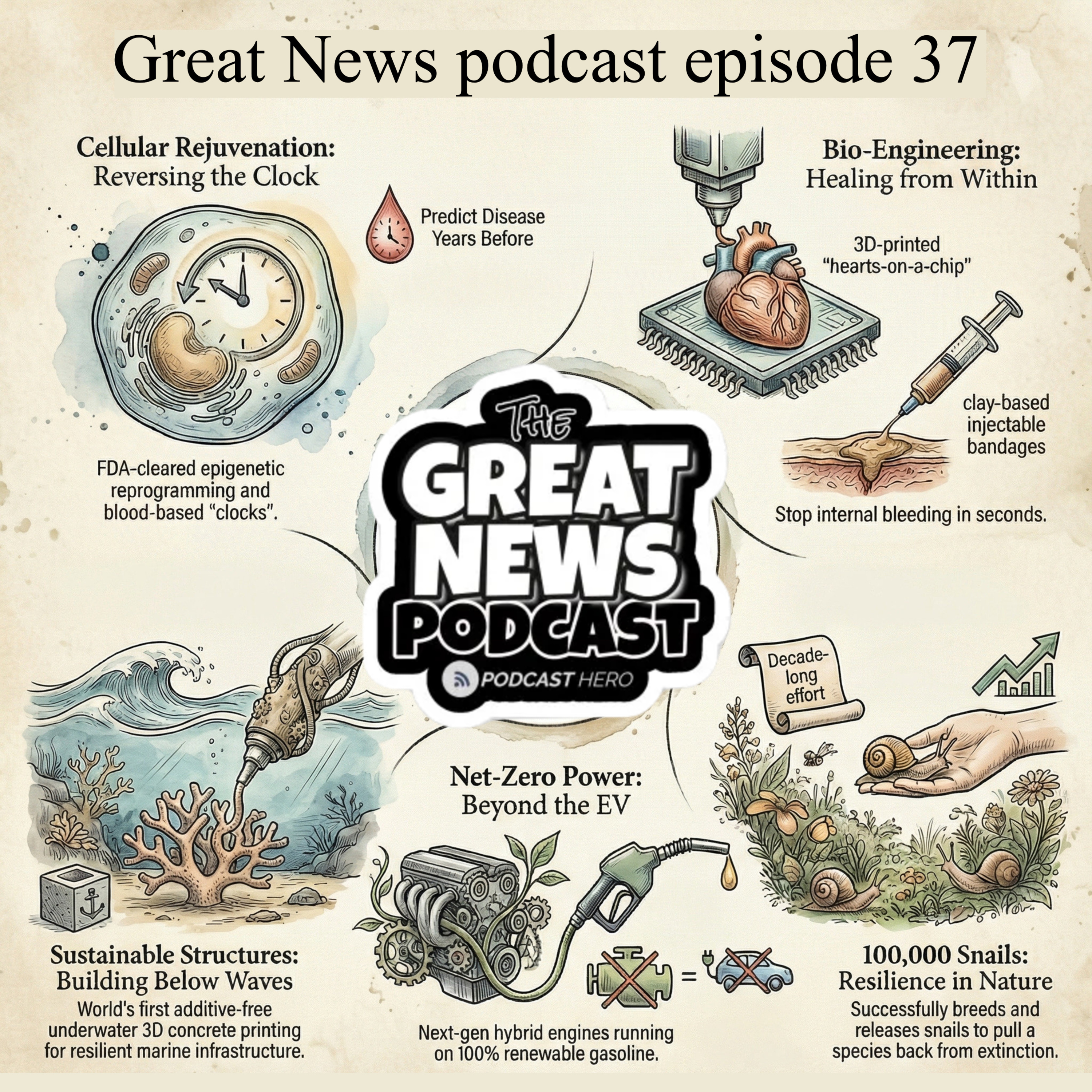
This topic was featured in Great News podcast episode 37.

The Great News Podcast is your source for positive news, inspiring stories, and good news from around the world. We skip the doom and gloom of mainstream media to focus on scientific breakthroughs, environmental wins, and the inspiring news that proves the world is getting better. Join Andrew McGivern for a dose of optimism and uplifting stories that will change your perspective on human progress.
It is easy to find the
Keep looking for the good in the world, because it is not only there – its everywhere.
This episode is brought to you by the Daily Quote. The podcast designed to kickstart your day in a positive way.Today, we’re exploring how scientists are turning back the clock on aging cells, printing infrastructure beneath the ocean waves, and building a ”heart-on-a-chip” to revolutionize medicine.And don't forget to stick around to the end for the speed round for even more great news!The First Epigenetic Reprogramming Therapy Enters Human TrialsThe World’s First Underwater 3D Concrete Printer
The Tiny Chip That Could Change Heart Medicine ForeverThe Horse H12 is a Cleaner Combustion Engine
Alright, Let's dive into the speed round for even more great news:
The greater Bermuda snail, once feared extinct, is officially safe after conservationists bred and released over 100,000 molluscs.
Researchers at Texas A&M have developed clay-based bandages that can be injected into deep wounds to stop severe internal bleeding, reducing clotting time by 70%.
A new blood test can now predict when Alzheimer’s symptoms will begin—with an accuracy within three to four years—long before memory problems appear.
Scientists are testing CAR T cell therapy to target and destroy the amyloid plaques in the brain that cause Alzheimer's, successfully reshaping the immune landscape in preclinical models.
And my favorite quote of the day from the Daily Quote podcast this week is from James Clear who said,
“Every action you take is a vote for the type of person you wish to become.”
Start your day with an inspiring quote every single day with the Daily Quote – available in your favourite podcast app.
From rejuvenating cells to printing structures underwater, today’s stories prove that those seeds of innovation are growing into a brighter world.
I’m Andrew McGivern, and until next time, and there will be a next time, keep looking for the good in the world, because it’s everywhere.
Source: Science Alert