
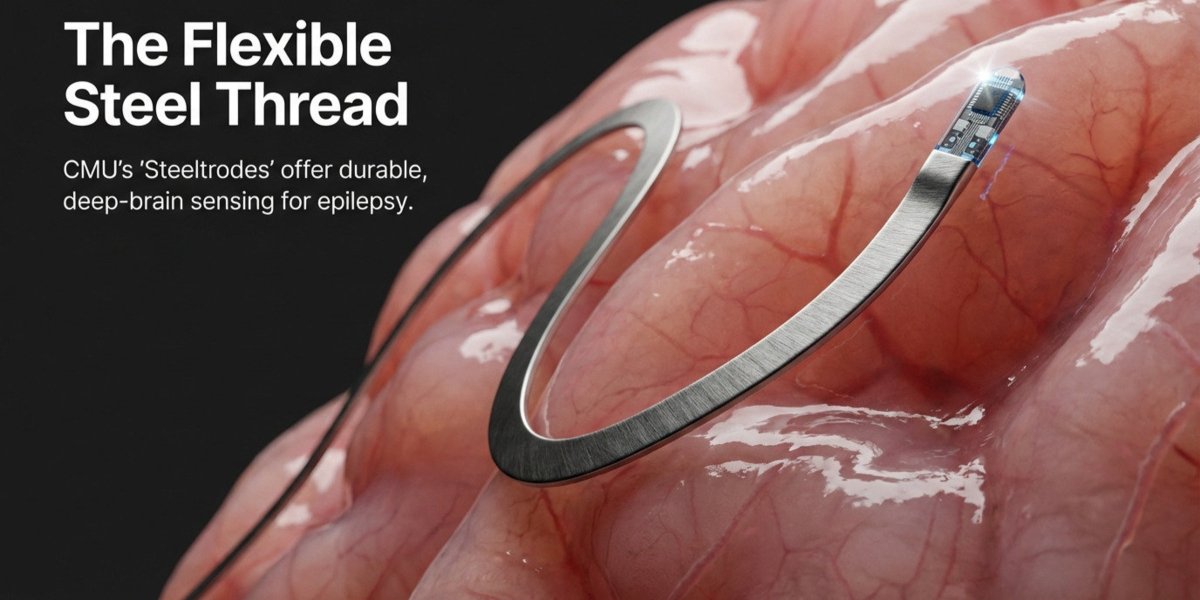
For decades, neuroscientists have relied on silicon-based probes to peer into the brain’s electrical activity. They work reasonably well — until they don’t. Silicon is a brittle material that can shatter during placement MedicalXpress, which is a deeply unsettling risk when the placement in question is inside a human brain. Now, researchers at Carnegie Mellon University have found a compelling solution hiding in plain sight: stainless steel.
The CMU team has fabricated the first microfabricated stainless steel neural probe that allows for customizable, high-density neural recording, making brain readings much safer than before. They’re calling these devices “steeltrodes,” and the results, published in Nature Communications, are impressive.
The core problem with silicon probes is that while they work well in shallow brain tissue, their brittleness makes deep-brain navigation genuinely dangerous. By creating probes made out of stainless steel, researchers are able to navigate to the middle brain with minimal cortical tissue damage, enabling inter- and intraoperative neural recording for epilepsy localization and deep-brain-stimulation implantation.
The material choice isn’t arbitrary. Stainless steel is already used in biomedical implants such as prosthetics and coronary stents — it’s biocompatible, resilient, and far less brittle than silicon. The challenge has always been manufacturing: getting stainless steel to work at the microscopic scale required for neural probes is notoriously difficult territory. The team demonstrated probes 8 cm long and roughly 300 micrometres wide, featuring rigid shanks with optional flexible cables for high-resolution recording.
What makes steeltrodes particularly exciting isn’t just safety — it’s scalability. The devices are robust, reusable, customizable, and can be produced at scale. That last point matters enormously. High-quality neural probes today are expensive and largely handmade, which limits their use. A manufacturable stainless steel alternative could make this technology accessible far more broadly.
In the future, the team hopes that neurosurgeons will be able to use multiple steeltrodes on a patient simultaneously to generate a more comprehensive recording of brain activity. The clinical implications are wide-ranging — this breakthrough is particularly important both as a diagnostic tool and as an intervention tool for patients with brain disorders such as epilepsy, Parkinson’s disease, and schizophrenia.
It’s a reminder that sometimes the most elegant innovations don’t come from exotic new materials, but from finally figuring out how to properly use the ones we already trust with our lives.
This topic was featured on Great News podcast episode 29:

The Great News Podcast is your source for positive news, inspiring stories, and good news from around the world. We skip the doom and gloom of mainstream media to focus on scientific breakthroughs, environmental wins, and the inspiring news that proves the world is getting better. Join Andrew McGivern for a dose of optimism and uplifting stories that will change your perspective on human progress.
It is easy to find the
Keep looking for the good in the world, because it is not only there – its everywhere.
Today, we are diving into some truly groundbreaking advancements in medicine and brain health.
A New Brain Probe Could Transform Neurosurgery
What if we could 3D-bioprint a functioning human liver to buy a patient enough time to heal without a full transplant? That is our lead story today.
Plus, we have a spray-on powder that can seal life-threatening wounds in just one second, a new type of stainless steel probe that makes brain sensing safer and cheaper than ever before.
And don't forget to stick around for the speed round, where we’ll dive into even more great news.
LINKS:

Source: Medical Xpress