
Improving indoor environment reduces asthma attacks
If you’re one of the millions of adults living with asthma, relief might be closer than your nearest pharmacy. According to new research from Texas A&M University, a handful of simple changes to your home environment could significantly reduce the frequency and severity of asthma attacks.
What the Research Found
The study, published in the journal Atmosphere, analyzed data from over 1,600 adults with asthma across Texas between 2019 and 2022. Researchers examined how indoor environments affect asthma attacks, symptoms, sleep disruption, and limitations on daily activities.
The findings were striking — and actionable. Two factors stood out as the biggest indoor triggers: the absence of exhaust fans in kitchens and bathrooms, and smoking indoors. Beyond that, homes with mold, mice or rats, or furry pets were linked to more frequent asthma flare-ups, while the use of air purifiers was associated with fewer problems.
“Adults spend as much as 90% of their time indoors, where the air can actually be dirtier than it is outdoors,” said lead author Alexander Obeng, a doctoral researcher at Texas A&M’s School of Public Health.
Why This Study Is Different
Most research on indoor asthma triggers has focused on children. This study deliberately centered on adults — an important distinction, since the majority of asthma cases in the US occur in grown-ups. Texas made for an ideal study setting, given its wide range of climates and housing stock, from older homes and mobile residences to modern multi-unit buildings. The widespread use of air conditioning across the state also plays a role, reducing natural ventilation and potentially concentrating indoor pollutants.
Who Is Most at Risk
The data revealed troubling disparities: women, older adults, and Black adults experience more severe asthma complications than other groups. Researchers attribute this in part to differences in income, housing quality, and access to health care — factors that compound the burden of the disease for already-vulnerable populations.
What You Can Do
The good news is that many of the most effective interventions are within reach. Here’s where to start:
- Improve ventilation. Install or use exhaust fans in your kitchen and bathroom to remove moisture, cooking fumes, and other airborne irritants.
- Add an air purifier. Portable HEPA air purifiers can make a measurable difference in indoor air quality, especially in bedrooms.
- Don’t smoke indoors. Cigarette smoke is one of the most potent asthma triggers — keeping it outside is one of the single most impactful changes you can make.
- Control moisture and pests. Mold and rodent droppings are powerful allergens. Address leaks promptly and seal entry points for pests.
- Manage pet allergens. If furry pets are part of the picture, regular grooming, keeping pets out of bedrooms, and using air purifiers can help reduce exposure.
A Call for Systemic Support
Individual action matters, but the researchers also recognize that not everyone can afford to make these changes on their own. The study recommends subsidies to help low-income families purchase air purifiers, stronger requirements for landlords to maintain healthy ventilation standards, and better patient education from health care providers on how to reduce asthma triggers at home.
For the roughly 25 million Americans living with asthma, the environment inside four walls may be just as important as any medication in managing the condition. And for many, making those walls a little healthier could be transformative.
This topic was featured on Great News podcast episode 35.

The Great News Podcast is your source for positive news, inspiring stories, and good news from around the world. We skip the doom and gloom of mainstream media to focus on scientific breakthroughs, environmental wins, and the inspiring news that proves the world is getting better. Join Andrew McGivern for a dose of optimism and uplifting stories that will change your perspective on human progress.
It is easy to find the
Keep looking for the good in the world, because it is not only there – its everywhere.
This podcast is brought to you by the Daily Quote. The podcast designed to kickstart your day in a positive way!
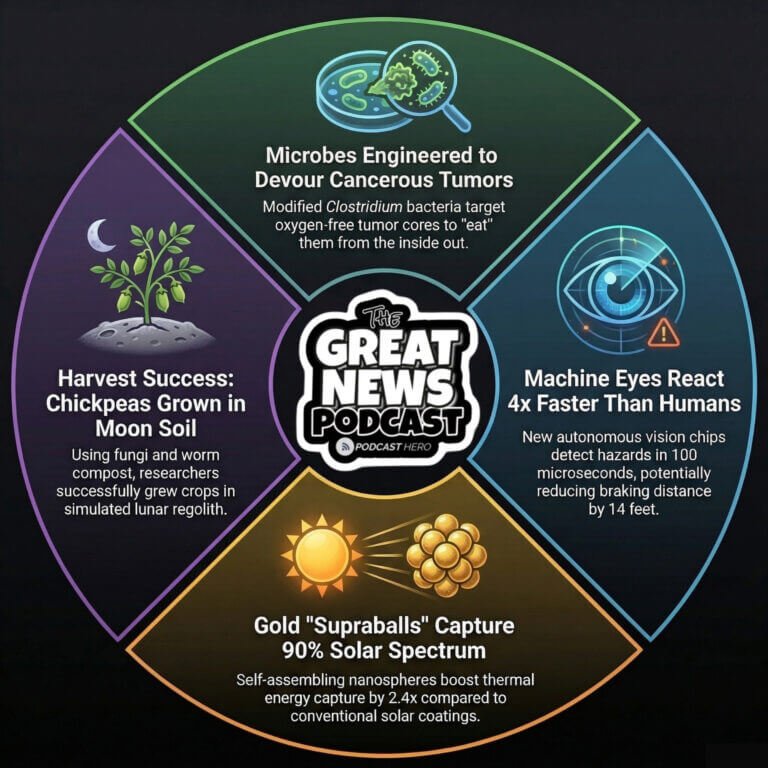
Today, we are exploring a medical breakthrough that uses ”hungry” bacteria to fight cancer, a massive electric flying taxi taking to the skies in China, and a successful harvest of chickpeas grown in actual moon dirt
Plus, we’ll look at a new computer chip that gives self-driving cars reflexes four times faster than the human brain
Bacteria that eats cancer from the inside out
Robot Cars react 4X faster than humans
And stick around for our speed round, where we’ll cover even more great news!
US Forests fighting harder against climate change
Gold Supraballs capture 90% of solar spectrum
A few changes at home reduce asthma attacks
New additive increases organic solar cell efficiency
If you like the Great News Podcast, You'll love the great news letter. Because the Great News Podcast is Great! But the Great News Letter is Greater!
The Great News Letter is FREE and includes all the good news stories.
Source: Futurity