Supraballs capture more of the sun’s energy!
Solar energy has long carried an uncomfortable irony: even as panels blanket rooftops and fields around the world, the technology underneath them is leaving most of the sun’s energy on the table. At any given moment, 89,000 terawatts of solar power strikes Earth’s surface, yet we’ve never had a practical way to capture it all. A new discovery from a team in Seoul might finally change that, and the secret ingredient is gold.
Researchers at KU-KIST Graduate School have developed what they’re calling plasmonic colloidal supraballs, self-assembling gold nanospheres that can absorb nearly the full usable solar spectrum in thermal-based devices.
Here’s the problem they’re solving: solar radiation spans ultraviolet, visible, and infrared wavelengths. Photovoltaic cells primarily convert visible light and part of the near-infrared spectrum into electricity, leaving much of the remaining energy untapped. Even solar-thermal collectors, which are better at capturing heat, are held back by surface coatings that fall well short of total absorption.
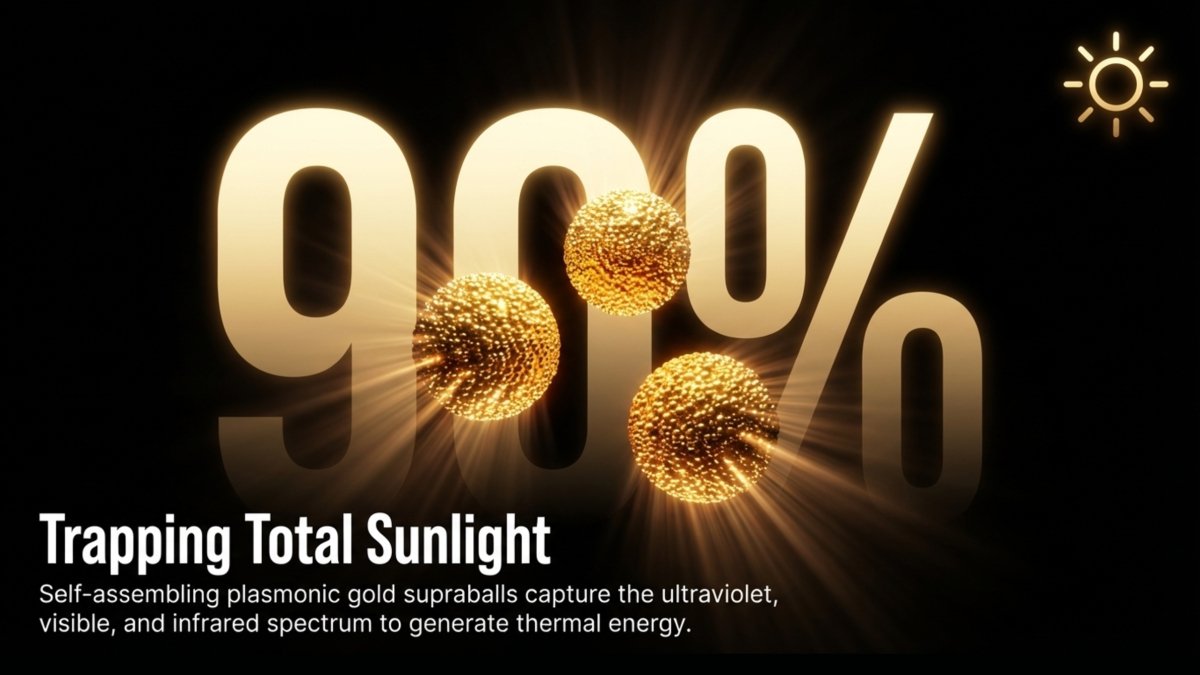
The supraballs work by exploiting physics at the nanoscale. Thousands of gold nanoparticles cluster together to form micrometer-scale spheres in solution, which are then drop-cast onto a surface, forming a dense, textured film. Once in place, localized surface plasmon resonances at the nanoparticle surfaces, combined with Mie-type resonances within the spheres, trap photons across UV, visible, and near-infrared wavelengths, converting much of this energy into heat.
The results are striking. This approach achieves roughly 90% absorption across the solar spectrum, creating a stronger temperature gradient that generates nearly 2.4 times the power output of conventional nanoparticle coatings.
What makes this especially exciting is how practical it is. Unlike concentrated solar plants that demand vast infrastructure, the supraballs require low-complexity fabrication via solution processing and are compatible with existing, commercially available devices. As lead researcher Seungwoo Lee put it, the technology could significantly lower the barrier for high-efficiency solar-thermal and photothermal systems in real-world energy applications.
The technology is primarily aimed at thermal systems — thermoelectric generators, solar-thermal collectors, and hybrid solar setups — rather than replacing conventional solar panels. But in a world still hungry for efficient, scalable clean energy, a coating that squeezes dramatically more power from the same sunlight is the kind of incremental breakthrough that quietly changes everything.
This topic was featured in Great News podcast episode 35.

The Great News Podcast is your source for positive news, inspiring stories, and good news from around the world. We skip the doom and gloom of mainstream media to focus on scientific breakthroughs, environmental wins, and the inspiring news that proves the world is getting better. Join Andrew McGivern for a dose of optimism and uplifting stories that will change your perspective on human progress.
It is easy to find the
Keep looking for the good in the world, because it is not only there – its everywhere.
This podcast is brought to you by the Daily Quote. The podcast designed to kickstart your day in a positive way!
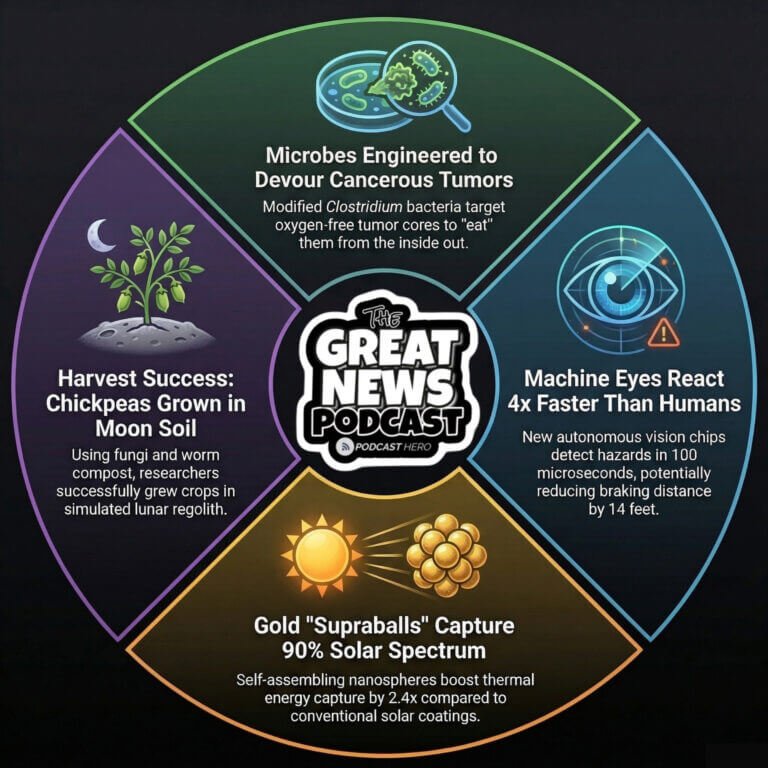
Today, we are exploring a medical breakthrough that uses ”hungry” bacteria to fight cancer, a massive electric flying taxi taking to the skies in China, and a successful harvest of chickpeas grown in actual moon dirt
Plus, we’ll look at a new computer chip that gives self-driving cars reflexes four times faster than the human brain
Bacteria that eats cancer from the inside out
Robot Cars react 4X faster than humans
And stick around for our speed round, where we’ll cover even more great news!
US Forests fighting harder against climate change
Gold Supraballs capture 90% of solar spectrum
A few changes at home reduce asthma attacks
New additive increases organic solar cell efficiency
If you like the Great News Podcast, You'll love the great news letter. Because the Great News Podcast is Great! But the Great News Letter is Greater!
The Great News Letter is FREE and includes all the good news stories.
Source: New Atlas