AI and Humans Working Together on Self Driving Tech
For years, Waymo kept the inner workings of its robotaxi operation shrouded in mystery. How often do its vehicles need human help? Who’s watching? From where? The company deflected these questions — until now.
Under pressure from U.S. senators, Waymo recently disclosed a number that quietly says everything: at any given moment, just 70 people are on duty overseeing a fleet of over 3,000 vehicles. That’s roughly one human agent per 41 cars, across a network delivering more than 400,000 rides and 4 million miles every single week.
What These “Agents” Actually Do
Here’s the part that often gets lost in the headlines: these aren’t remote drivers. Waymo is firm on this point — no human is ever performing the actual act of driving. Instead, these remote assistance agents step in when a car gets confused. Spotted a strange obstacle in the road? The car phones home. An agent might tell it to proceed, reroute, or provide a sequence of waypoints to navigate a tight spot. The car still drives itself; it just gets a nudge in the right direction.
This distinction matters enormously. It means Waymo’s autonomy is real — not a polished illusion propped up by an army of hidden teleoperators.
The Philippines Controversy
The disclosure didn’t come without friction. When Waymo’s Chief Safety Officer testified before the Senate Commerce Committee, he revealed that some of these agents are based in the Philippines. Senator Ed Markey wasn’t pleased, raising concerns about cybersecurity and whether overseas workers could give “driver-like control” of vehicles on American roads. A separate House member asked the Department of Transportation to investigate.
Waymo responded with more detail: it operates four remote assistance centers — in Arizona, Michigan, and two Philippine cities — with roughly half the on-duty agents in each country. Philippine-based agents must hold a valid local driver’s license and meet English proficiency standards.
Whether you find this concerning or unremarkable probably depends on how you think about the role. If an agent is essentially clicking “yes, you can ignore that traffic cone,” their physical location seems less critical than their training and the security of the connection. But it’s a fair debate to have, and Waymo is right to be more transparent about it.
Why This Number Is So Important
The 70-agent figure isn’t just a staffing data point — it’s a proof of concept for scalability.
One of the deepest skepticisms about robotaxis has always been: can you actually run this without hiding enormous human labor costs behind the curtain? The answer, at Waymo’s current scale, appears to be yes. The company is completing over 20 million lifetime rides, expanding into Miami, Houston, Dallas, and beyond, and doing it all with a support team that could fit in a large conference room.
As Waymo grows toward its stated goal of 1 million rides per week by the end of 2026, that ratio will be tested. But the current numbers suggest the underlying technology is doing the heavy lifting — and the humans are truly just there for the edge cases.
The Bigger Picture
There’s an old saying in tech that any sufficiently advanced product looks like magic until you see how the sausage is made. Waymo’s sausage-making turns out to be surprisingly lean. The controversy around remote agents — overseas workers, Congressional hearings, security concerns — has had the unintended effect of pulling back the curtain on just how autonomous these vehicles really are.
Seventy people. Three thousand cars. Millions of miles. The future of transportation is less dramatic than the movies imagined, and maybe more impressive for it.
This topic was featured in Great News podcast episode 33.

The Great News Podcast is your source for positive news, inspiring stories, and good news from around the world. We skip the doom and gloom of mainstream media to focus on scientific breakthroughs, environmental wins, and the inspiring news that proves the world is getting better. Join Andrew McGivern for a dose of optimism and uplifting stories that will change your perspective on human progress.
It is easy to find the
Keep looking for the good in the world, because it is not only there – its everywhere.
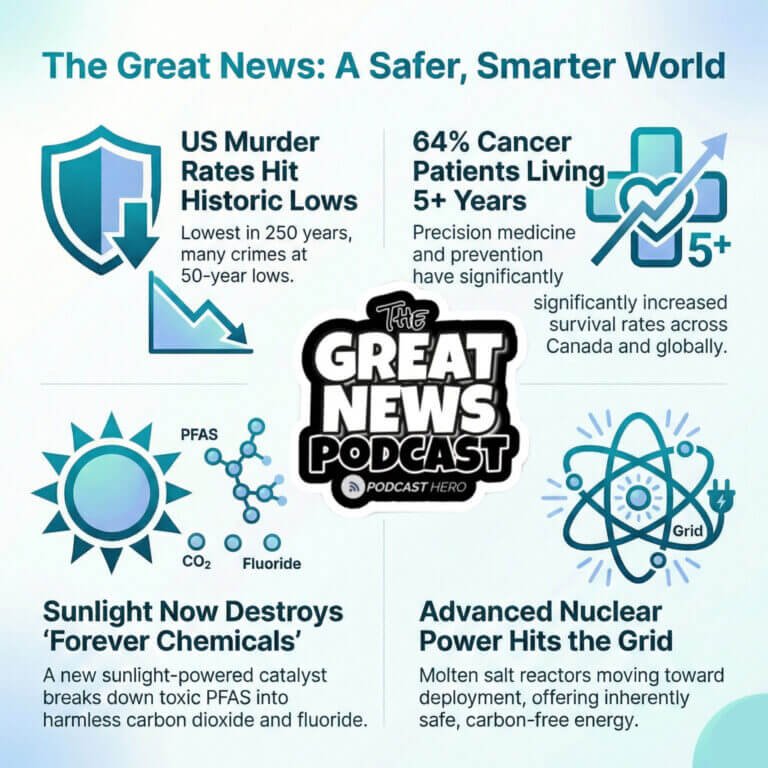
Today we are diving into some truly groundbreaking developments in public safety, medicine, and clean energy.
What if I told you that despite what you see on social media, we are living in one of the safest times in history? That’s our lead story today.
Plus, we have a major update on the fight against cancer, a way to destroy ”forever chemicals” using nothing but sunlight, and a partnership that’s bringing advanced nuclear power to the grid.
America’s Crime Drop Is Real — And That’s Worth Celebrating
Canada’s Improved Cancer Survival Rate
Could Sunlight Be the Answer to “Forever Chemicals”The Next Generation of Nuclear Power Is Getting Closer to Reality
And don't forget to stick around for the speed round, where we'll dive into even more great news.70 People, 3,000 Cars: What Waymo Just Revealed About the Future of Self-Driving
The Battery Breakthrough Hidden in Plain Sight, Water
The Macrophages that could help fight Type 2 Diabetes
Making Hydrogen with Sun and Water?
And don't forget to follow the Daily Quote podcast. Kickstart Your Day in a Positive Way!
Source: Understanding AI