Scientists Use Sunlight to Transform Plastic Waste
What if the plastic cluttering our oceans could be turned into something genuinely useful — using nothing but sunlight? That’s exactly what researchers at the University of Waterloo have managed to do, and the results are quietly remarkable.
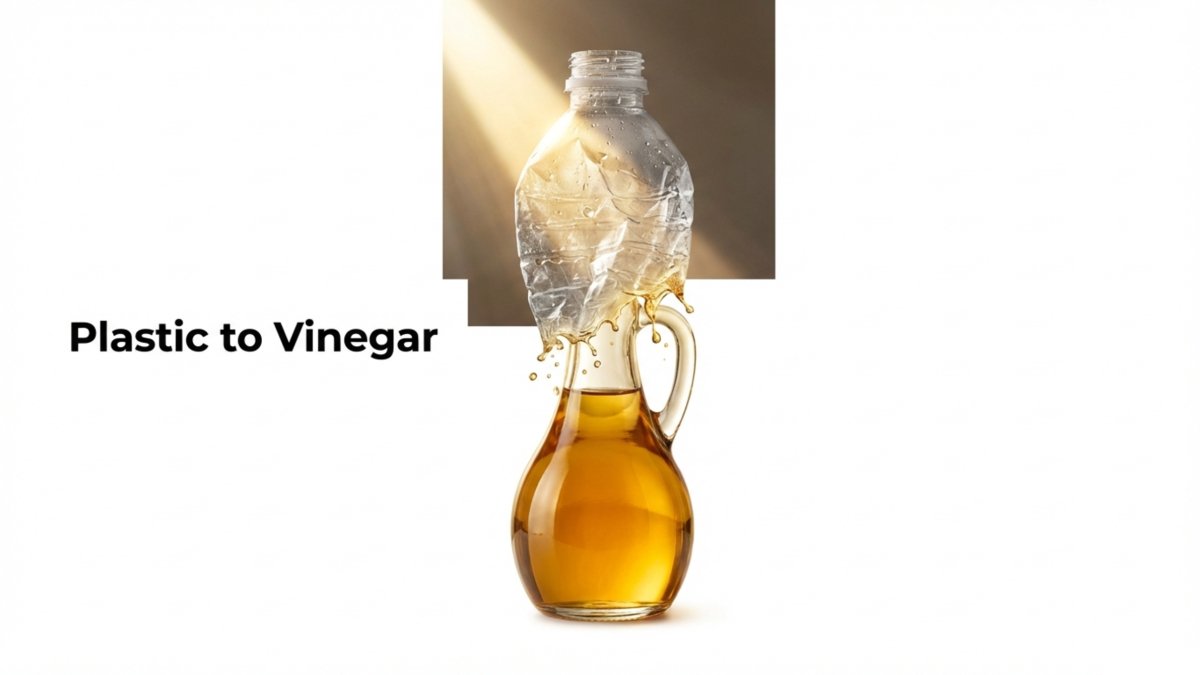
The team has developed a solar-powered catalyst that converts plastic waste into acetic acid — the chemical that gives vinegar its sharp tang, and a widely used industrial compound. The process doesn’t require fossil fuels or high heat. It runs on sunlight, in water, and it doesn’t emit carbon dioxide while doing so.
Nature as the Blueprint
The catalyst draws inspiration from fungi, which break down complex organic matter through a sequence of carefully staged enzymatic reactions. The Waterloo team mimicked this approach by engineering a “cascade photocatalysis” system — a chain reaction triggered by light that progressively dismantles plastic polymers. At the heart of the design are single iron atoms embedded within a carbon nitride framework. When sunlight hits the material, these atomic-scale reaction sites go to work with impressive selectivity, producing acetic acid rather than a jumble of unwanted byproducts.
The system was tested on some of the most common plastics in circulation — PVC, PP, PE, and PET — and crucially, it held up when processing mixed plastic streams. That last point matters enormously for any real-world application, since plastic waste rarely arrives pre-sorted.
Why This Matters
Plastic pollution is one of those problems that feels both urgent and intractable. Microplastics have been found everywhere from deep ocean sediments to human bloodstreams. Most recycling approaches either require significant energy inputs or can only handle specific plastic types. This new method is different: it works in water, which means it could potentially address microplastics in aquatic environments directly, rather than just filtering them out and sending the problem elsewhere.
And unlike recycling that merely downgrades plastic into lower-quality material, this process genuinely upcycles it. Acetic acid is a valuable chemical with applications across food production, pharmaceuticals, and energy systems. Turning garbage into a commodity changes the economic logic of dealing with waste.
The Road Ahead
The researchers have also conducted a techno-economic analysis suggesting the approach is commercially promising — not just environmentally sound. That said, the system is still at the laboratory stage. Scaling up any photocatalytic process brings engineering challenges, from reactor design to catalyst durability at volume.
Still, the core concept is elegant: use a freely available, clean energy source to convert one of our most persistent pollutants into something industry actually needs. If the Waterloo team — led by Professor Yimin Wu and PhD student Wei Wei — can get this out of the lab, it could represent a genuinely new chapter in how we think about plastic waste. Not as a disposal problem, but as a feedstock waiting to be unlocked.
This topic was featured in Great News podcast episode 33.

The Great News Podcast is your source for positive news, inspiring stories, and good news from around the world. We skip the doom and gloom of mainstream media to focus on scientific breakthroughs, environmental wins, and the inspiring news that proves the world is getting better. Join Andrew McGivern for a dose of optimism and uplifting stories that will change your perspective on human progress.
It is easy to find the
Keep looking for the good in the world, because it is not only there – its everywhere.
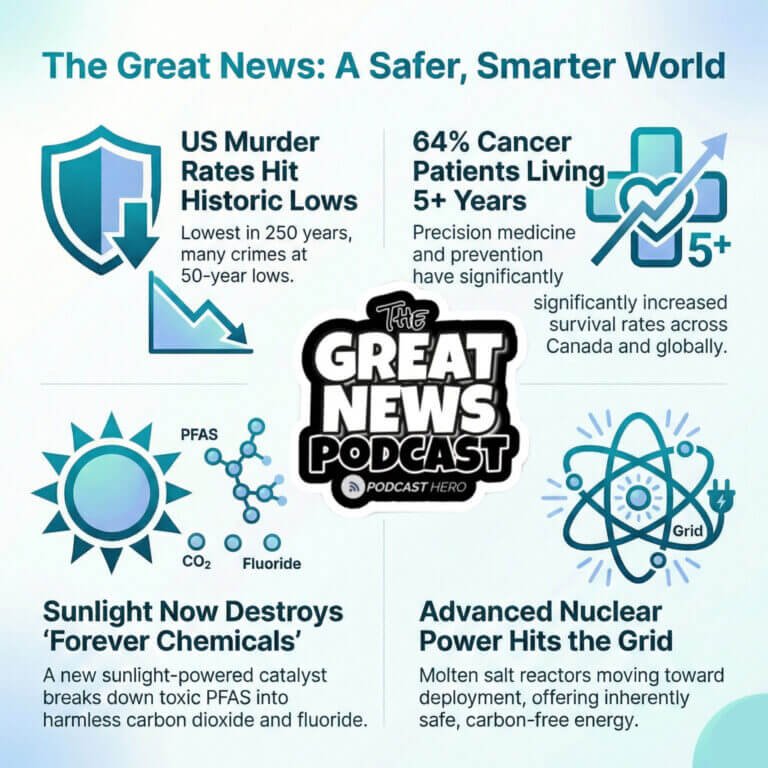
Today we are diving into some truly groundbreaking developments in public safety, medicine, and clean energy.
What if I told you that despite what you see on social media, we are living in one of the safest times in history? That’s our lead story today.
Plus, we have a major update on the fight against cancer, a way to destroy ”forever chemicals” using nothing but sunlight, and a partnership that’s bringing advanced nuclear power to the grid.
America’s Crime Drop Is Real — And That’s Worth Celebrating
Canada’s Improved Cancer Survival Rate
Could Sunlight Be the Answer to “Forever Chemicals”The Next Generation of Nuclear Power Is Getting Closer to Reality
And don't forget to stick around for the speed round, where we'll dive into even more great news.70 People, 3,000 Cars: What Waymo Just Revealed About the Future of Self-Driving
The Battery Breakthrough Hidden in Plain Sight, Water
The Macrophages that could help fight Type 2 Diabetes
Making Hydrogen with Sun and Water?
And don't forget to follow the Daily Quote podcast. Kickstart Your Day in a Positive Way!