In trauma medicine, seconds aren’t just precious — they’re often the difference between life and death. Bleeding is the leading cause of death in the first few hours after injury, and death from bleeding is the number one cause of potentially survivable deaths in combat situations. For all of modern medicine’s sophistication, the tools available to stop a severe bleed in the field have remained frustratingly limited — until now.
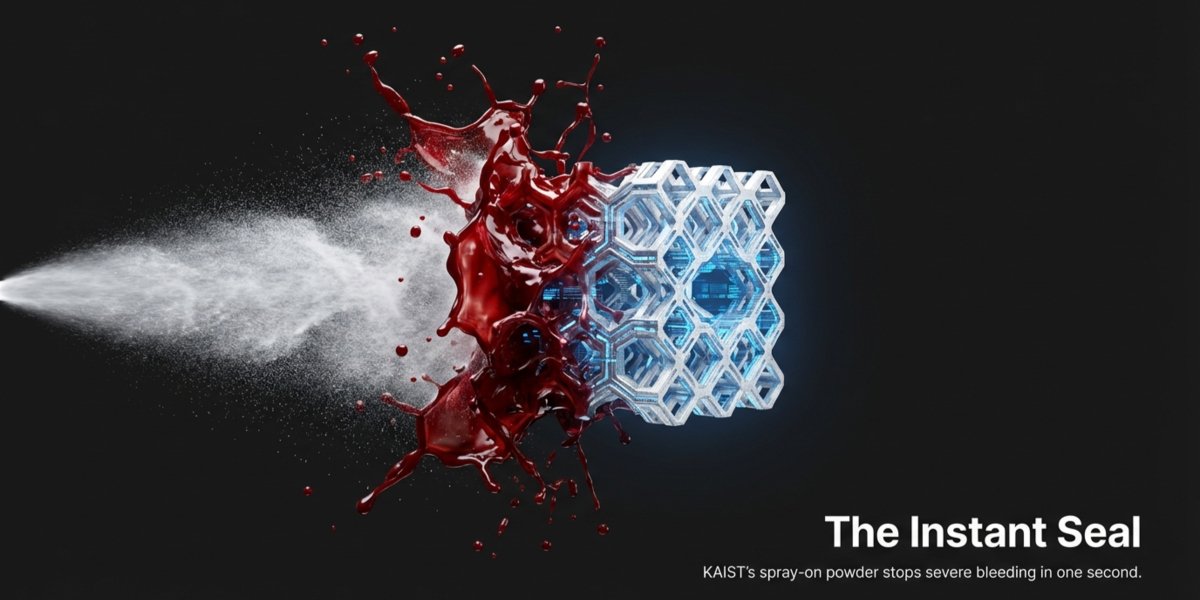
Researchers at South Korea’s Korea Advanced Institute of Science and Technology (KAIST) have developed something that sounds almost too good to be true: a next-generation powder-type hemostatic agent that can halt bleeding within one second when sprayed directly onto a wound. The material, called AGCL powder, doesn’t just absorb blood like existing products — it actively transforms into a tough, wound-conforming hydrogel the moment it makes contact.
The Chemistry Behind the Magic
The secret is elegantly simple. AGCL powder is made from a smart combination of biocompatible polymers — alginate, gellan gum, and chitosan. Calcium ions in the blood trigger the powder to gel, while chitosan promotes clotting and helps the gel stick to tissue. These are not exotic or experimental compounds; all three are already established in medical use. What’s new is the way they’ve been combined and structured to work in concert, creating what amounts to a biological superglue that the body itself activates.
The performance numbers are striking. The engineered three-dimensional matrix can absorb blood equivalent to 725% of its own weight while maintaining strong adhesion. Its sealing strength measured over 40 kilopascals — comparable to being pressed firmly by hand — allowing it to hold even under high-pressure bleeding scenarios. Crucially, the powder can be applied to wounds of many shapes and sizes, including those that are deep or uneven, exactly the kinds of injuries that defeat conventional dressings and gauze.
Built for the Worst Conditions
The research team didn’t design this in a vacuum. The agent was developed through a cross-disciplinary collaboration between materials science and biological engineering, with input from an active-duty South Korean Army Major whose battlefield experience shaped the design’s real-world focus. That grounding in reality shows in the details. The powder stays stable for two years at room temperature, making it perfect for disaster relief or remote medical situations where refrigeration doesn’t exist.
Safety was equally prioritized. AGCL powder is composed entirely of naturally derived materials, showing a hemolysis rate of less than 3%, a cell viability rate of over 99%, and an antibacterial effect of 99.9%, making it safe even when in contact with blood. In animal testing, in surgical liver injury experiments, the amount of bleeding and hemostasis time were significantly reduced compared to commercial hemostatic agents, and liver function recovered to normal levels two weeks after surgery, with no abnormal findings in systemic toxicity evaluations.
Beyond the Battlefield
While the technology was designed with soldiers in mind, its implications extend far beyond combat. AGCL powder requires almost no skill to apply and works in seconds — whether used by trained medics or potentially even civilians in a worst-case scenario, the product offers a fast, low-effort, high-reward intervention. Emergency responders at accident scenes, paramedics, disaster relief teams, and even ordinary people caught in a crisis could all benefit.
KAIST characterized the project as an example of defense technology transitioning into civilian innovation — a path previously taken by technologies such as GPS and microwave ovens. The research has already won both the 2025 KAIST Q-Day President’s Award and the Minister of National Defense Award, signaling its perceived importance beyond academia.
The powder is not yet approved for clinical use in humans, but given the strength of the preclinical data, that milestone may not be far off. Army Major Kyusoon Park, who served as a study co-author, said the substance not only allows “instant hardening” under extreme conditions like combat or disasters and his motivation, he explained, was simple: “a sense of mission to save even one more soldier.”
Sometimes the most transformative technologies are the ones that do exactly one thing, but do it perfectly. A powder that turns blood into armor in a single second might be just that.
This topic was featured on Great News podcast episode 29:

The Great News Podcast is your source for positive news, inspiring stories, and good news from around the world. We skip the doom and gloom of mainstream media to focus on scientific breakthroughs, environmental wins, and the inspiring news that proves the world is getting better. Join Andrew McGivern for a dose of optimism and uplifting stories that will change your perspective on human progress.
It is easy to find the
Keep looking for the good in the world, because it is not only there – its everywhere.
Today, we are diving into some truly groundbreaking advancements in medicine and brain health.
A New Brain Probe Could Transform Neurosurgery
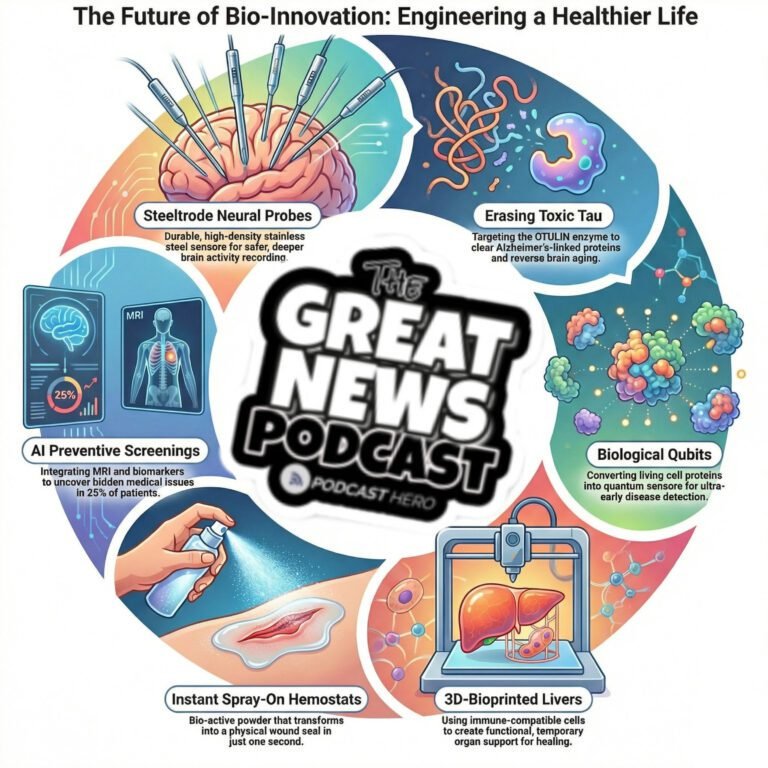
What if we could 3D-bioprint a functioning human liver to buy a patient enough time to heal without a full transplant? That is our lead story today.
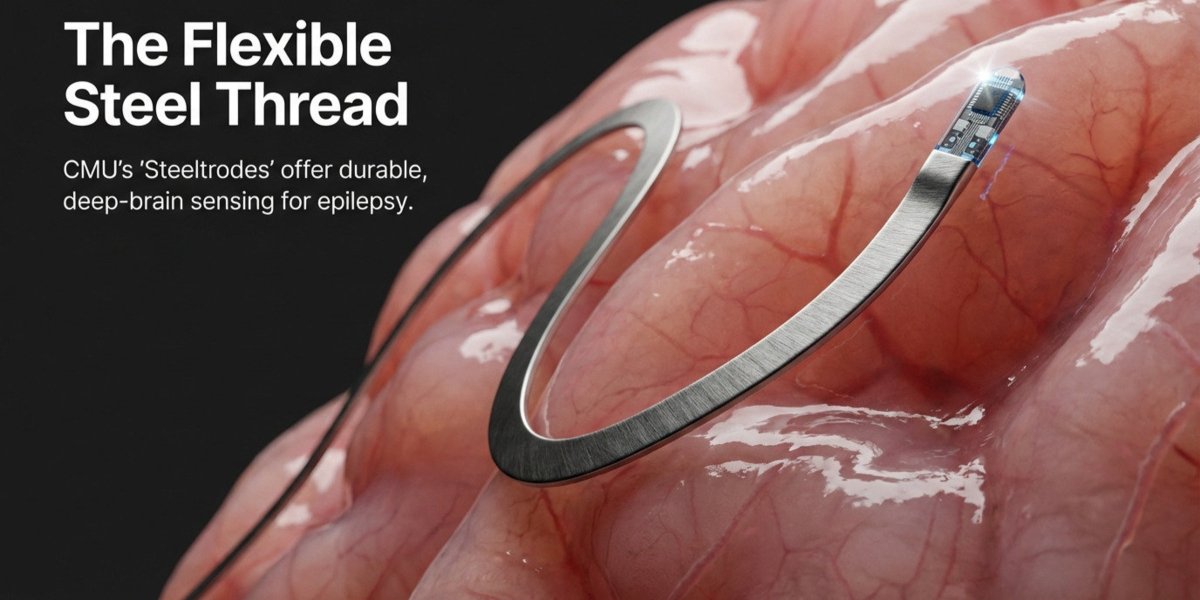
Plus, we have a spray-on powder that can seal life-threatening wounds in just one second, a new type of stainless steel probe that makes brain sensing safer and cheaper than ever before.
And don't forget to stick around for the speed round, where we’ll dive into even more great news.
LINKS:
Source: SciTechDaily