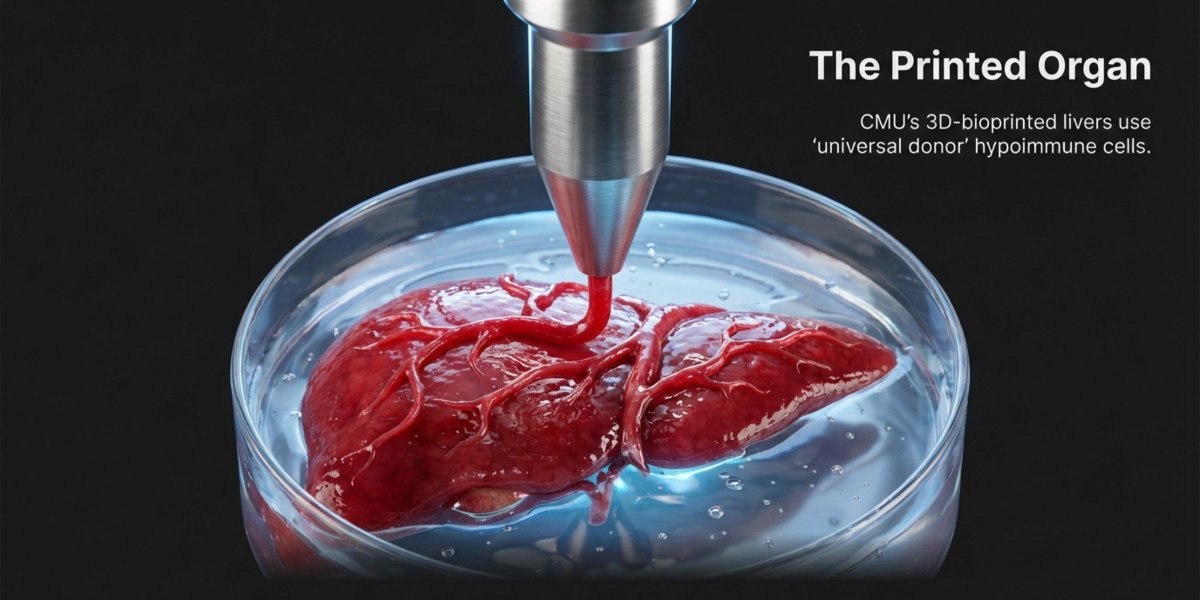
Over 100,000 people are currently on transplant waiting lists in the US. For many of them, the wait is a death sentence — not because medicine lacks the knowledge to save them, but because there simply aren’t enough donor organs to go around. A bold new project from Carnegie Mellon University is aiming squarely at that problem, with a vision that would have seemed like science fiction not long ago: printing a functional human liver.
The LIVE Project
The project, titled Liver Immunocompetent Volumetric Engineering (LIVE), aims to address the shortage of donor organs by developing bioengineered tissue to treat acute liver failure. Specifically, the project seeks to develop a temporary liver that buys time for the patient’s own organ to heal, ultimately bypassing the need for a full transplant. In January 2026, CMU announced it had secured $28.5 million in funding from the Advanced Research Projects Agency for Health (ARPA-H) to make it happen.
The genius of the approach lies in biology’s own rulebook. In the human body, the liver is the only organ capable of complete regeneration, but it needs time to heal. Usually, the time runs out before the healing begins. The bioprinted liver isn’t meant to be permanent — it’s a bridge. “The liver we are creating would last for about two to four weeks,” explained Adam Feinberg, professor of biomedical engineering at CMU and the project’s principal investigator. That window is enough to let the patient’s original organ recover, sparing a donor liver for someone whose body cannot regenerate its own.
Cracking the Immune Problem
Building a convincing liver structure is one challenge. Getting the body to accept it is another — and historically, it’s been the harder of the two. Transplanted organs trigger immune rejection, condemning patients to a lifetime of toxic immunosuppression drugs that themselves damage other organs.
The LIVE team has an elegant workaround. The project is using hypoimmune cells — “universal donor” cells genetically engineered to be invisible to the human immune system — removing the need for anti-rejection drugs, which are often toxic to a patient’s remaining liver and kidney tissue. The printed organ would not read as foreign to the body at all, slipping past the immune system’s defences entirely.
To physically construct the tissue, the team is using FRESH 3D bioprinting, a proprietary technique that enables researchers to print soft, delicate biological materials such as collagen and human stem cells into complex structures.
A Blueprint for the Body
The liver is first, but the ambitions extend much further. While the liver is the initial target due to its regenerative properties, the team — which includes experts from the University of Washington, Mayo Clinic, and the University of Pittsburgh — believes this is the blueprint for the future of healthcare. Ultimately, this technique will be applied to bioengineer the heart, pancreas, and other organs. If the platform works, it could be adapted to print heart tissue for infants with congenital defects, insulin-producing cells for diabetics, or functional kidneys.
The team expects to have an adult-scale bioengineered liver ready for pre-clinical testing within the next five years. That’s an ambitious timeline, and significant hurdles remain before any of this reaches a patient’s bedside. But the combination of a compelling biological rationale, cutting-edge printing technology, immune-evasive cells, and serious federal funding puts this project on a trajectory that deserves to be watched closely.
The organ donor waiting list has been a tragedy measured in lives for decades. The possibility that a printer — rather than a donor — could one day close that gap is one of the more hopeful things medicine has to offer right now.
This topic was featured on Great News podcast episode 29:

The Great News Podcast is your source for positive news, inspiring stories, and good news from around the world. We skip the doom and gloom of mainstream media to focus on scientific breakthroughs, environmental wins, and the inspiring news that proves the world is getting better. Join Andrew McGivern for a dose of optimism and uplifting stories that will change your perspective on human progress.
It is easy to find the
Keep looking for the good in the world, because it is not only there – its everywhere.
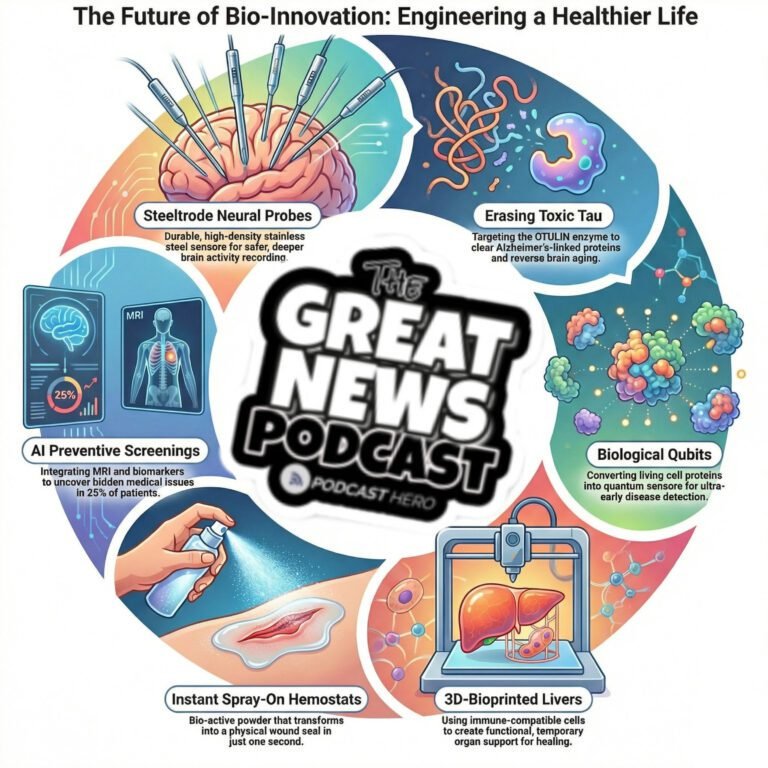
Today, we are diving into some truly groundbreaking advancements in medicine and brain health.
A New Brain Probe Could Transform Neurosurgery
What if we could 3D-bioprint a functioning human liver to buy a patient enough time to heal without a full transplant? That is our lead story today.
Plus, we have a spray-on powder that can seal life-threatening wounds in just one second, a new type of stainless steel probe that makes brain sensing safer and cheaper than ever before.
And don't forget to stick around for the speed round, where we’ll dive into even more great news.
LINKS:
Source: Interesting Engineering