Making Hydrogen with Sun and Water?
What if the answer to our energy crisis was hiding in the quantum realm? Researchers at the University of Michigan think it might be — and they have the results to back it up.
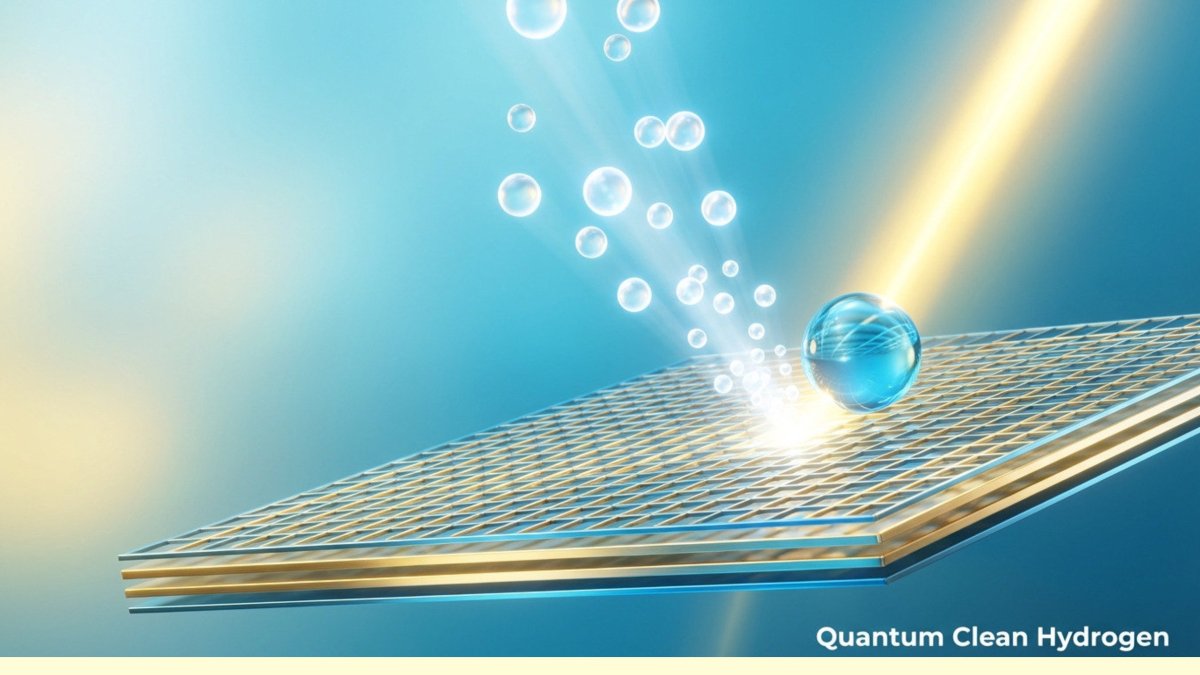
The team has developed a new class of materials called excitonic quantum superlattices that can split water into hydrogen and oxygen using nothing but sunlight. The breakthrough, published in Nature Energy, brings us a meaningful step closer to a world where clean hydrogen fuel is generated directly from the sun — no fossil fuels required.
Why Hydrogen, and Why Now?
Hydrogen is one of the most promising clean fuels on the planet. When burned, it emits only water vapor, making it an attractive option for powering heavy industry, trucks, ships, and trains — sectors that are notoriously difficult to electrify. The catch? Most hydrogen today is produced from natural gas, which defeats the purpose entirely.
One elegant solution is photocatalytic water splitting: using sunlight to drive a chemical reaction that breaks water molecules into hydrogen and oxygen. It’s clean, scalable in theory, and powered by the most abundant energy source we have. The problem has always been efficiency — photocatalysts tend to waste most of the energy they absorb before it can do useful work.
Enter the Quantum Superlattice
The Michigan team tackled this problem at the quantum level. Their superlattices are made from ultra-thin, alternating layers of gallium nitride and indium gallium nitride, stacked in a precise periodic structure. This architecture dramatically improves how the material handles light-generated charge carriers — the electrons and electron “holes” that drive the water-splitting reaction.
The key mechanism is something called the quantum-confined Stark effect, which extends the lifespan of indirect excitons (bound pairs of electrons and holes). Normally these charge carriers recombine and release energy as heat before they can be put to work. By keeping them alive longer, the superlattice steers them more effectively toward the chemical reaction that produces hydrogen.
Promising Numbers — With Room to Grow
In lab tests, the material achieved a solar-to-hydrogen efficiency of 3.16% under concentrated sunlight, and averaged 1.64% in real-world outdoor demonstrations using 204-fold sunlight intensity. These may sound modest, but they represent a genuine advance for photocatalytic systems, which have historically struggled to move beyond proof-of-concept.
Commercial viability will require higher efficiencies still, and the researchers are clear-eyed about that. But the design principles demonstrated here — quantum engineering at the nanometer scale to control charge dynamics — could inspire a whole new generation of photocatalyst materials.
The Bigger Picture
The implications of cracking clean hydrogen production at scale are enormous. Hydrogen could decarbonize some of the hardest-to-clean corners of the global economy, from steel manufacturing to long-haul freight. Paired with advances like this one, solar-powered hydrogen generation could become a cornerstone of the net-zero energy systems of the future.
Quantum physics has long promised to unlock new material properties that classical engineering can’t achieve. This research is a reminder that those promises are starting to pay off — one nanometer-thin layer at a time.
This topic was featured in Great News podcast episode 33.

The Great News Podcast is your source for positive news, inspiring stories, and good news from around the world. We skip the doom and gloom of mainstream media to focus on scientific breakthroughs, environmental wins, and the inspiring news that proves the world is getting better. Join Andrew McGivern for a dose of optimism and uplifting stories that will change your perspective on human progress.
It is easy to find the
Keep looking for the good in the world, because it is not only there – its everywhere.
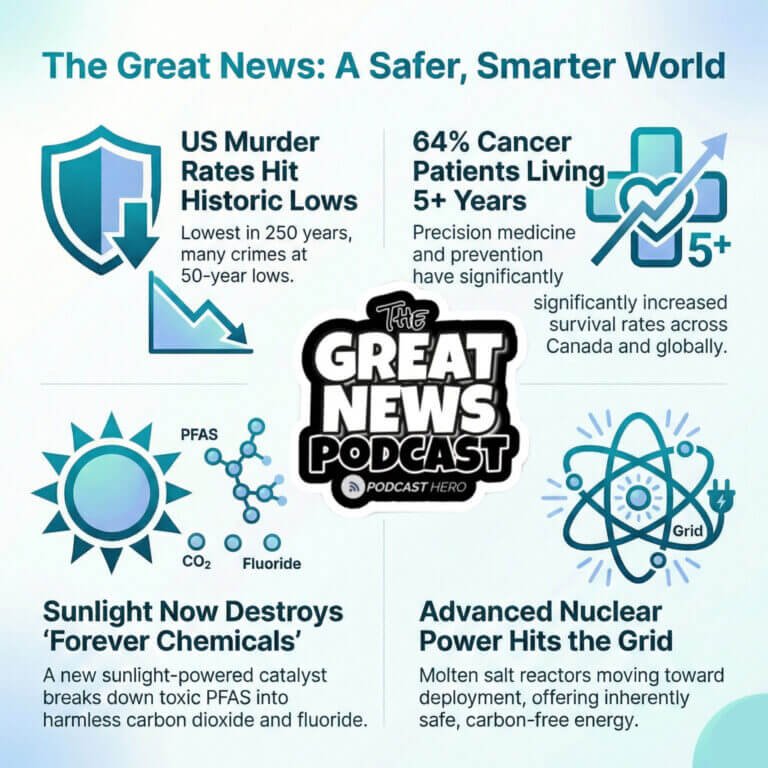
Today we are diving into some truly groundbreaking developments in public safety, medicine, and clean energy.
What if I told you that despite what you see on social media, we are living in one of the safest times in history? That’s our lead story today.
Plus, we have a major update on the fight against cancer, a way to destroy ”forever chemicals” using nothing but sunlight, and a partnership that’s bringing advanced nuclear power to the grid.
America’s Crime Drop Is Real — And That’s Worth Celebrating
Canada’s Improved Cancer Survival Rate
Could Sunlight Be the Answer to “Forever Chemicals”The Next Generation of Nuclear Power Is Getting Closer to Reality
And don't forget to stick around for the speed round, where we'll dive into even more great news.70 People, 3,000 Cars: What Waymo Just Revealed About the Future of Self-Driving
The Battery Breakthrough Hidden in Plain Sight, Water
The Macrophages that could help fight Type 2 Diabetes
Making Hydrogen with Sun and Water?
And don't forget to follow the Daily Quote podcast. Kickstart Your Day in a Positive Way!
Source: Interesting Engineering