

Welcome to the Daily Quote, the podcast designed to kickstart your day in a positive way. I'm Andrew McGivern and this episode is brought to you by the Great News podcast… because good news should be heard. The link is in the show notes.
Today's quote comes from Naval Ravikant, entrepreneur, angel investor, co-founder of AngelList, and one of the most original and deep thinkers in the world of business and philosophy. A man who has a rare gift for taking a widely accepted idea and flipping it in a single sentence. He once said:
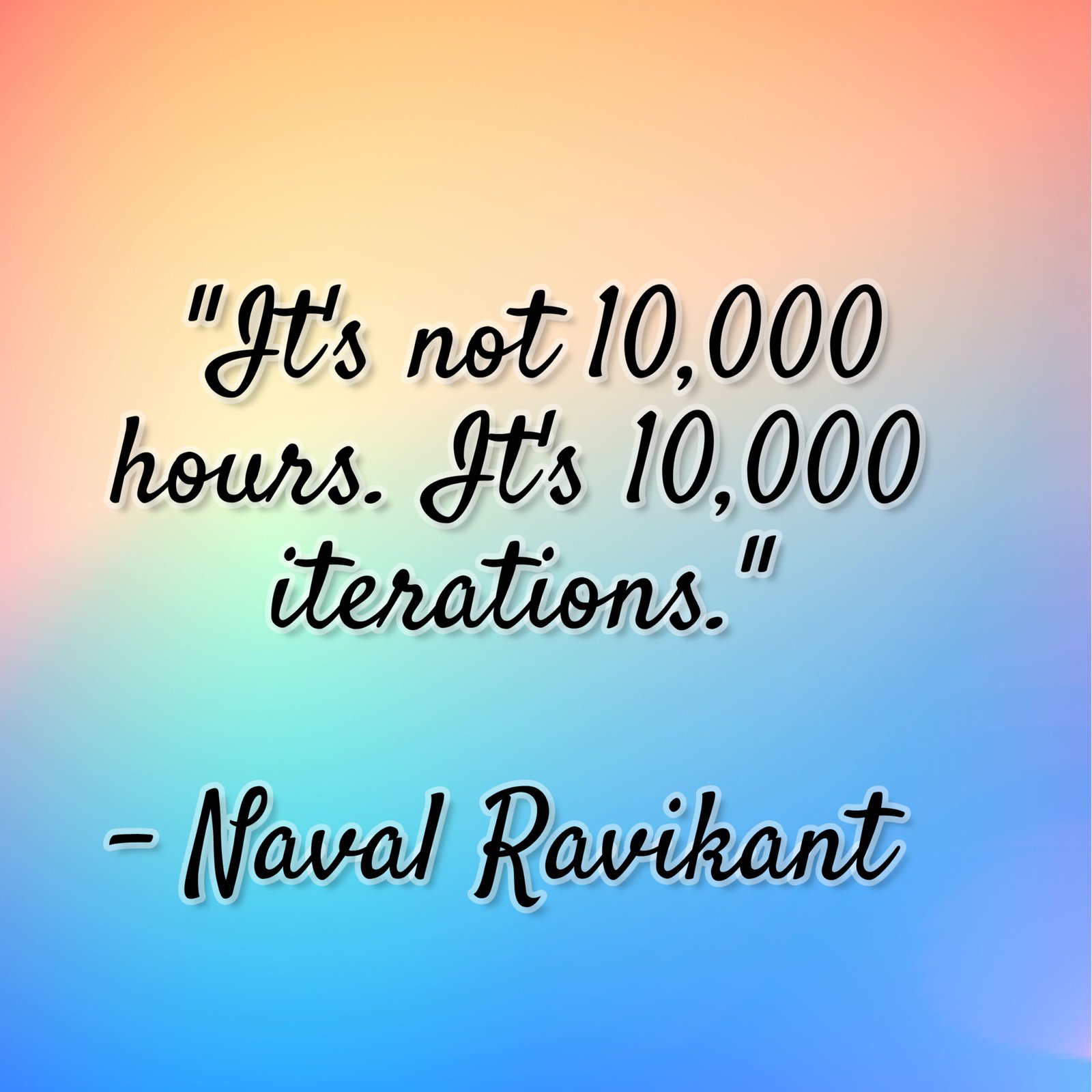
”It's not 10,000 hours. It's 10,000 iterations.”To understand why that's so significant, you need to know what he's pushing back against.
In his book Outliers, Malcolm Gladwell popularized what became known as the 10,000-hour rule, the idea that to achieve world-class expertise in any skill, you need to accumulate 10,000 hours of deliberate practice.
He pointed to the Beatles logging 10,000 hours of live performance and Bill Gates spending 10,000 hours programming before the age of 13. The message was galvanizing: greatness isn't a gift. It's a volume of practice. Put in the hours, and mastery follows.
It's a compelling idea but it's missing something critical.
You can't get to the next level in your career, your craft, or your life by just doing the same things over and over. Do what you've always done, get what you always got. Hours spent repeating the same mistakes, cementing the same patterns, practicing the same flaws… those hours don't produce mastery. They produce highly skilled mediocrity. The pianist who practices the wrong technique for 10,000 hours doesn't become a master. They become someone who has deeply embedded a limitation.
What Naval is pointing at is the difference between passive repetition and active iteration. An iteration isn't just another attempt. It's an attempt followed by honest assessment on what worked, what didn't, what needs to change and then a deliberately adjusted next attempt. The feedback loop is everything. Without it, practice is just going through the motions.
Think about how this plays out across any craft. The writer who produces 10,000 words and reads none of them back grows slowly. The writer who produces 1,000 words, studies them ruthlessly, identifies what's weak, and rewrites with that knowledge, that writer grows fast. The entrepreneur who launches a business and never examines why it's struggling doesn't learn anything. The one who treats every failed campaign as data, every customer conversation as a signal, every stumble as a course correction, that person compresses years of learning into months.
Since time is constant, optimizing for mastery happens when you reduce the interval between iterations, not when you maximize the time spent on each one. Speed of learning beats length of effort. And speed of learning comes from the quality of the feedback loop you build around your practice. So here's the question: In the skill, the project, the craft you're currently building, are you just accumulating hours? Or are you completing iterations?Because the hours will pass regardless. Time is the one thing everyone has on a daily basis. What's rarer is the discipline to stop, assess honestly, adjust deliberately, and go again with that knowledge in hand.10,000 iterations. Each one a little smarter than the last.That's not just how you get good. That's how you get great.
That's it for today. I'm Andrew McGivern — I'll see you in the next one with another Daily Quote.