
Light Speed Ahead:
We’ve all been there — buffering screens, dropped video calls, and sluggish downloads in a house full of devices all fighting over the same Wi-Fi signal. It’s a frustration that’s only going to grow as our hunger for bandwidth keeps increasing. But a team of researchers from the University of Cambridge may have just found a remarkably elegant fix: ditch the radio waves, and use light instead.
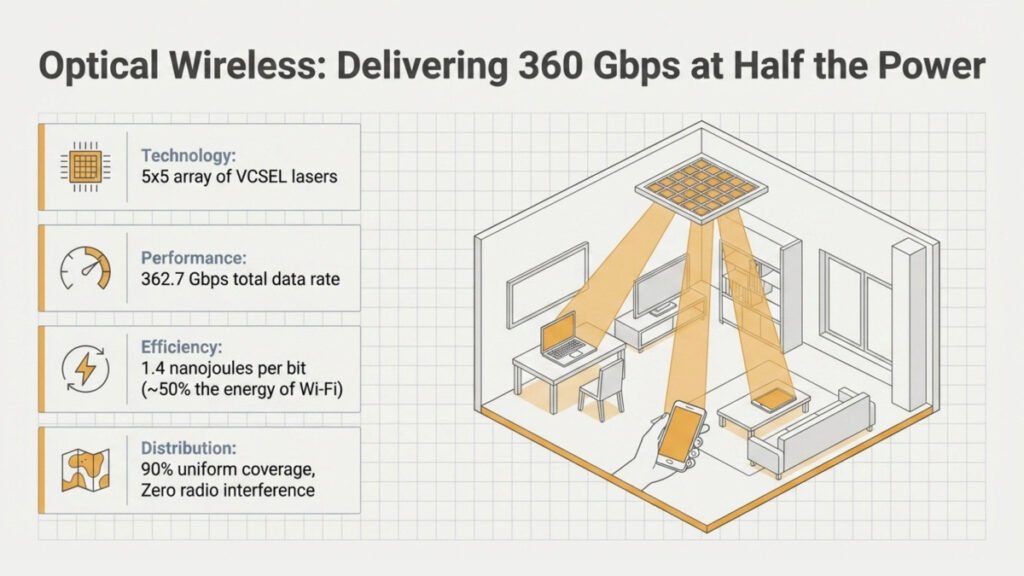
Their new system is built around a chip barely a millimeter in size, packed with a 5×5 grid of 25 microscopic lasers called VCSELs (vertical-cavity surface-emitting lasers). Each laser operates independently, carrying its own dedicated stream of data simultaneously. The result? In testing over a short indoor link, the setup reached more than 360 gigabits per second, a speed that makes even the fastest home Wi-Fi look like dial-up.
But raw speed isn’t even the most impressive part. The system consumes approximately 1.4 nanojoules per bit which is about half the energy of traditional Wi-Fi. That’s a meaningful leap at a time when the global energy footprint of our connected devices is a genuine concern.
So how does it work? A custom optical setup shapes each beam into a defined square, limiting overlap so multiple links can run side by side without interference. Unlike radio waves that scatter in every direction and compete with each other, light can be aimed with precision, making it ideal for dense environments like offices, hospitals, and data centers.
The bottleneck in testing turned out to be the receiver hardware, not the transmitter itself, meaning even higher speeds are likely on the horizon as components improve.
Of course, this isn’t a signal to throw out your router just yet. Researchers emphasize that optical wireless technology is not meant to replace Wi-Fi or cellular networks — instead, it can work alongside them, handling high-capacity data traffic in indoor environments and reducing congestion on radio-based systems. Think of it as a turbo lane on a highway, not a whole new road.
Looking ahead, similar systems could be built into ceilings, lighting fixtures, or wireless access points, delivering fast, secure, and energy-efficient connections to many users simultaneously.
The future of connectivity might not be in the airwaves at all — it might be riding beams of light you can’t even see. And honestly? That future sounds pretty bright.
This topic is covered in Great News podcast episode 39.

The Great News Podcast is your source for positive news, inspiring stories, and good news from around the world. We skip the doom and gloom of mainstream media to focus on scientific breakthroughs, environmental wins, and the inspiring news that proves the world is getting better. Join Andrew McGivern for a dose of optimism and uplifting stories that will change your perspective on human progress.
It is easy to find the
Keep looking for the good in the world, because it is not only there – its everywhere.
The Great News podcast is brought to you by the Daily Quote.
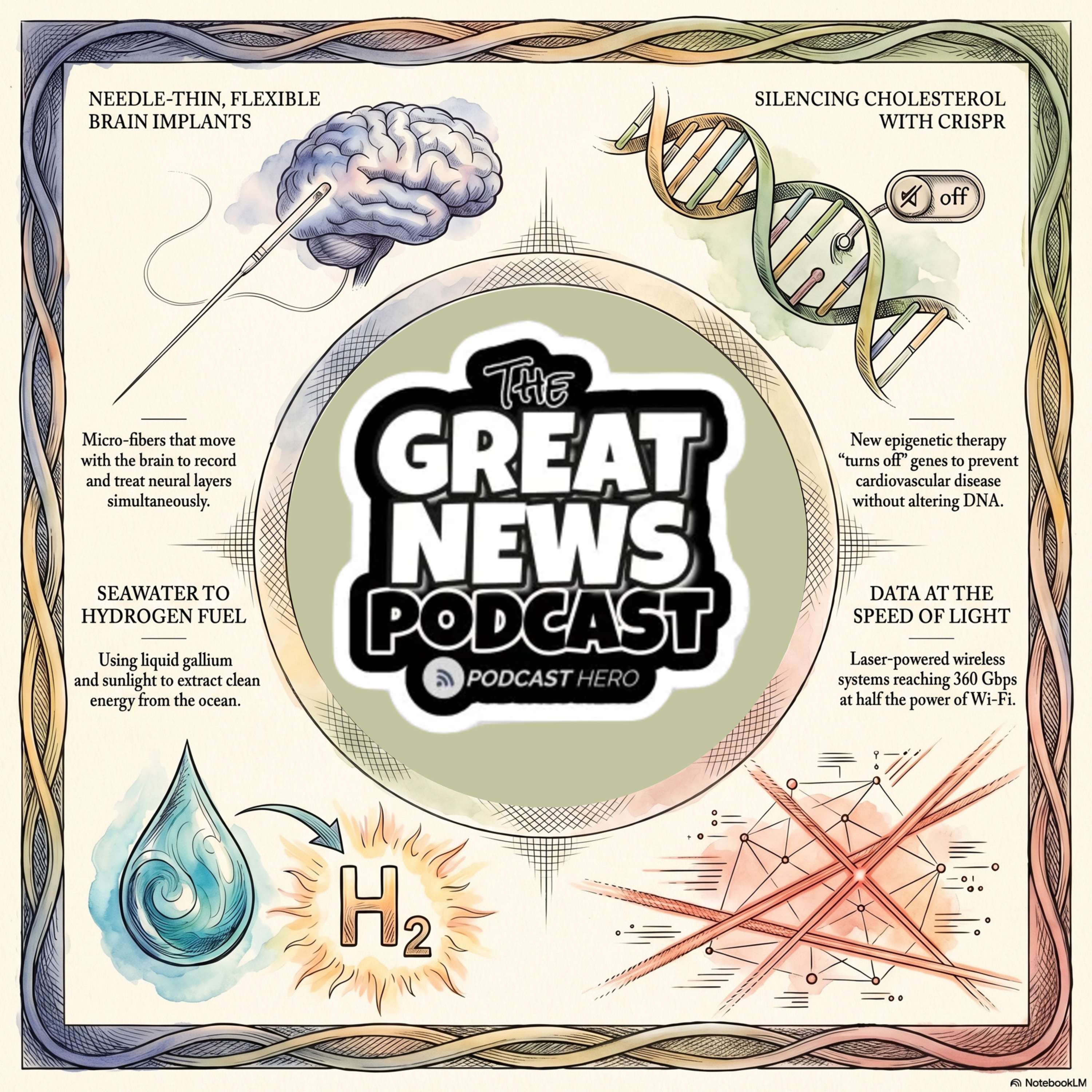
Today, a discovery that could turn our oceans into a source of clean, green fuel. That's our lead story today.
Plus, we’ll look at a ”molecular staple” for hard-to-treat cancers, a way to silence cholesterol without permanently altering your DNA, and a wireless system that’s twice as efficient as Wi-Fi.
Turning Sunlight and Seawater into Hydrogen
How Stapled Peptides Could Change Cancer Treatment
How Laser Tech Is Rewriting the Rules of WirelessAnd don’t forget to stick around for the speed round where we’ll celebrate a historic victory against an ancient disease.Chile Eliminates Leprosy
Revolutionizing Brain Research and Treatment!
How CAR T Therapy Is Learning to Fight Cancer Smarter
If you like the Great News Podcast, you will love the Great News Letter. Because the Great News Podcast is Great but the Great News Letter is Greater!
The Great News Letter is an email newsletter that you can subscribe to for FREE and get all the good news delivered to your email inbox.
For this episode we got some feedback from Brian de V. You can leave feedback for the show too by going to greatnewspodcast.com/feedback.
Or if you listen in Spotify – leave a comment right there as you listen.
Until next time… and there will be a next time.
Keep looking for the good in the world because no only is it there, its everywhere!
Source: ScienceDaily