

Welcome to the Daily Quote, the podcast designed to kickstart your day in a positive way. I'm your host Andrew McGivern and this episode is brought to you by the Great News podcast. To listen find the link in the show notes.
Today's quote comes from Aristotle, Greek philosopher, student of Plato, teacher of Alexander the Great, and one of the most consequential thinkers in the history of Western civilization. A man who wrote about everything from biology to politics to poetry, and who considered friendship so essential to the good life that he dedicated two entire sections of his masterwork Nicomachean Ethics to it.
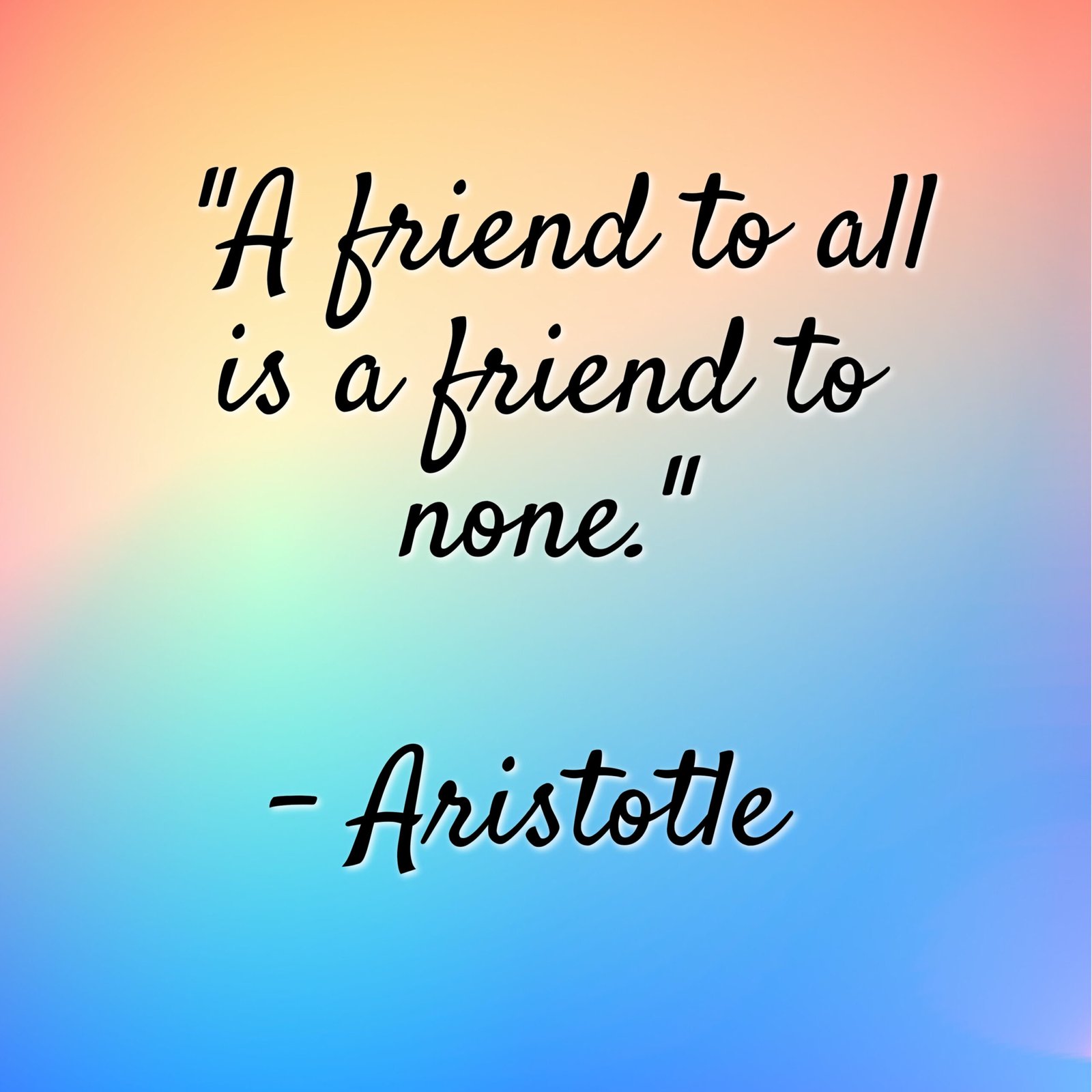
From that work, written 2,300 years ago, he said:
”A friend to all is a friend to none.”
These words land differently depending on which side of the social media age you're reading them from.
To understand what Aristotle meant, you need to know that he didn't see friendship as a single thing. He argued that friendships are built on one of three foundations: utility, pleasure, or virtue.
Friendships of utility are built on what each person gets from the other, the colleague, the contact, the connection who is useful to know. Friendships of pleasure are built on enjoyment, the people who make you laugh, who you have fun with, whose company feels good. Both are real. Both have value. But both, Aristotle observed, are conditional. They last as long as the utility or the pleasure does and when those change, so does the friendship.
Then there is the third kind. The friendship of virtue, the truest kind built on a mutual appreciation for who the other person actually is.
A genuine desire for the other's wellbeing, not for what they provide or how they make you feel, but simply for their own sake. These are the friendships that survive difficulty, distance, and time. The ones where the other person knows the full picture of you and chooses to stay.
And here is Aristotle's point: a friend to all is a friend to none, because we cannot prioritize everyone. The closest friends strive to be there at the important moments of each other's lives, even if this means letting other people down. Deep friendship requires something scarce, your real attention, your genuine investment, your willingness to show up for this person specifically when you could be showing up for anyone.
The person who distributes that quality of presence across hundreds of relationships has, by mathematical necessity, given none of them enough. Aristotle said it himself: ”We must be content if we find a few such.”
Quality over quantity, not as a preference, but as a structural truth about what deep friendship actually requires.
Now consider what he would make of a world where a person can have five thousand Facebook friends, ten thousand Instagram followers, and still feel profoundly, inexplicably alone. The number of connections has never been higher. The depth of those connections has never been more diluted.
Aristotle identified the trap 2,300 years before the algorithm was invented and he described it perfectly.
So here's the question — and it's worth asking honestly: Of all the people in your life you call friends, how many of them know your full story? How many have your back when you need them? And how many are you there for?
Because Aristotle's point isn't that you should be unfriendly to the world. It's that the word friend has a depth to it that gets lost when it's applied to everyone and that the rarest and most valuable thing you can offer another human being is the kind of friendship that costs you something. Your time. Your honesty. Your genuine, non-diluted presence.
Be warm with everyone. But be a real friend to a few.
That's it for today. I'm Andrew McGivern — I'll see you in the next one with another Daily Quote.