Molten Salt Reactors That Don’t Melt Down
A major new partnership between Oak Ridge National Laboratory (ORNL) and nuclear startup Kairos Power is bringing advanced molten salt reactors one step closer to your power grid — and it could help reshape how America generates clean electricity.
A $27 Million Bet on the Future of Nuclear
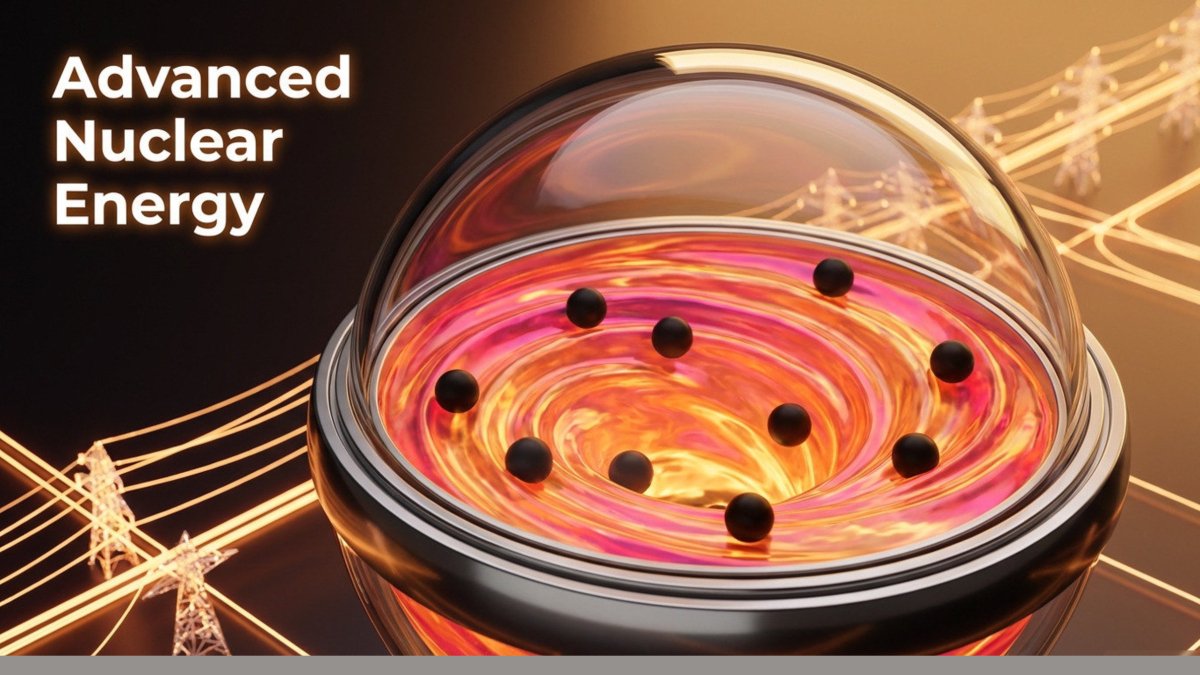
ORNL and Kairos Power have launched a $27 million collaboration aimed at accelerating the deployment of a novel reactor design called the fluoride salt-cooled high-temperature reactor (KP-FHR). Unlike conventional nuclear plants that use water as a coolant, this reactor uses molten fluoride salt — a shift that allows it to operate at higher temperatures while maintaining strong inherent safety characteristics.
At the heart of the design are TRISO fuel pebbles: tiny, specially engineered fuel particles built to withstand extreme heat without melting or breaking down. Think of them as the nuclear world’s answer to a nearly indestructible fuel source.
What Makes This Partnership Different
The collaboration isn’t just about building a reactor — it’s about solving the hard engineering problems that stand between a promising design and a working power plant. Researchers will study how ceramics and carbon composites hold up against highly corrosive salts at extreme temperatures, develop remote maintenance systems that can operate under radiation exposure, and figure out how to manage spent fuel pebbles safely and efficiently.
Crucially, the project is also tapping into cutting-edge manufacturing techniques. Advances in 3D printing and additive manufacturing are being integrated into the reactor’s component production, pushing the boundaries of what’s been possible with nuclear hardware.
Fuel Security: A Key Piece of the Puzzle
One of the biggest hurdles for next-generation reactors has been fuel supply. Kairos Power recently finalized an agreement with the Department of Energy to secure High-Assay Low-Enriched Uranium (HALEU) — a fuel enriched between 5% and 20% that’s required for the compact, efficient designs of advanced reactors. The company will manufacture its own TRISO fuel pebbles in partnership with Los Alamos National Laboratory.
Combined with $303 million in risk-reduction funding from the DOE’s Advanced Reactor Demonstration Program, these moves signal serious momentum behind getting the technology to commercial maturity.
A Landmark Already Underway
The ultimate goal is to support the Hermes 1 demonstration reactor, currently under construction in Oak Ridge, Tennessee. It holds a notable distinction: it’s the first non-light-water reactor design to receive construction approval from the US Nuclear Regulatory Commission, with safety-related construction having begun in May 2025.
East Tennessee is quietly becoming the nuclear capital of the world, hosting the largest concentration of nuclear science collaborations globally, involving the University of Tennessee, the Tennessee Valley Authority, and a growing roster of industry players.
Why It Matters Now
With energy demand projected to surge significantly by 2050 — driven by manufacturing growth, AI data centers, and electrification — the need for reliable, carbon-free baseload power has never been more urgent. Molten salt reactors, if they can be successfully commercialized, offer a compelling answer: safer by design, more efficient than legacy nuclear, and capable of running around the clock regardless of weather.
The race to next-generation nuclear is on. And if partnerships like this one are any indication, the finish line may be closer than many people think.
This topic was featured in Great News podcast episode 33.

The Great News Podcast is your source for positive news, inspiring stories, and good news from around the world. We skip the doom and gloom of mainstream media to focus on scientific breakthroughs, environmental wins, and the inspiring news that proves the world is getting better. Join Andrew McGivern for a dose of optimism and uplifting stories that will change your perspective on human progress.
It is easy to find the
Keep looking for the good in the world, because it is not only there – its everywhere.
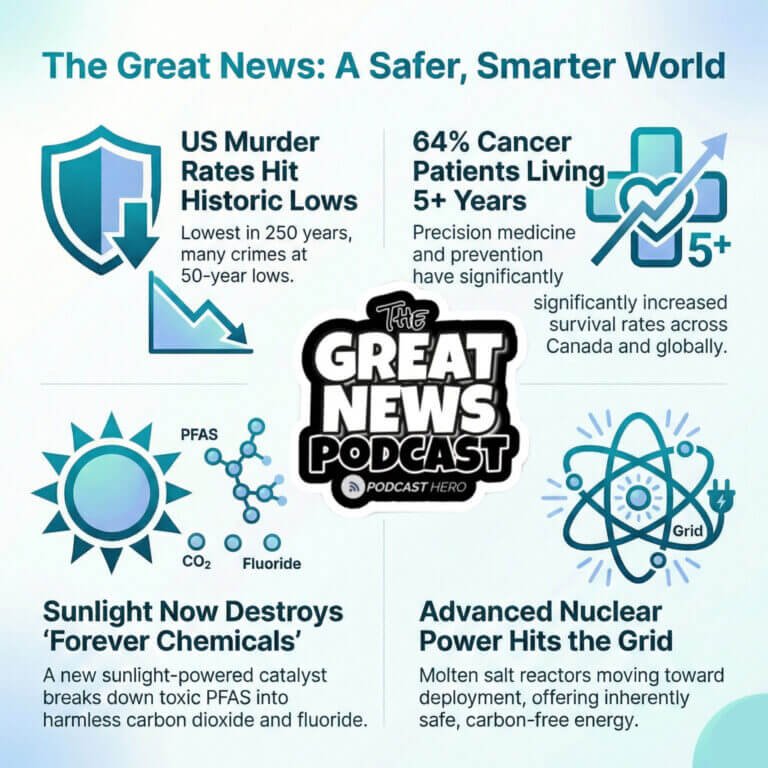
Today we are diving into some truly groundbreaking developments in public safety, medicine, and clean energy.
What if I told you that despite what you see on social media, we are living in one of the safest times in history? That’s our lead story today.
Plus, we have a major update on the fight against cancer, a way to destroy ”forever chemicals” using nothing but sunlight, and a partnership that’s bringing advanced nuclear power to the grid.
America’s Crime Drop Is Real — And That’s Worth Celebrating
Canada’s Improved Cancer Survival Rate
Could Sunlight Be the Answer to “Forever Chemicals”The Next Generation of Nuclear Power Is Getting Closer to Reality
And don't forget to stick around for the speed round, where we'll dive into even more great news.70 People, 3,000 Cars: What Waymo Just Revealed About the Future of Self-Driving
The Battery Breakthrough Hidden in Plain Sight, Water
The Macrophages that could help fight Type 2 Diabetes
Making Hydrogen with Sun and Water?
And don't forget to follow the Daily Quote podcast. Kickstart Your Day in a Positive Way!
Source: Interesting Engineering