A mini heart on a chip…
Every year, cardiovascular disease claims more lives than any other condition on the planet. It’s a problem that has humbled medicine for generations, partly because testing how a human heart responds to a drug or disease, without putting a real patient at risk, has always been extraordinarily difficult. A remarkable new development out of Canada suggests that may be about to change.
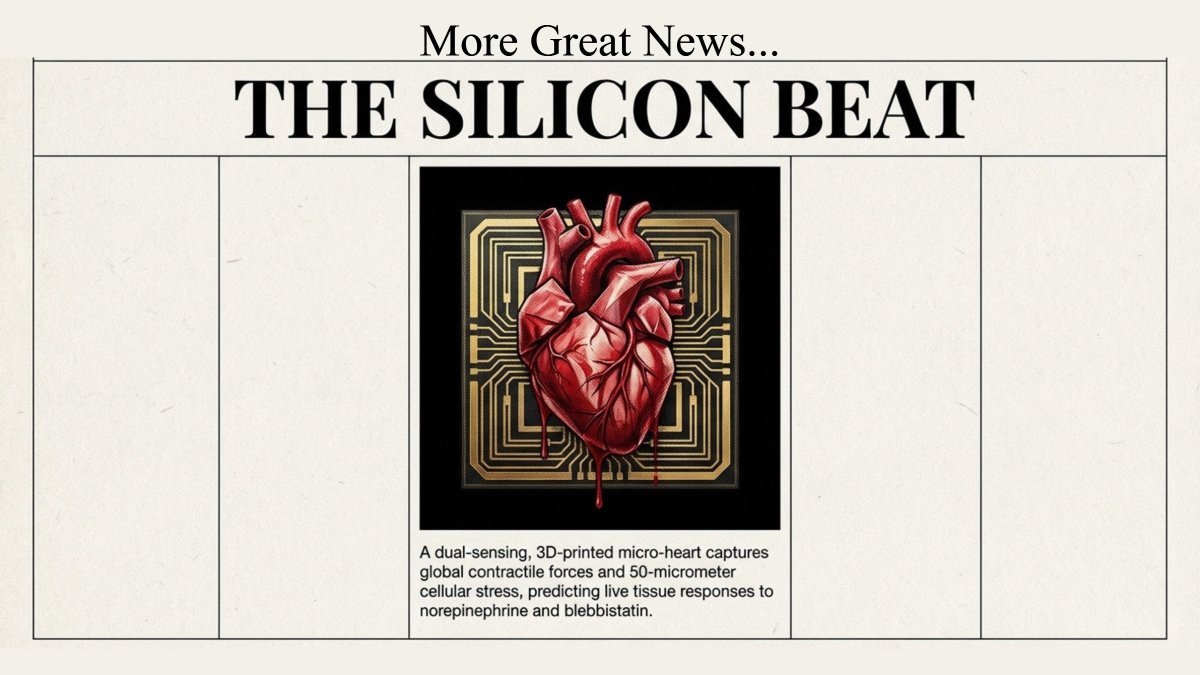
Scientists have engineered a three-dimensional “heart-on-a-chip” (HOC), a small device containing living cardiac tissue that beats on its own, mobilizes calcium to trigger muscular activity, and responds predictably to common drugs. What makes this version especially significant is that it’s the first to incorporate a dual-sensing platform that provides real-time tracking of activity throughout the heart tissue down to the cellular level.
How Does It Work?
The researchers harvested cardiac muscle cells and cardiac connective tissue cells from rats, inserting them into a gel-like matrix rich in fibrous proteins and nutrients to stimulate growth, then seeded them on tiny, flexible silicon-based chips. Science Alert
To capture what’s happening inside the tissue at two different scales, the team embedded two types of sensors. To measure large-scale forces, they sandwiched the engineered heart tissue between two elastic pillars that deform with each heartbeat, the amount of deformation corresponding to the contractile strength throughout the tissue. For finer detail, flexible, hydrogel-based microsensors, averaging just 50 micrometers in size, were immersed within the tissue to capture local mechanical stresses at the cellular level.
This cellular resolution matters enormously, because many cardiovascular diseases are associated with dysfunction in cardiomyocytes, the individual contractile cells that form heart muscle tissue.
Putting It to the Test
To see whether the chip could reliably predict drug responses, the researchers applied two well-studied compounds. One was norepinephrine, which increases heart activity, and the other was blebbistatin, which suppresses it. Both drugs worked as predicted, demonstrating that the HOCs can forecast how cardiac force generation and heart rhythms respond to common compounds.
As lead author Ali Mousavi put it, “the ability to observe the tissue’s response to different compounds in real time represents a major advantage for preclinical development and translational research.”
What Comes Next?
The team’s ambitions go well beyond the lab bench. They plan to simulate specific disorders by building heart tissues using cells from patients living with various cardiac conditions, including dilated cardiomyopathy and arrhythmias.
The longer-term vision is one of true personalized medicine. Senior author Houman Savoji describes the goal as “giving us the ability to identify the most effective medication for each person before treatment is even administered.”
In other words, rather than prescribing a heart medication and hoping it works, a doctor might one day run the trial first, on a chip grown from the patient’s own cells. It’s a future worth beating for.
This topic was featured on Great News podcast episode 37.
Source: Science Alert