Printing Beneath the Waves
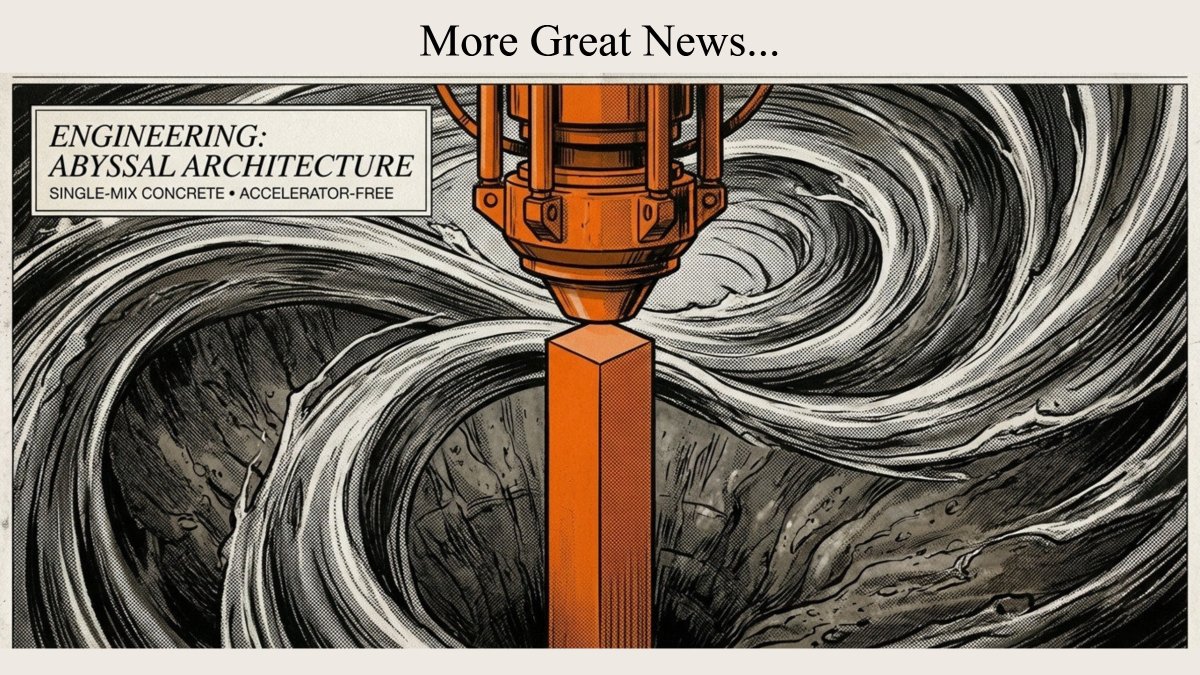
Construction has always stopped at the water’s edge… until now. Australian researchers have achieved a genuine engineering first: a 3D concrete printing system that works fully submerged, no chemical tricks required.
The breakthrough comes from a collaboration between the University of Wollongong (UOW) and Melbourne-based construction tech firm LUYTEN 3D. Their system is capable of building stable structures underwater without chemical accelerators or additives, something that has never been demonstrated before.
So what’s the big deal about skipping the chemicals? Traditional underwater concrete work typically depends on multi-stage processes or rapid-setting chemical additives to prevent fresh concrete from washing out in moving water. These additives add cost, complexity, and environmental risk to every subsea project. The UOW-LUYTEN team sidestepped all of that by engineering the concrete itself differently. Their single-mix formulation maintains stability underwater through smart material design alone, resisting washout and maintaining structural integrity during printing.
Project lead Dr. Aziz Ahmed put it plainly: “Our trials confirm that our single-mix solution is not just theoretically sound but practically viable.”
The real excitement, though, is in what this makes possible. The technology has immediate applications in defense, ports, and coastal infrastructure, including the AUKUS submarine program and the construction of sustainable anchors for floating offshore wind farms. As offshore wind energy scales up globally, the ability to build and repair foundations directly on the seabed, cheaply and without a fleet of specialist vessels, could be transformative.
LUYTEN 3D’s CEO Ahmed Mahil framed it as a fundamental shift in how engineers think about building: “Underwater 3D printing allows us to address infrastructure resilience where it’s needed most, below the surface, whether that’s ports, wharves, defense applications, or other subsea assets.”
And the team isn’t stopping there. Researchers see the system as a platform for future innovation, including construction techniques for extraterrestrial environments. If you can print concrete at the bottom of the ocean, the moon’s surface starts to look a little less daunting.
For decades, the deep has been a place humans could visit but not really build in. That may be changing, one printed layer at a time.
This topic was featured on Great News podcast episode 37.
Source: Interesting Engineering