What if the best tool for detecting disease was already living inside you?
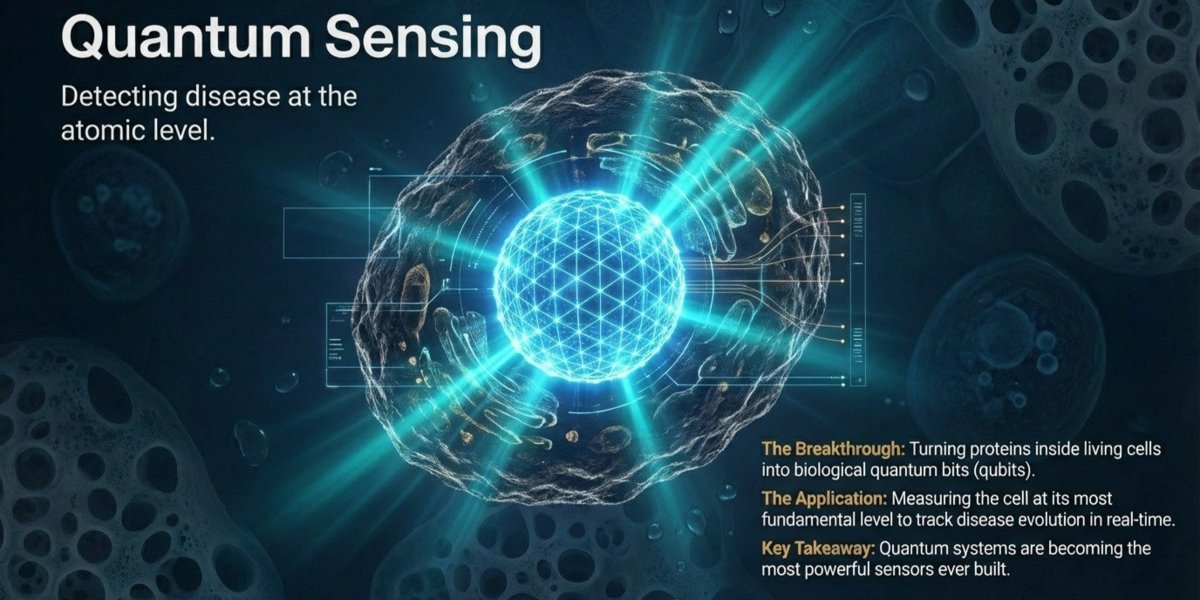
That’s no longer just a futuristic thought experiment. Scientists at the University of Chicago have turned an ordinary protein found in living cells into the world’s first biological quantum bit — a qubit — and the implications for medicine are extraordinary.
From Quantum Computers to Quantum Sensors
Most of us have heard about quantum computing, but the quieter revolution happening right now is in quantum sensing. While quantum computers aim to solve complex calculations, quantum sensors exploit the same quantum properties — extreme sensitivity to the surrounding environment — to measure things that were previously unmeasurable.
Peter Maurer, an assistant professor at UChicago’s Pritzker School of Molecular Engineering, describes it simply: a qubit is a quantum system that can exist in two states at once, and because of that, it is exquisitely sensitive to disturbances around it — magnetic fields, electric fields, temperature, forces. Point that sensitivity inward, into a living cell, and suddenly you have a tool capable of detecting the molecular fingerprints of disease.
A Sensor the Size of a Molecule
The challenge with earlier quantum sensors was size and placement. Previous approaches used tiny diamond particles injected into cells, but these nanodiamonds were still 10 to 20 times larger than the proteins they were trying to study, and couldn’t be precisely positioned.
Maurer’s team solved this by engineering a qubit directly into a yellow fluorescent protein — a molecule that cells already produce naturally. Because it’s encoded genetically, cells don’t just accept it; they manufacture it and deliver it to exactly the right location inside themselves. The result is a quantum sensor that is molecule-sized, genetically programmable, and placed with atomic precision.
The discovery was named one of the top ten physics breakthroughs of 2025 by Physics World.
Seeing What Was Invisible Before
Current microscopy can tell scientists where a molecule is inside a cell. What it can’t easily tell them is what happened to that molecule — whether a protein has been chemically modified, whether it’s been altered by disease, or whether a drug is actually changing its behavior.
Quantum sensors can detect those differences by reading magnetic signatures at the nanoscale — essentially performing MRI at the level of a single molecule. This could reveal the subtle protein changes that precede diseases like Alzheimer’s long before any symptoms appear, and without destroying the cell to find out.
Maurer’s lab is also developing diamond quantum sensors mounted on surgical and endoscopic tools that could help doctors distinguish cancerous tissue from healthy tissue during procedures, in real time.
A Two-Way Street
Perhaps most intriguingly, Maurer sees this as a relationship that runs in both directions. Biology could help improve quantum technology, not just the other way around. By using evolutionary principles — mutating the gene encoding the protein qubit and selecting for better-performing variants — scientists could let nature optimize quantum systems in ways that deliberate engineering never could.
As Maurer puts it, biology has been running black-box optimization for billions of years. We’re just starting to plug into it.
The Bigger Picture
We are at an early threshold. Quantum sensing is already the most mature branch of quantum technology — atomic clocks built on quantum principles gave us GPS decades ago. Now, the same foundational ideas are being scaled down to the level of a single living cell.
The most exciting applications, Maurer admits, may be ones we haven’t imagined yet. But the path toward earlier disease detection, non-invasive diagnostics, and a deeper understanding of how our cells work — and fail — is becoming clearer. And it starts with a protein that was already there, quietly waiting to become a sensor.
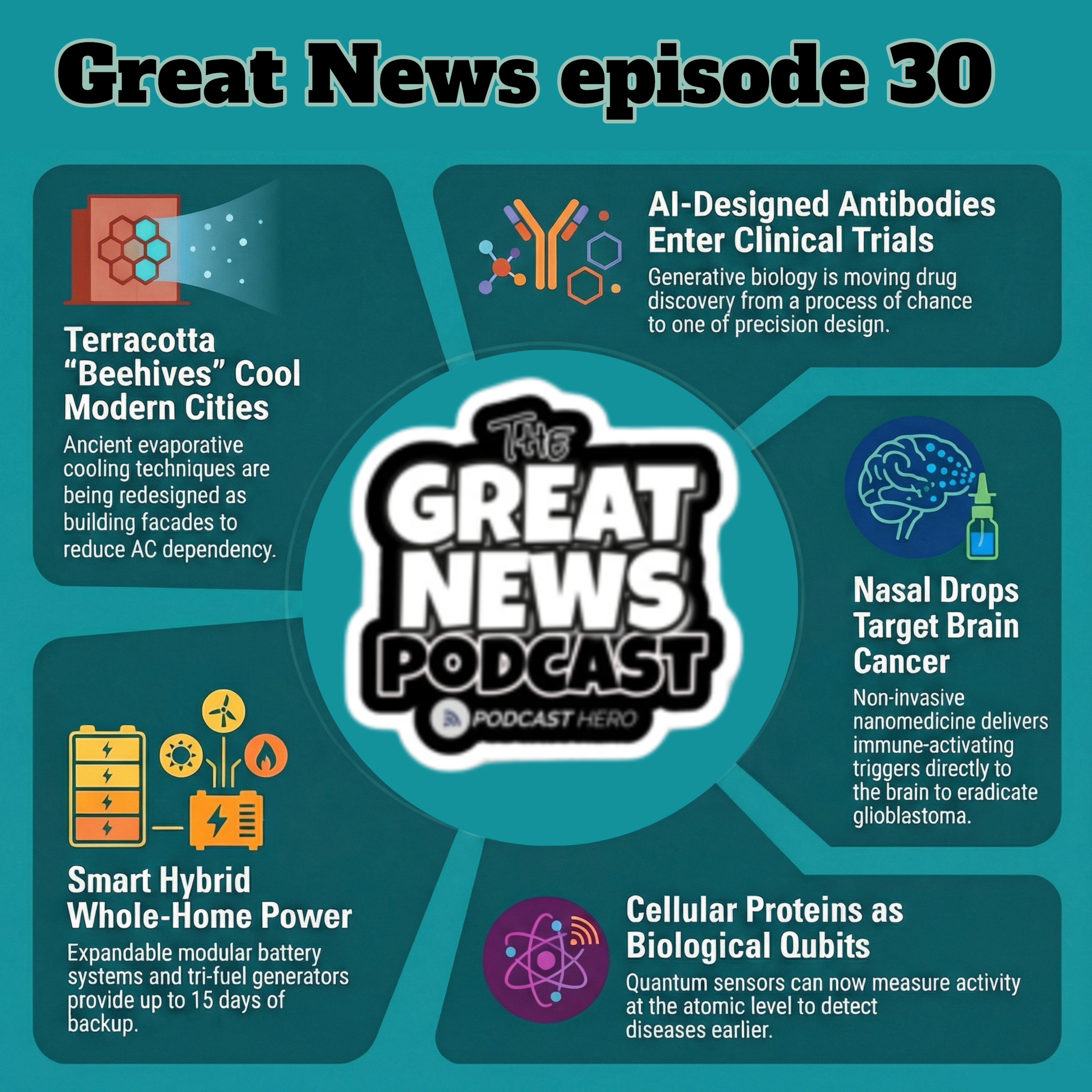
This topic was featured on Great News podcast episode 30.

Because good news should be heard…
Today, we are exploring how artificial intelligence is moving medicine from a game of chance to a masterwork of design. Plus, we’ll look at a cooling system inspired by ancient beehives, a non-invasive nasal drop that could tackle the deadliest brain cancers, and a backup power system that ensures you’ll never even notice a blackout.
How AI Is Reinventing the AntibodyClay, Cool Air, and a 5,000-Year-Old IdeaNasal Nanodrops: A Promising New Weapon Against the Deadliest Brain CancerNever Get Caught in the Dark Again
And stay tuned for our speed round, where we’ll cover everything from quantum biological sensors to the ”switch” that might repair the human liver.
Source: Futurity