We tend to think of ageing as an inevitable biological clock ticking down in the background. But a growing body of research suggests that much of what we experience as ageing — the chronic inflammation, the declining organ function, the increased vulnerability to disease — is driven not by the passage of time itself, but by something more specific: the accumulation of damaged cells that refuse to die.
These are called senescent cells. Rather than clearing themselves away when they become dysfunctional, they linger in tissues and secrete a cocktail of inflammatory signals known as SASP (Senescence-Associated Secretory Phenotype). Over time, as more of these cells build up, they create a low-grade but persistent inflammatory environment that contributes to a wide range of age-related conditions — from arthritis and cardiovascular disease to cognitive decline.
The question researchers have been wrestling with is: how do we get rid of them?
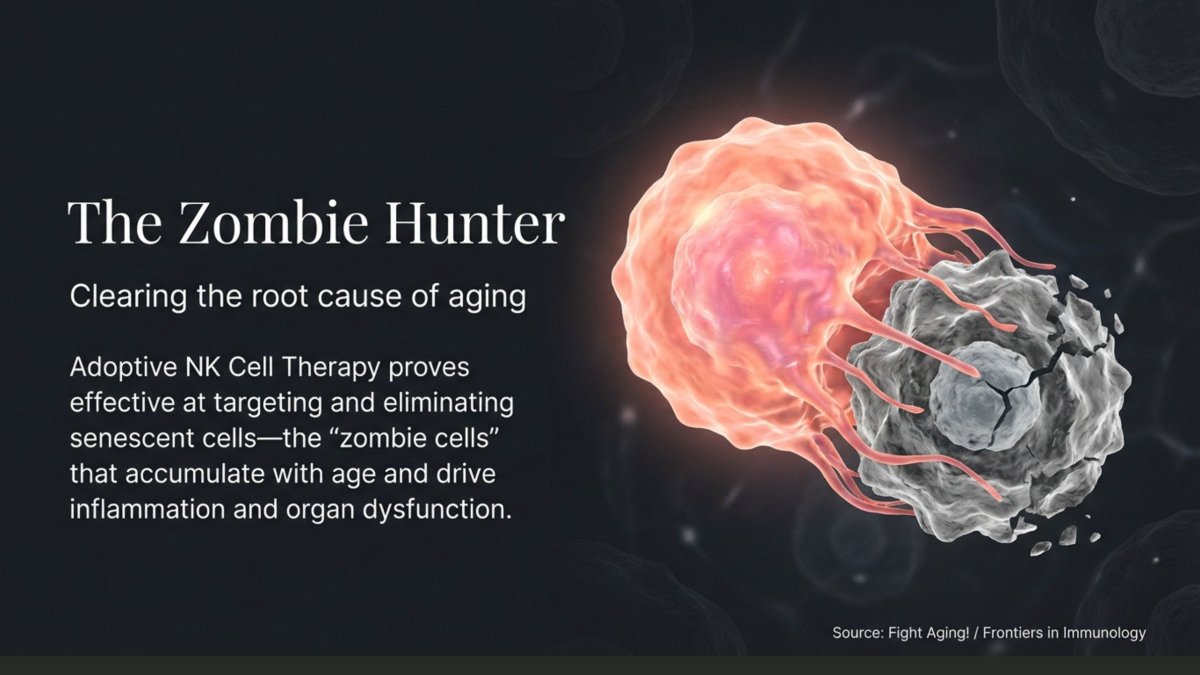
A new avenue of investigation focuses on natural killer (NK) cells — a type of immune cell whose job, among other things, is to identify and destroy senescent cells. NK cells are integral components of the innate immune system, critical for clearing senescent cells, and also for orchestrating broader immune responses to survey and eradicate these compromised cells. Preserving NK cell function throughout the ageing process is considered paramount for mitigating age-associated diseases and promoting robust health in later life.
The challenge is that as we age, our NK cells become less effective — a phenomenon known as immunosenescence. The very cells meant to clear up the problem gradually lose their ability to do so. Adoptive NK cell-based senotherapy — where NK cells are introduced externally to reinforce or replace this declining function — has demonstrated considerable promise in rejuvenating immunosenescence and facilitating the elimination of senescent cells.
In plain terms, the idea is to boost or replenish the body’s own clean-up crew. Rather than developing a chemical drug that hunts down senescent cells, this approach harnesses the immune system’s natural architecture, directing it back towards a task it was already designed to perform — but has been gradually losing the capacity to carry out.
There are legitimate practical challenges to address. Cell-based therapies are expensive and logistically complex compared to, say, a small-molecule drug. Some researchers believe that approaches which retrain or reinvigorate existing immune cells — rather than introducing new ones from outside — may ultimately prove more scalable. Others are exploring senolytic vaccines as an alternative route to the same destination.
But the direction of travel is clear and compelling. The accumulating evidence provides a promising proof-of-concept for adoptive NK cell-based senotherapy, indicating its potential as a significant development in longevity therapeutics.
The implications extend well beyond longevity for its own sake. If we can reduce the burden of senescent cells in aged tissues, we may be able to meaningfully delay or reduce the severity of many of the diseases that define later life. The goal isn’t necessarily to live forever — it’s to spend far fewer years in decline.
Ageing, it turns out, may not be as inevitable as we once thought. It may be something we can learn to clean up after.
This topic was covered in Great News podcast episode 31.

The Great News Podcast is your source for positive news, inspiring stories, and good news from around the world. We skip the doom and gloom of mainstream media to focus on scientific breakthroughs, environmental wins, and the inspiring news that proves the world is getting better. Join Andrew McGivern for a dose of optimism and uplifting stories that will change your perspective on human progress.
It is easy to find the
Keep looking for the good in the world, because it is not only there – its everywhere.
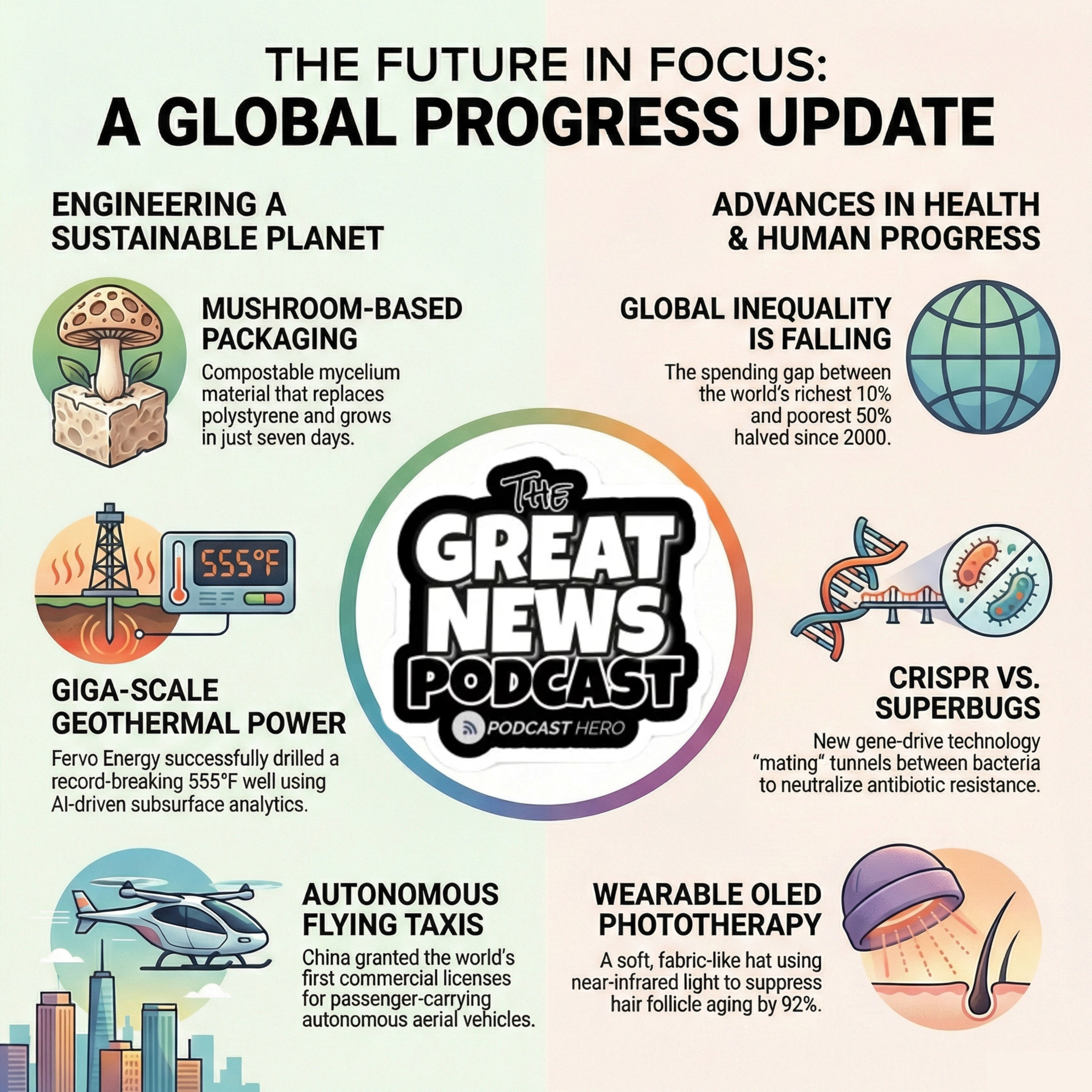
Today we’re diving into some truly groundbreaking advancements in biotechnology, sustainable energy, and global economics. What if we could actually reverse antibiotic resistance in bacteria instead of just trying to keep up with it?
Plus, we have packaging that grows itself from mushrooms, a giga-scale geothermal breakthrough in Utah, and new data showing the world is more equal than you might think.
- What If We Could Teach Bacteria to Forget How to Resist Antibiotics?
- Global Inequality Declines Substantially
- Geothermal Breakthrough
And don't forget to stick around for the speed round where we'll dive into even more great news.
- The Screen Time Panic May Be Missing the Point
- China grants commercial flying taxi licenses
- The Future of Hair Loss Treatment Might Just Be a Hat
- Your Immune System Could Be the Key to Slowing Ageing
- AI has identified 15 new magnetic materials
And don't forget to follow the Daily Quote
Source: Fight Aging!