Magnets are hiding in plain sight in almost every piece of modern technology. They spin the motors in electric vehicles, power the turbines in wind farms, and sit inside the speakers, hard drives, and medical scanners we rely on every day. Yet the most powerful permanent magnets we have are almost entirely dependent on rare earth elements — materials that are expensive, largely imported, and increasingly hard to secure. It’s one of the quietest but most significant bottlenecks in the clean energy transition.
Researchers at the University of New Hampshire may have just found a faster way through it — and the key is AI.
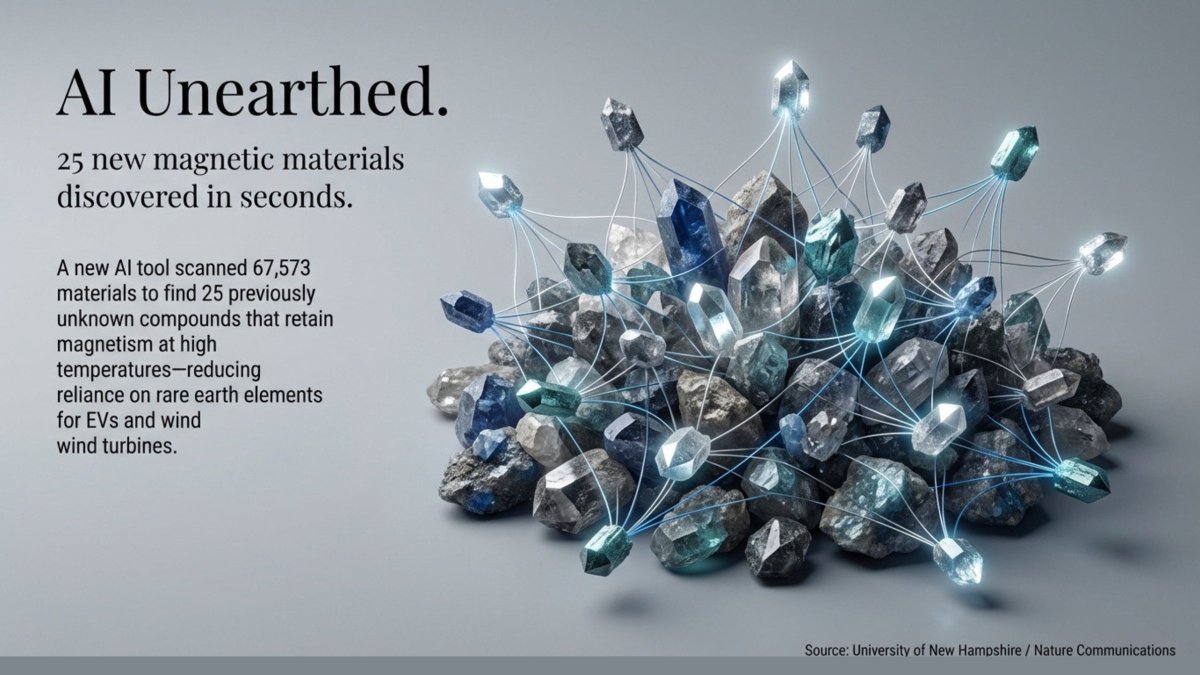
Scientists used artificial intelligence to rapidly scan decades of scientific literature and build a searchable database of 67,573 magnetic materials, including 25 previously unknown compounds that retain their magnetism at high temperatures — a critical requirement for real-world applications. The database, called the Northeast Materials Database, is now available for researchers to explore.
The challenge they were solving is one of sheer scale. Scientists know that many undiscovered magnetic compounds exist, but testing every possible combination of elements — potentially millions — in the lab is prohibitively time-consuming and expensive. The traditional approach to materials discovery can take decades. The UNH team compressed that timeline dramatically by training an AI system to read scientific papers, extract experimental data, and feed it into models that predict whether a material is magnetic and at what temperature it loses that property.
Lead author Suman Itani, a PhD student in physics, noted that collecting this kind of information by hand would take an enormous amount of effort — but their AI system can do it quickly and automatically organise everything into a single, searchable database.
The implications go well beyond academic curiosity. High-performance magnets are essential in many modern technologies, from the motors in electric vehicles to the turbines in renewable energy generators. The ability to identify materials that can operate at high temperatures without relying on rare earth elements could revolutionize these industries. Reducing dependence on rare earths also has significant geopolitical dimensions — much of the global supply is concentrated in a small number of countries, creating real supply chain vulnerability for nations trying to scale up clean energy manufacturing.
What’s particularly exciting about this research is that the 25 newly identified materials are just the beginning. The database provides scientists with a targeted shortlist of candidates for laboratory validation — turning what was once a needle-in-a-haystack problem into something far more tractable. And the AI framework itself could be adapted to other areas of materials science well beyond magnets.
As physics professor Jiadong Zang put it, the team is tackling one of the most difficult challenges in materials science — discovering sustainable alternatives to permanent magnets — and they are optimistic that their experimental database and growing AI technologies will make this goal achievable.
We tend to think of AI’s role in the energy transition in terms of grid optimisation or demand forecasting. But some of its most profound contributions may come from the lab — quietly identifying the materials that will make tomorrow’s clean technology possible.
This topic was covered in Great News podcast episode 31.

The Great News Podcast is your source for positive news, inspiring stories, and good news from around the world. We skip the doom and gloom of mainstream media to focus on scientific breakthroughs, environmental wins, and the inspiring news that proves the world is getting better. Join Andrew McGivern for a dose of optimism and uplifting stories that will change your perspective on human progress.
It is easy to find the
Keep looking for the good in the world, because it is not only there – its everywhere.
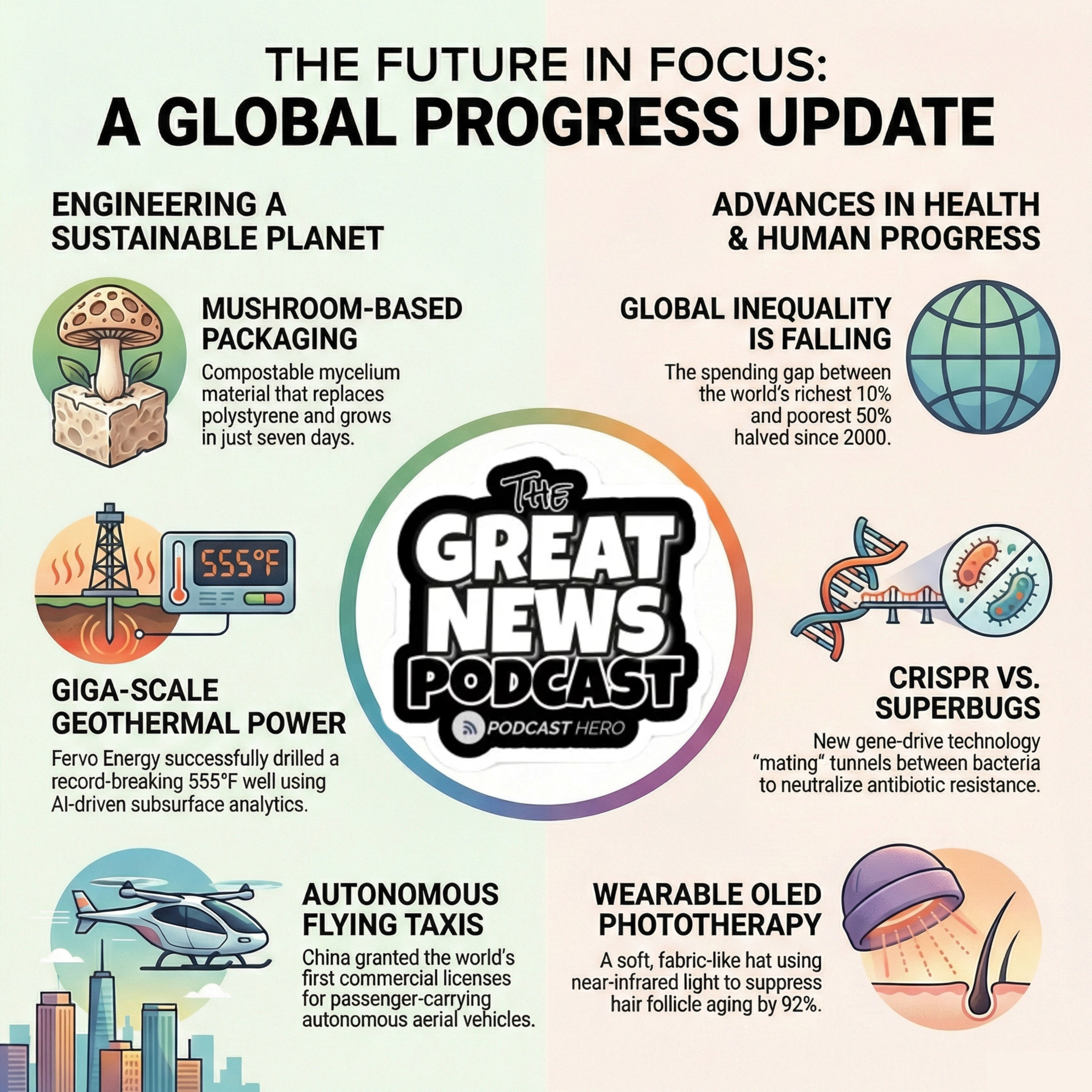
Today we’re diving into some truly groundbreaking advancements in biotechnology, sustainable energy, and global economics. What if we could actually reverse antibiotic resistance in bacteria instead of just trying to keep up with it?
Plus, we have packaging that grows itself from mushrooms, a giga-scale geothermal breakthrough in Utah, and new data showing the world is more equal than you might think.
- What If We Could Teach Bacteria to Forget How to Resist Antibiotics?
- Global Inequality Declines Substantially
- Geothermal Breakthrough
And don't forget to stick around for the speed round where we'll dive into even more great news.
- The Screen Time Panic May Be Missing the Point
- China grants commercial flying taxi licenses
- The Future of Hair Loss Treatment Might Just Be a Hat
- Your Immune System Could Be the Key to Slowing Ageing
- AI has identified 15 new magnetic materials
And don't forget to follow the Daily Quote
Source: SciTechDaily