Ancient Clay, Modern Lifesaver:
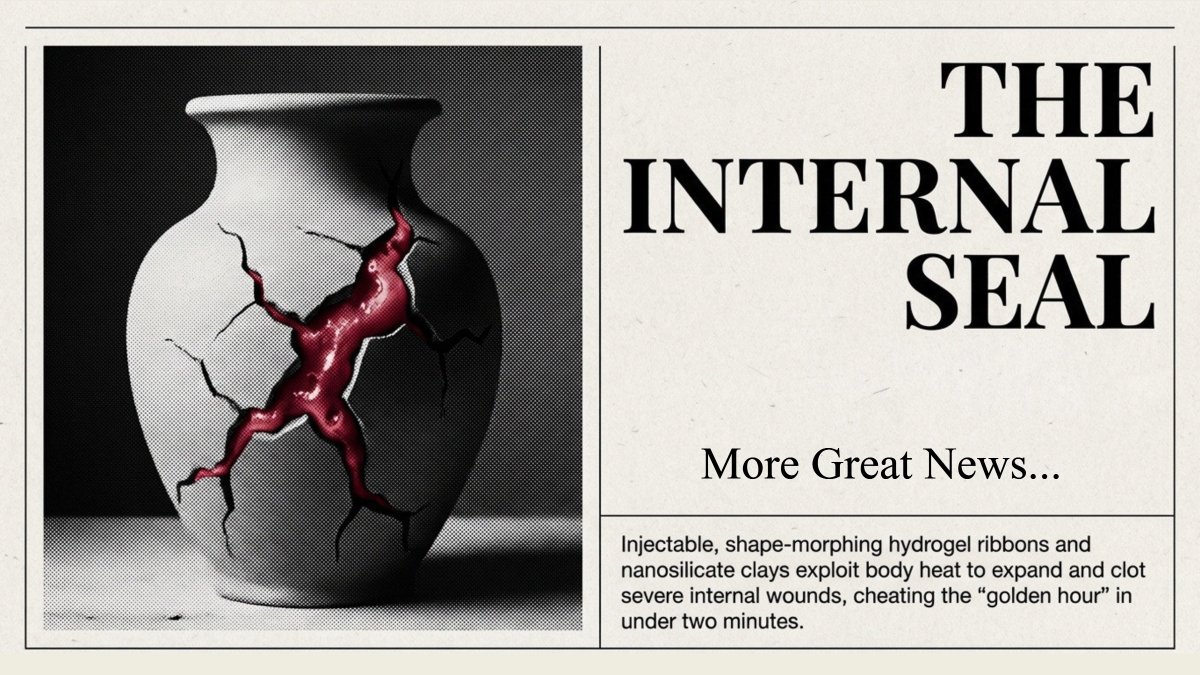
When someone suffers a severe internal injury, time is brutally unforgiving. Severe blood loss can rapidly lead to hemorrhagic shock, and many patients die within one to two hours of an injury, a window doctors grimly call the “golden hour.” Now, researchers at Texas A&M University may have found a way to buy more of that precious time, and the secret ingredient has been hiding in the earth for millennia: clay.
Dr. Akhilesh Gaharwar and his colleagues in the biomedical engineering department are developing a suite of injectable hemostatic bandages — materials that stop bleeding and accelerate clotting — specifically designed for deep internal injuries where traditional methods like compression simply aren’t possible.
What makes this research remarkable is both its simplicity and its roots in history. Certain naturally occurring clay minerals contain silicate-based particles that can speed up blood coagulation, and ancient civilizations in China, Egypt, Greece, and Rome are believed to have used clay pastes on wounds for exactly this reason. The Texas A&M team has taken that ancient wisdom and engineered it into something far more powerful and precise.
Their two approaches are clever. One combines clay nanoparticles with an expanding foam that reacts to body heat — once injected into a wound, it expands to fill the space, sealing severed blood vessels and keeping the clotting particles exactly where they’re needed. The other uses tiny “micro-ribbons” coated in the same nanoparticles, which curl and tangle together upon contact with body heat, forming a foam-like plug at the injury site.
The results so far are striking. These dressings can reduce bleeding time by almost 70%, bringing clotting time down from the normal six to seven minutes to just one to two minutes.
Perhaps most importantly, the goal isn’t just a hospital tool. The researchers envision a device simple enough for a critically injured person to apply themselves in the field — no special apparatus, no surgical training required. Think ambulance first-aid kits and soldiers’ backpacks.
If these materials can save 30 to 40 percent of hemorrhagic shock victims, the researchers believe that would be a major achievement. Given how many trauma deaths come down to those first critical minutes, it’s hard to disagree.
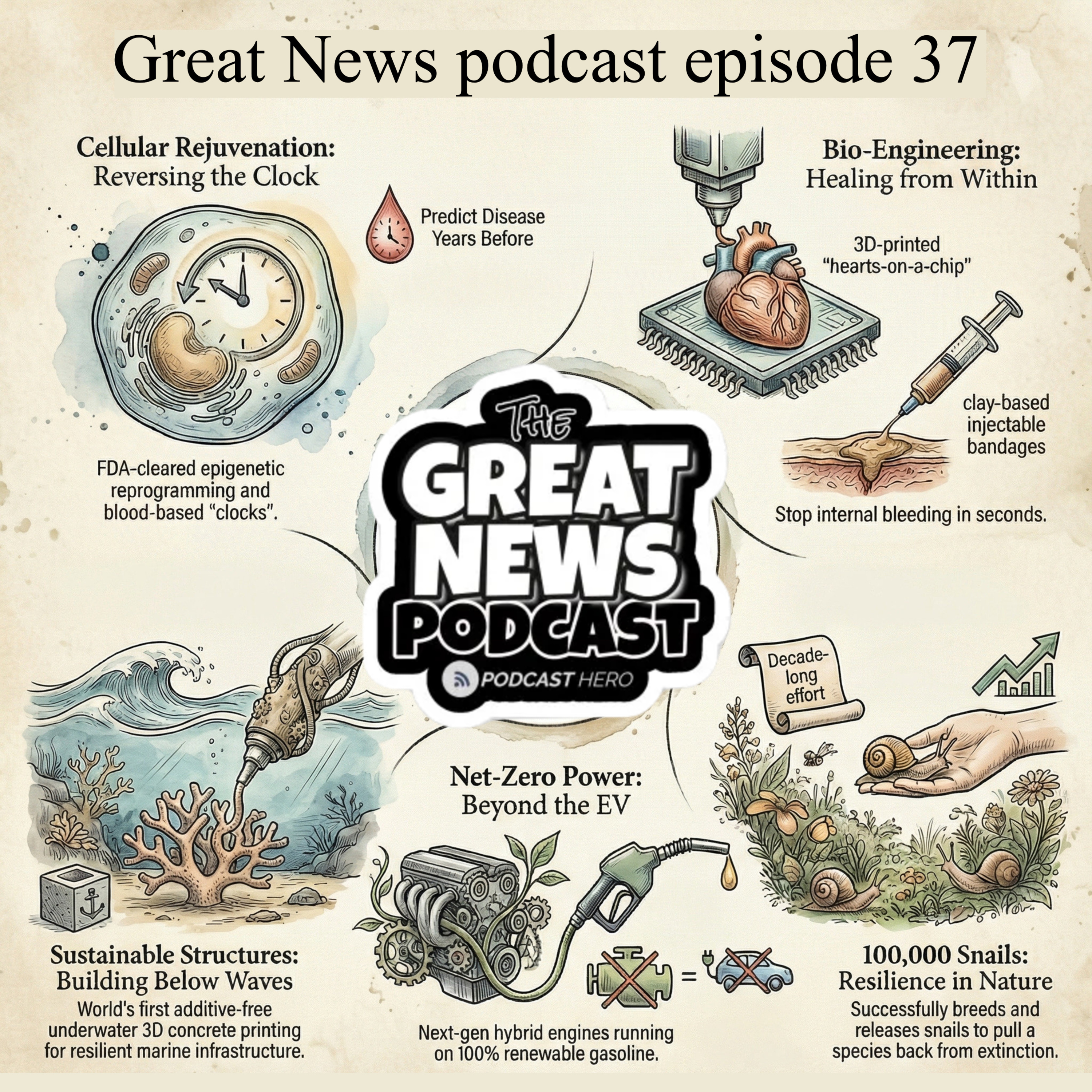
This topic is featured in Great News podcast episode 37.

The Great News Podcast is your source for positive news, inspiring stories, and good news from around the world. We skip the doom and gloom of mainstream media to focus on scientific breakthroughs, environmental wins, and the inspiring news that proves the world is getting better. Join Andrew McGivern for a dose of optimism and uplifting stories that will change your perspective on human progress.
It is easy to find the
Keep looking for the good in the world, because it is not only there – its everywhere.
This episode is brought to you by the Daily Quote. The podcast designed to kickstart your day in a positive way.Today, we’re exploring how scientists are turning back the clock on aging cells, printing infrastructure beneath the ocean waves, and building a ”heart-on-a-chip” to revolutionize medicine.And don't forget to stick around to the end for the speed round for even more great news!The First Epigenetic Reprogramming Therapy Enters Human TrialsThe World’s First Underwater 3D Concrete Printer
The Tiny Chip That Could Change Heart Medicine ForeverThe Horse H12 is a Cleaner Combustion Engine
Alright, Let's dive into the speed round for even more great news:
The greater Bermuda snail, once feared extinct, is officially safe after conservationists bred and released over 100,000 molluscs.
Researchers at Texas A&M have developed clay-based bandages that can be injected into deep wounds to stop severe internal bleeding, reducing clotting time by 70%.
A new blood test can now predict when Alzheimer’s symptoms will begin—with an accuracy within three to four years—long before memory problems appear.
Scientists are testing CAR T cell therapy to target and destroy the amyloid plaques in the brain that cause Alzheimer's, successfully reshaping the immune landscape in preclinical models.
And my favorite quote of the day from the Daily Quote podcast this week is from James Clear who said,
“Every action you take is a vote for the type of person you wish to become.”
Start your day with an inspiring quote every single day with the Daily Quote – available in your favourite podcast app.
From rejuvenating cells to printing structures underwater, today’s stories prove that those seeds of innovation are growing into a brighter world.
I’m Andrew McGivern, and until next time, and there will be a next time, keep looking for the good in the world, because it’s everywhere.
Source: News-Medical