A Historic Win for Public Health:
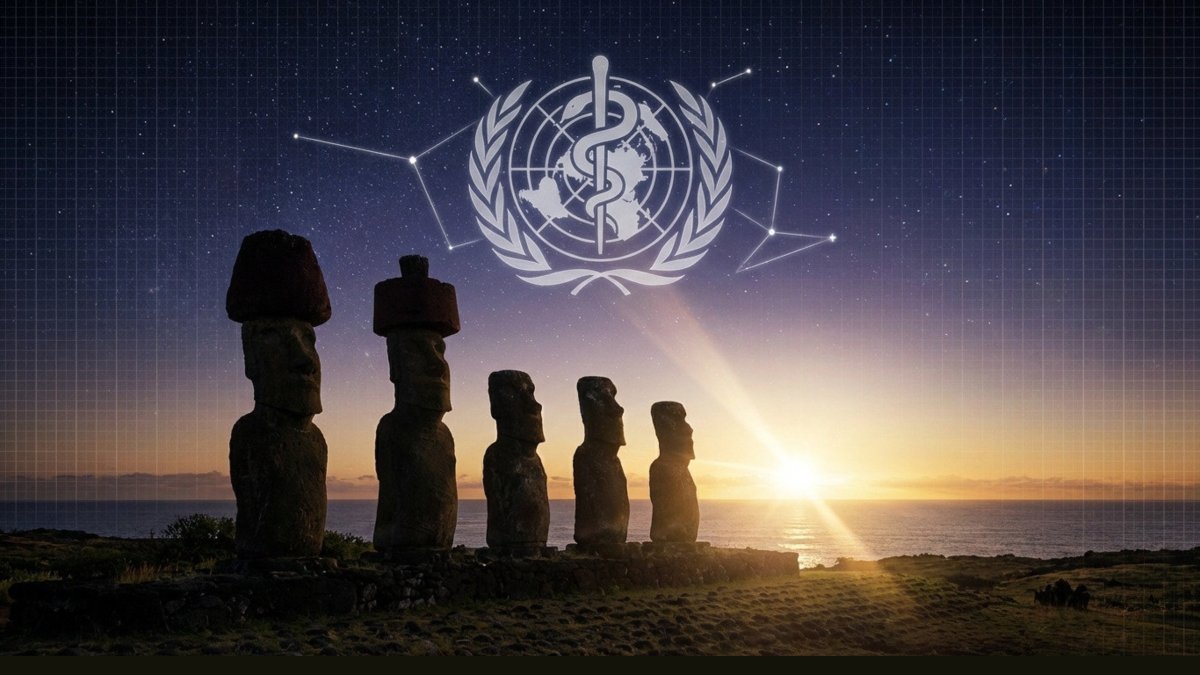
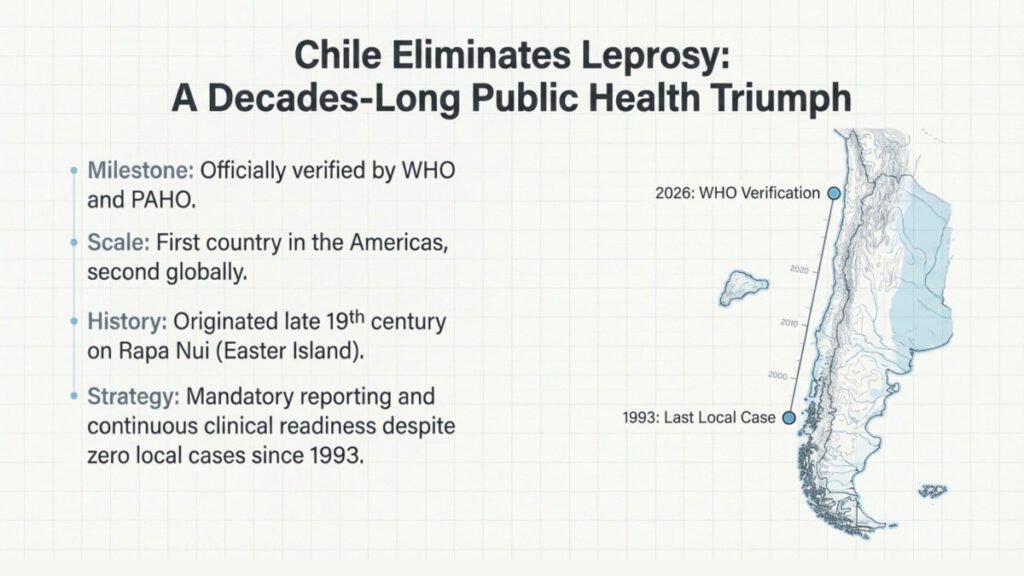
In a remarkable milestone for global medicine, Chile has become the first nation in the Americas, and only the second in the entire world, to receive official World Health Organization (WHO) verification for the elimination of leprosy.
The announcement, made jointly by the WHO and the Pan American Health Organization (PAHO) in March 2026, marks the end of a centuries-long struggle with a disease that has haunted human civilization since antiquity.
A Disease With Deep Roots in Chile
Leprosy, also known as Hansen’s disease, first appeared in Chile in the late 19th century, concentrated largely on Rapa Nui (Easter Island). On the mainland, cases were relatively rare and sporadic. Chilean health authorities responded with a combination of isolation and treatment measures on the island, successfully containing the spread. By the late 1990s, the final secondary cases on Rapa Nui had been managed, and the country has recorded no locally acquired case since 1993.
That’s over 30 years of zero transmission. A generation has grown up in Chile without leprosy being a lived reality.
Vigilance Was the Secret
What makes Chile’s success especially instructive is that health officials never allowed complacency to creep in. Even as the disease faded into the background, leprosy remained a notifiable condition, meaning any suspected case had to be officially reported. Authorities maintained continuous surveillance, mandatory reporting systems, and clinical readiness throughout the country’s healthcare infrastructure.
This is the quiet, unglamorous work of public health: maintaining systems for threats that no longer seem imminent. Chile’s approach shows that eliminating a disease is not just about defeating it once, it’s about ensuring it can never quietly return.
Why This Matters Beyond Chile
Leprosy still affects hundreds of thousands of people in parts of Africa, Asia, and Latin America. It is a disease historically associated with stigma and social exclusion, often affecting the most marginalized communities. Chile’s verification offers both a model and a source of hope.
If a country can bring leprosy from endemic status to complete elimination through decades of sustained effort, investment in public health infrastructure, and vigilant monitoring, others can too.
This is what human progress looks like. Its not dramatic, headline-grabbing moments alone, but the steady, determined work of building healthier societies one generation at a time.
This topic was featured in Great News podcast episode 39.

The Great News Podcast is your source for positive news, inspiring stories, and good news from around the world. We skip the doom and gloom of mainstream media to focus on scientific breakthroughs, environmental wins, and the inspiring news that proves the world is getting better. Join Andrew McGivern for a dose of optimism and uplifting stories that will change your perspective on human progress.
It is easy to find the
Keep looking for the good in the world, because it is not only there – its everywhere.
The Great News podcast is brought to you by the Daily Quote.
Today, a discovery that could turn our oceans into a source of clean, green fuel. That's our lead story today.
Plus, we’ll look at a ”molecular staple” for hard-to-treat cancers, a way to silence cholesterol without permanently altering your DNA, and a wireless system that’s twice as efficient as Wi-Fi.
Turning Sunlight and Seawater into Hydrogen
How Stapled Peptides Could Change Cancer Treatment
How Laser Tech Is Rewriting the Rules of WirelessAnd don’t forget to stick around for the speed round where we’ll celebrate a historic victory against an ancient disease.Chile Eliminates Leprosy
Revolutionizing Brain Research and Treatment!
How CAR T Therapy Is Learning to Fight Cancer Smarter
If you like the Great News Podcast, you will love the Great News Letter. Because the Great News Podcast is Great but the Great News Letter is Greater!
The Great News Letter is an email newsletter that you can subscribe to for FREE and get all the good news delivered to your email inbox.
For this episode we got some feedback from Brian de V. You can leave feedback for the show too by going to greatnewspodcast.com/feedback.
Or if you listen in Spotify – leave a comment right there as you listen.
Until next time… and there will be a next time.
Keep looking for the good in the world because no only is it there, its everywhere!
Source:
World Health Organization / Pan American Health Organization, March 2026