Solar energy is booming — but the silicon panels dominating rooftops and power plants come with a dirty secret. Manufacturing them is energy-intensive, relies on toxic chemicals, and creates recycling headaches that the industry hasn’t fully solved. Organic solar cells have long been floated as a cleaner alternative, but they’ve suffered from one stubborn flaw: they fall apart too quickly to be worth deploying at scale.
That might be about to change.
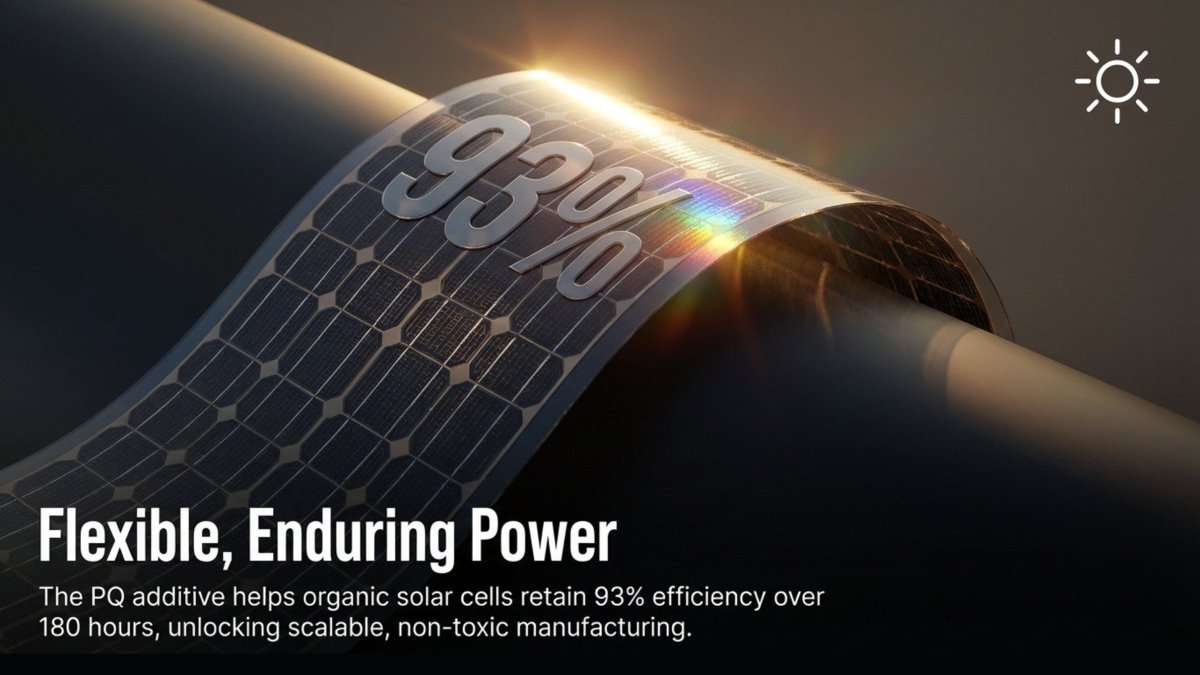
Researchers at Penn State University have identified a promising fix — and it’s surprisingly straightforward. Led by Assistant Professor Nutifafa Doumon and doctoral candidate Souk Yoon “John” Kim, the team added a solid compound called 9,10-phenanthrenequinone (PQ) — a simple carbon-and-hydrogen derivative — to the active layer of organic solar cells. The results were striking. Devices with PQ retained more than 93% of their original power-conversion efficiency after 180 hours of sustained heat. By comparison, cells using a commonly employed (but toxic) additive retained only about 76% over the same period.
That’s not just a marginal improvement — it’s the difference between a technology that replaces itself constantly and one that can realistically sit on a roof for years.
Why It Matters
Organic solar cells have a lot going for them on paper. They’re lighter, more flexible, and cheaper to manufacture than their silicon counterparts. They don’t require the same harsh chemicals to produce, and they can be printed onto surfaces in ways rigid silicon panels simply can’t. The problem has always been durability. Organic materials degrade when exposed to the heat and light they’re designed to harvest, making their commercial appeal difficult to justify.
PQ addresses this by stabilizing the cell’s active layer — the part that actually absorbs sunlight and generates electricity — slowing the degradation process that has historically made organic photovoltaics a short-lived proposition.
What makes PQ especially appealing is that it’s not some exotic lab-only material. It’s low-cost, commercially available, and environmentally safer than many existing additives. There’s a real pathway here from research bench to manufacturing floor.
Cautious Optimism
The Penn State team is careful not to oversell their findings. “We’re not claiming that PQ solves all the problems,” Doumon noted. “Our findings are one step forward.” The team is already exploring other solid additives to understand where PQ fits in the broader landscape of options.
But even incremental gains in stability matter enormously. Every percentage point of retained efficiency reduces how often cells need to be replaced — cutting both waste and the long-term cost of ownership. The research was published in ACS Materials Au and recognized in the journal’s “2025 Rising Stars in Materials Science” issue, a sign that the wider scientific community sees real promise here.
The Bigger Picture
Silicon solar panels aren’t going anywhere soon. But as the energy transition accelerates, there’s growing appetite for purpose-built alternatives — flexible panels for curved surfaces, lightweight cells for vehicles, low-cost solutions for the developing world. Organic solar cells are ideally suited for these use cases, if the durability problem can be cracked.
PQ won’t be the last word on that challenge. But it’s a meaningful step toward a future where clean solar energy comes in more forms than a rectangular panel bolted to a roof.
This topic is featured in Great News podcast episode 35.

The Great News Podcast is your source for positive news, inspiring stories, and good news from around the world. We skip the doom and gloom of mainstream media to focus on scientific breakthroughs, environmental wins, and the inspiring news that proves the world is getting better. Join Andrew McGivern for a dose of optimism and uplifting stories that will change your perspective on human progress.
It is easy to find the
Keep looking for the good in the world, because it is not only there – its everywhere.
This podcast is brought to you by the Daily Quote. The podcast designed to kickstart your day in a positive way!
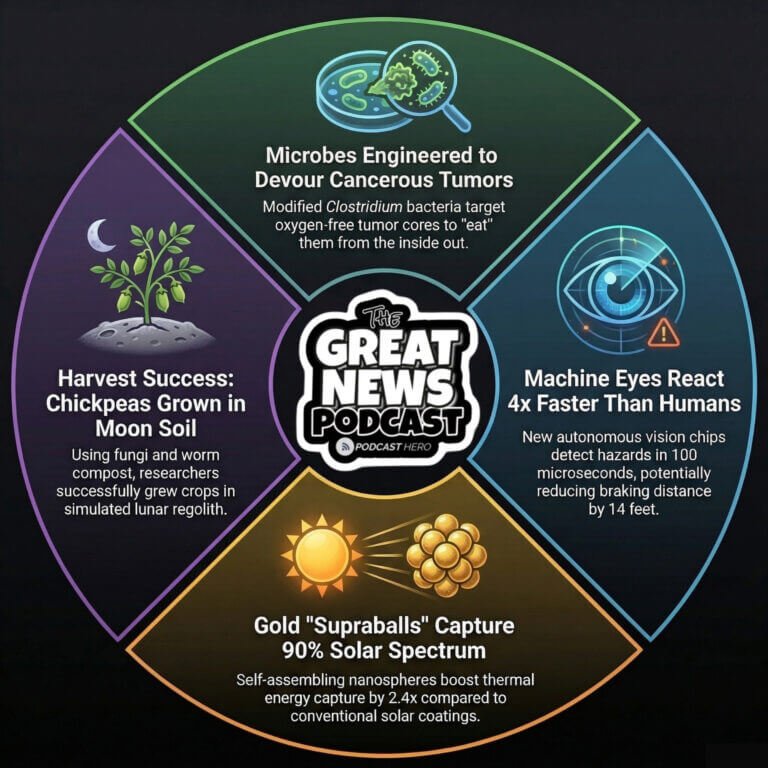
Today, we are exploring a medical breakthrough that uses ”hungry” bacteria to fight cancer, a massive electric flying taxi taking to the skies in China, and a successful harvest of chickpeas grown in actual moon dirt
Plus, we’ll look at a new computer chip that gives self-driving cars reflexes four times faster than the human brain
Bacteria that eats cancer from the inside out
Robot Cars react 4X faster than humans
And stick around for our speed round, where we’ll cover even more great news!
US Forests fighting harder against climate change
Gold Supraballs capture 90% of solar spectrum
A few changes at home reduce asthma attacks
New additive increases organic solar cell efficiency
If you like the Great News Podcast, You'll love the great news letter. Because the Great News Podcast is Great! But the Great News Letter is Greater!
The Great News Letter is FREE and includes all the good news stories.
Source: Interesting Engineering