Machine vision is 4X faster than humans
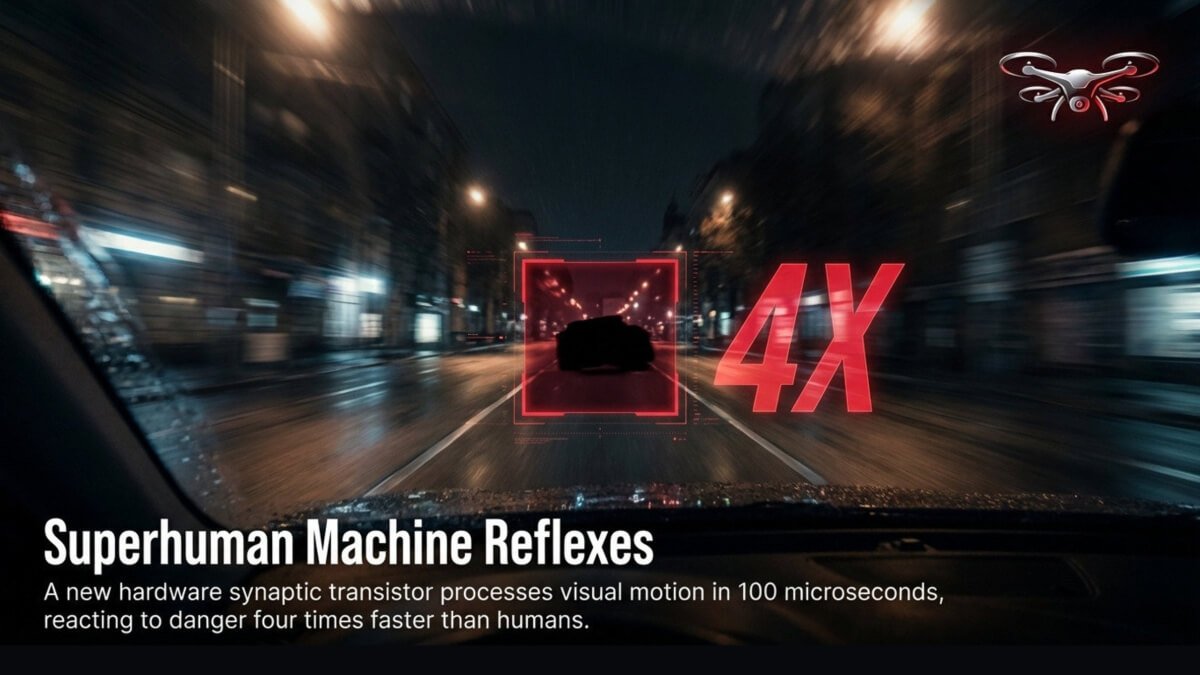
One of the most persistent criticisms of autonomous vehicles has always been reaction time. Humans are surprisingly quick — the brain processes a hazard and triggers a response in roughly 0.15 seconds. Self-driving cars, by contrast, traveling at 50 miles per hour can take around 0.5 seconds to react to an obstacle, covering roughly 43 feet before braking even begins. That gap has long been a serious safety concern, and engineers have struggled to close it through software improvements alone.
A new piece of hardware may change that.
A multinational research team has developed a chip-based “reflex” system for autonomous vehicles that draws inspiration from an unlikely source: the human brain itself. Rather than analyzing every pixel of every video frame — the conventional approach — the system uses a “filter-then-process” method, where a two-dimensional synaptic transistor array first strips out irrelevant visual data and flags only meaningful motion, before passing those signals on to standard computer vision algorithms.
The results are striking. In lab tests, the system processed motion data four times faster than current leading algorithms, and under ideal conditions even surpassed human-level reaction performance. Real-world driving tests showed a 213% improvement in hazard detection, while robotic arm tests demonstrated an astonishing 740% boost in object-grasping speed. For drones, reaction time dropped by at least a third.
What makes this particularly exciting is that it doesn’t require scrapping existing camera hardware. As co-author Gao Shuo of Beihang University explained, the approach works as a plug-in enhancement to current computer vision systems — making it practical to deploy rather than just impressive in a lab. At highway speed, the roughly 0.2-second improvement translates to around 14 fewer feet of braking distance, a margin that, in a real crash scenario, can be the difference between a near-miss and a collision.
The research was published in Nature Communications, and the team hopes to begin working directly with automotive and drone manufacturers. It’s a meaningful step toward autonomous vehicles that don’t just drive themselves — but drive themselves safely.
This topic was featured on Great News podcast episode 35.

The Great News Podcast is your source for positive news, inspiring stories, and good news from around the world. We skip the doom and gloom of mainstream media to focus on scientific breakthroughs, environmental wins, and the inspiring news that proves the world is getting better. Join Andrew McGivern for a dose of optimism and uplifting stories that will change your perspective on human progress.
It is easy to find the
Keep looking for the good in the world, because it is not only there – its everywhere.
This podcast is brought to you by the Daily Quote. The podcast designed to kickstart your day in a positive way!
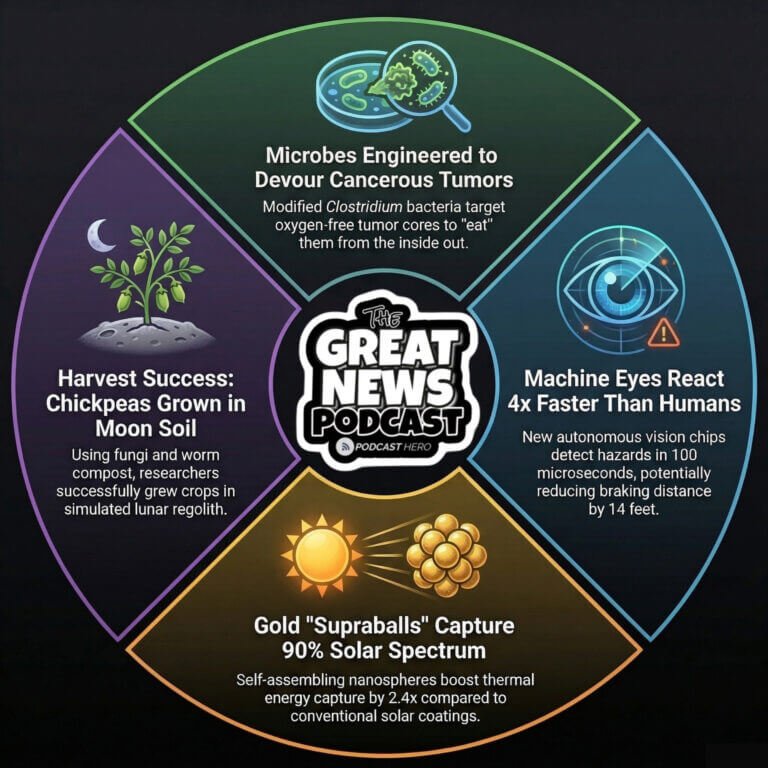
Today, we are exploring a medical breakthrough that uses ”hungry” bacteria to fight cancer, a massive electric flying taxi taking to the skies in China, and a successful harvest of chickpeas grown in actual moon dirt
Plus, we’ll look at a new computer chip that gives self-driving cars reflexes four times faster than the human brain
Bacteria that eats cancer from the inside out
Robot Cars react 4X faster than humans
And stick around for our speed round, where we’ll cover even more great news!
US Forests fighting harder against climate change
Gold Supraballs capture 90% of solar spectrum
A few changes at home reduce asthma attacks
New additive increases organic solar cell efficiency
If you like the Great News Podcast, You'll love the great news letter. Because the Great News Podcast is Great! But the Great News Letter is Greater!
The Great News Letter is FREE and includes all the good news stories.
Source: Interesting Engineering