The Alchemist’s Dream
For decades, nuclear energy has presented a paradoxical challenge: a powerful, carbon-free source of electricity that simultaneously generates highly radioactive waste, posing a long-term environmental and safety dilemma. The question of how to safely manage spent nuclear fuel, which can remain dangerous for hundreds of thousands of years, has fueled public debate and hindered the broader adoption of nuclear power. However, a revolutionary technology is emerging from the laboratories of the U.S. Department of Energy that promises to transform this liability into an asset, converting nuclear waste into additional electricity while drastically reducing its radioactive lifespan.
Accelerator-Driven Systems: A New Paradigm for Nuclear Waste
At the heart of this innovation are Accelerator-Driven Systems (ADS), a technology being advanced by researchers at the Thomas Jefferson National Accelerator Facility (Jefferson Lab). Supported by $8.17 million in grants from the DOE’s NEWTON (Nuclear Energy Waste Transmutation Optimized Now) program, these projects represent a fundamental shift in how we view used nuclear fuel—from a permanent liability requiring deep geological repositories to a recyclable fuel source.
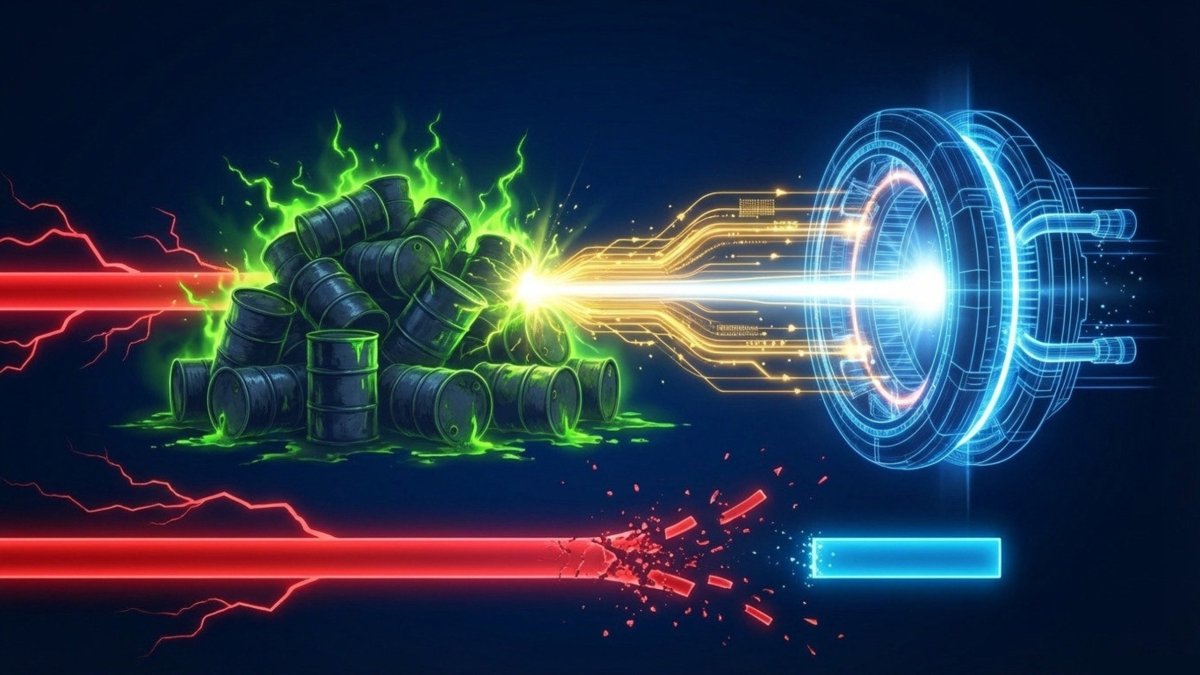
The ADS works by employing a particle accelerator to fire high-energy protons at a target, such as liquid mercury. This collision triggers a process called “spallation,” which releases a flood of neutrons. These neutrons then interact with the unwanted, long-lived isotopes present in nuclear waste, effectively “burning” or transmuting the most hazardous components.
The Transformative Impact:
•Drastic Reduction in Radioactivity: Unprocessed nuclear fuel remains dangerous for approximately 100,000 years. Through partitioning and recycling via ADS, this hazardous lifespan can be reduced to a mere 300 years, a staggering 99.7% reduction.
•Additional Carbon-Free Electricity: The transmutation process itself generates significant heat. This heat can be harnessed to produce additional carbon-free electricity, feeding directly into the grid and enhancing energy security .
As Rongli Geng, head of SRF Science & Technology at Jefferson Lab and principal investigator for both projects, succinctly puts it, “Instead of having a lifetime of 100,000 years in storage, for example, you can shorten the storage years down to 300”.
Overcoming Technical Hurdles for Economic Viability
For ADS to become a widespread solution, it must be both technically feasible and economically viable. Jefferson Lab is tackling two primary technical challenges to achieve this:
1.Enhanced Accelerator Efficiency: Traditional particle accelerators require massive, expensive cryogenic cooling systems to reach superconducting temperatures. Jefferson Lab is pioneering a more cost-effective approach by coating the interior of pure niobium cavities with tin. These niobium-tin cavities can operate at higher temperatures, allowing for the use of standard commercial cooling units instead of custom, large-scale cryogenic plants.
2.High-Power Magnetrons: The ADS requires a substantial power source—around 10 megawatts—to drive the particle beam. Researchers are adapting magnetron technology, the same component found in microwave ovens, to provide this power. The challenge lies in precisely matching the energy frequency at 805 Megahertz. Collaborating with Stellant Systems, they are prototyping advanced magnetrons capable of reaching these high-power thresholds with maximum efficiency.
A Future of Sustainable Nuclear Energy
The NEWTON program aims to enable the recycling of the entire U.S. commercial nuclear fuel stockpile within the next 30 years . By involving industry partners like RadiaBeam, General Atomics, and Stellant Systems from the outset, Jefferson Lab is accelerating the transition of these technologies from laboratory research to commercial manufacturing and deployment.
This initiative offers a compelling solution to the long-standing nuclear waste problem, transforming it from a burden into a valuable resource. It not only promises a cleaner, safer future for nuclear energy but also positions it as an even more sustainable component of our global energy mix, capable of meeting growing demands without the environmental footprint of fossil fuels.
This topic is featured in Great News podcast episode 38.
Sources:
Interesting Engineering. “US tech to turn nuclear waste into power, cut radioactive life by 99.7%.”