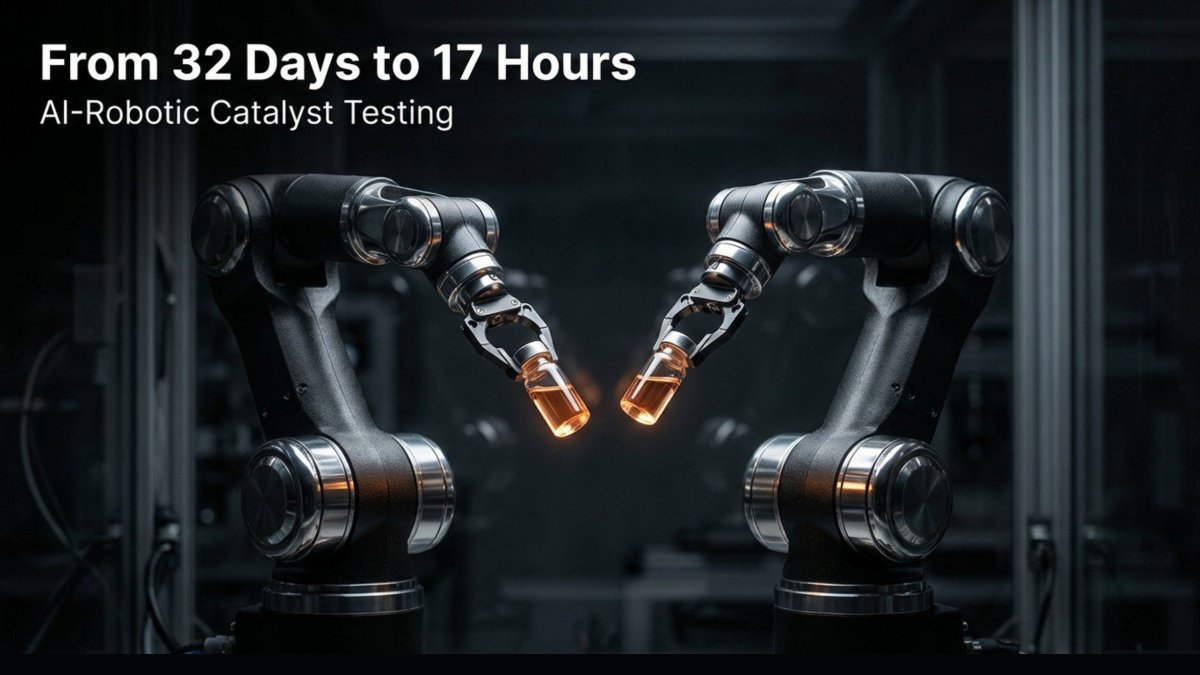
A Two Robot Team Cuts time from 32 Days Manual Work to 17 Hours
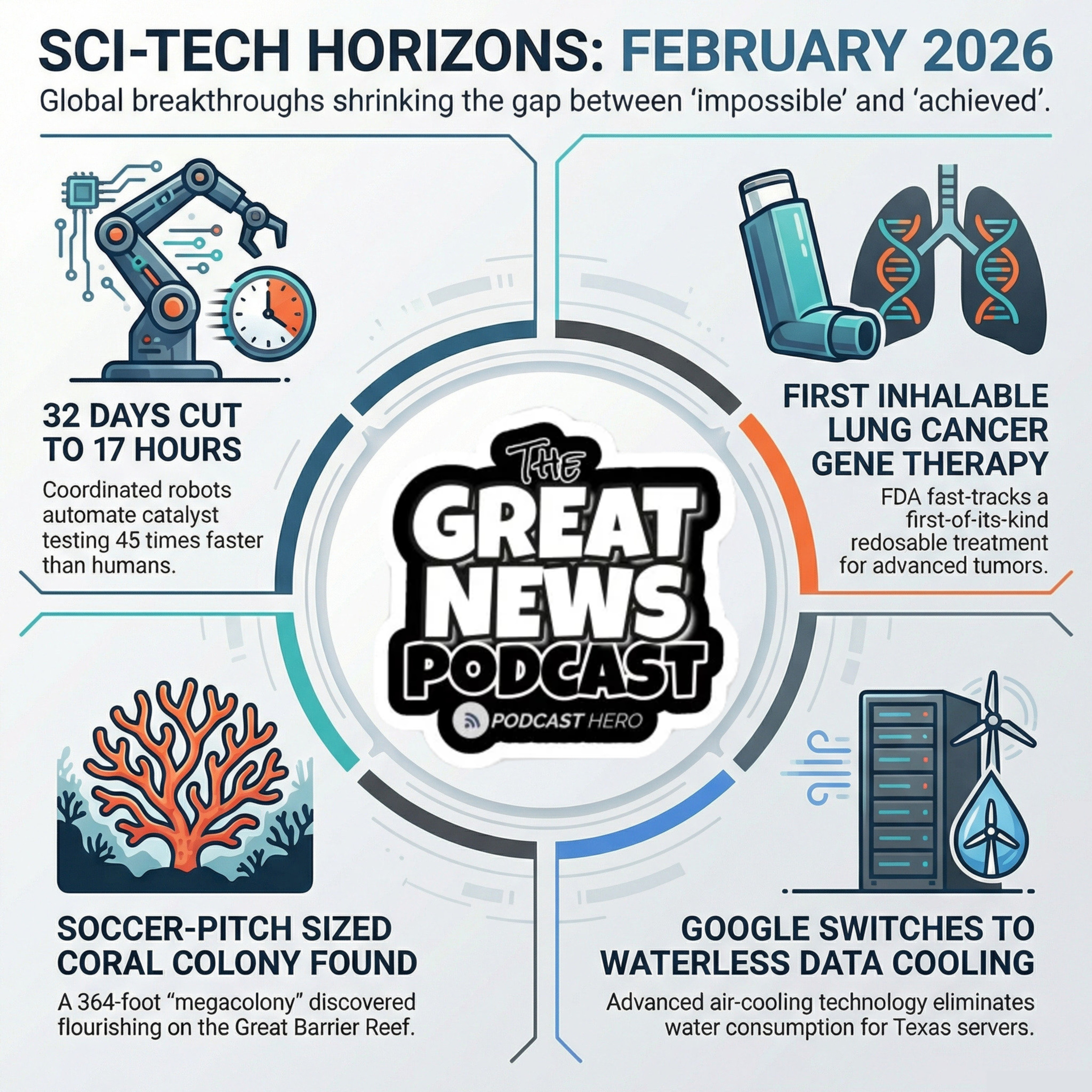
What once took a team of researchers over a month to complete can now be done in less than a day. That’s the headline-grabbing result from a new study out of South Korea’s Korea Institute of Energy Research (KIER), where scientists have developed a dual-robot platform that compresses 32 days of manual catalyst testing into just 17 hours.
The research, led by Dr. Ji Chan Park of KIER’s Clean Fuel Research Laboratory and published in Chemical Science, tackles a genuinely tedious bottleneck in materials science: catalyst performance evaluation. Developing new catalysts — the substances that speed up and control chemical reactions in everything from fuel cells to industrial manufacturing — requires enormous amounts of repetitive experimentation. Composition changes, reaction condition tweaks, sample loading, measurement recording — it’s painstaking work, and it’s exactly the kind of work that humans don’t do consistently. Results can vary depending on who runs the experiment and when.
The KIER team’s solution is an elegantly coordinated two-robot system. The first robot handles sample identification, precise positioning, and spectral measurements. The second manages the operational logistics — retrieving samples, disposing of used ones, and replacing consumables — allowing experiments to run continuously overnight and across long durations without anyone in the lab. Together, operating on an integrated control system, the two robots achieve a 45-fold speed increase and reduce result variability by about 32%.
That last point matters as much as the speed. Faster experiments mean little if the data is noisy. By removing human handling from the loop, the platform produces more reliable measurements that researchers can actually trust.
This isn’t just a proof-of-concept curiosity. The team has already secured a Korean patent for the system, and the technology has a clear commercial path toward deployment in industrial and research labs worldwide. As the race to develop better catalysts for clean energy applications intensifies, tools that can dramatically accelerate the discovery cycle could have real-world consequences for how quickly we develop cleaner fuels and more sustainable chemical processes.
The robots, it turns out, are pretty good at chemistry.
This topic is featured in Great News podcast episode 32

The Great News Podcast is your source for positive news, inspiring stories, and good news from around the world. We skip the doom and gloom of mainstream media to focus on scientific breakthroughs, environmental wins, and the inspiring news that proves the world is getting better. Join Andrew McGivern for a dose of optimism and uplifting stories that will change your perspective on human progress.
It is easy to find the
Keep looking for the good in the world, because it is not only there – its everywhere.
Today, we are diving into a ”fountain of youth” for the brain, a massive underwater discovery by a mother-daughter duo, and a plan to save the world's most popular fruit. Plus a new water free data center…
Can We Reprogram Our Way Out of Alzheimer's?
A Mother, a Daughter, and the World's Largest Coral Discovery
Protecting Commercial Bananas From Fungus
New AI Data Center to Use Zero Water?
And don't forget to stick around for the speed round:
Robots Are Transforming the Chemistry Lab — One Catalyst at a Time
Breathe In, Fight Back: The World's First Inhalable Gene
Therapy for Cancer Just Got Fast-Tracked
Why Your Funniest Teacher Was Probably Your Best Teacher
Source: Phys.org