Hair loss affects hundreds of millions of people worldwide, and the treatments available have long been a frustrating compromise. Drug-based options like minoxidil and finasteride work reasonably well, but come with concerns about side effects from prolonged use. Light therapy has emerged as a promising non-drug alternative — but until now, the devices designed to deliver it have been bulky, rigid, helmet-style contraptions that most people would rather not be seen wearing in public, let alone use consistently enough to see results.
Researchers at South Korea’s Korea Advanced Institute of Science and Technology (KAIST) may have quietly solved both problems at once.
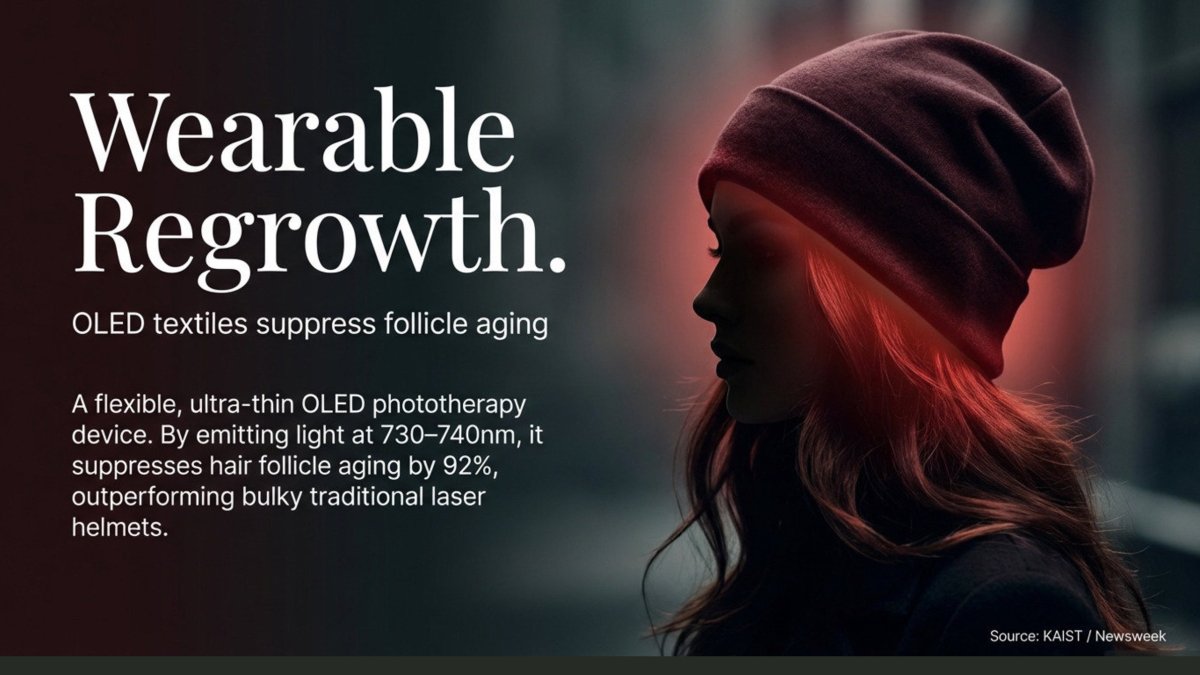
Working with a soft, cap-like design rather than the heavy helmet-style equipment of conventional phototherapy, the KAIST team has developed a wearable device built around flexible near-infrared OLED panels that naturally conform to the contours of the scalp, delivering uniform light exposure across the entire head. It looks like a hat. It works like a precision therapeutic device.
The science behind it is worth understanding. Hair loss is closely linked to the ageing of dermal papilla cells — specialized cells sitting at the base of hair follicles that regulate hair growth. As these cells age and begin to deteriorate, hair follicles shrink and eventually stop producing hair altogether. The KAIST team fabricated customized OLEDs that emit near-infrared light specifically in the 730–740 nanometer range, which is optimal for activating these dermal papilla cells. This precision matters: different wavelengths trigger different cellular responses, and the team adapted wavelength-control techniques originally developed for display screens — the kind used in smartphones and televisions — for therapeutic use.
When tested on human dermal papilla cells, exposure to the near-infrared OLED light reduced cellular ageing by approximately 92 percent, outperforming conventional red-light irradiation — the approach used by most existing hair loss devices on the market.
There are practical advantages beyond the striking lab results. Because OLEDs are thin and flexible, they can closely conform to the curved surface of the scalp, delivering uniform light stimulation across the entire area, something that existing point-source LED and laser devices have always struggled to achieve. The design is also low-heat, reducing any risk of scalp burns, and light enough to wear comfortably throughout daily life rather than being confined to a chair in a clinic.
It’s important to note that the technology hasn’t yet been tested on human subjects in a clinical trial — the current results are from cell-based experiments. The team plans to move into preclinical studies and, eventually, human trials, while also working on practical refinements like washability and flexible battery integration.
But the direction is genuinely exciting. Hair loss treatments have been largely static for decades. The idea that a comfortable, everyday hat — built on the same display technology as your phone screen, tuned to exactly the right wavelength of light — could actively protect hair follicles from ageing is the kind of convergence between consumer technology and medicine that tends to quietly change everything.
Sometimes the most significant breakthroughs come in the most unassuming packages.
This topic was covered in Great News podcast episode 31.

The Great News Podcast is your source for positive news, inspiring stories, and good news from around the world. We skip the doom and gloom of mainstream media to focus on scientific breakthroughs, environmental wins, and the inspiring news that proves the world is getting better. Join Andrew McGivern for a dose of optimism and uplifting stories that will change your perspective on human progress.
It is easy to find the
Keep looking for the good in the world, because it is not only there – its everywhere.
Today we’re diving into some truly groundbreaking advancements in biotechnology, sustainable energy, and global economics. What if we could actually reverse antibiotic resistance in bacteria instead of just trying to keep up with it?
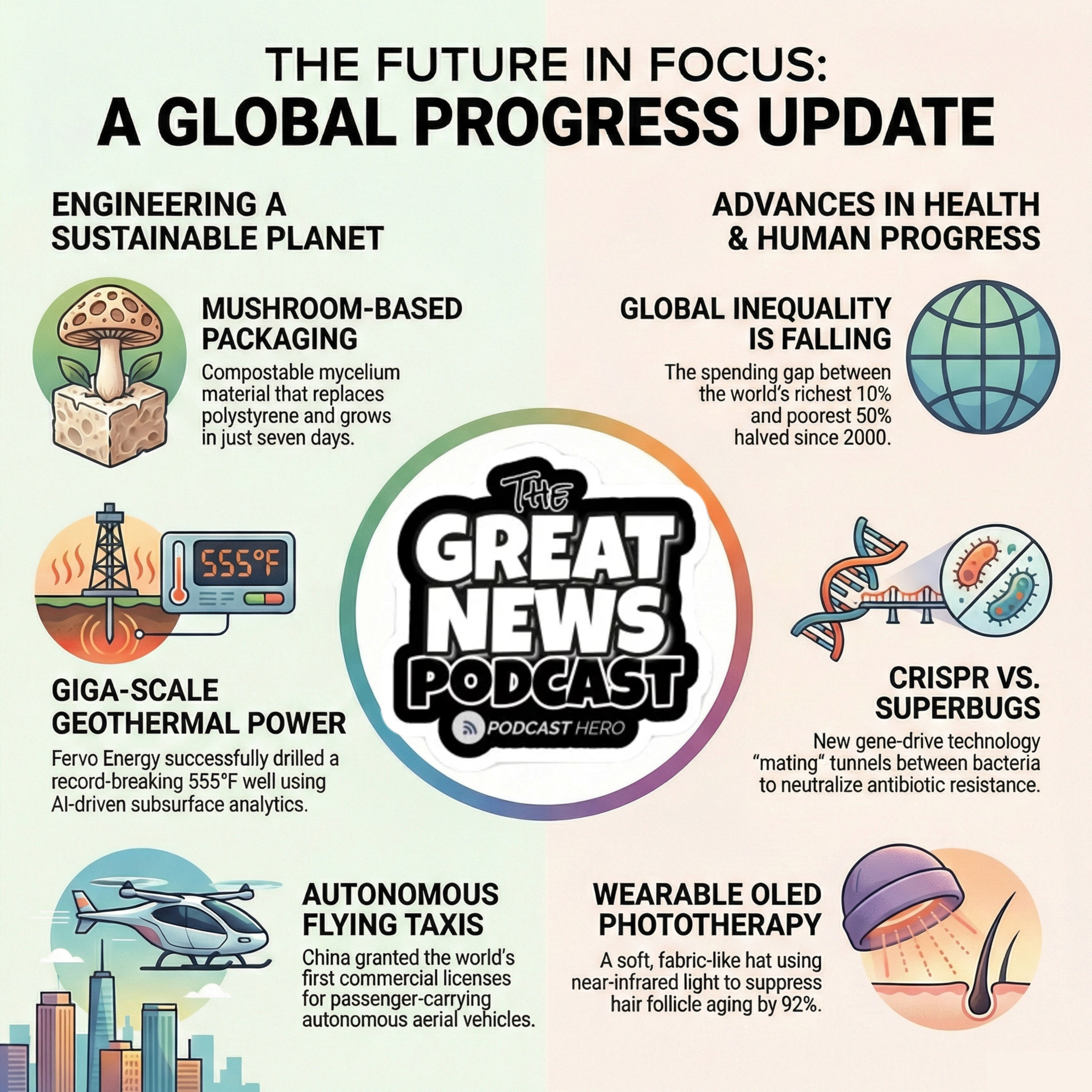
Plus, we have packaging that grows itself from mushrooms, a giga-scale geothermal breakthrough in Utah, and new data showing the world is more equal than you might think.
- What If We Could Teach Bacteria to Forget How to Resist Antibiotics?
- Global Inequality Declines Substantially
- Geothermal Breakthrough
And don't forget to stick around for the speed round where we'll dive into even more great news.
- The Screen Time Panic May Be Missing the Point
- China grants commercial flying taxi licenses
- The Future of Hair Loss Treatment Might Just Be a Hat
- Your Immune System Could Be the Key to Slowing Ageing
- AI has identified 15 new magnetic materials
And don't forget to follow the Daily Quote
Source: Newsweek