Turn on the news or scroll through social media and the picture of global inequality feels bleak and getting bleaker. Billionaires’ fortunes smash records. The cost of living squeezes households across the developed world. Headlines remind us that the richest handful of individuals own more than the bottom half of humanity combined. The narrative is overwhelming, and it feels self-evidently true.
But there’s another story — one that rarely makes the front page — and it’s told in the data.
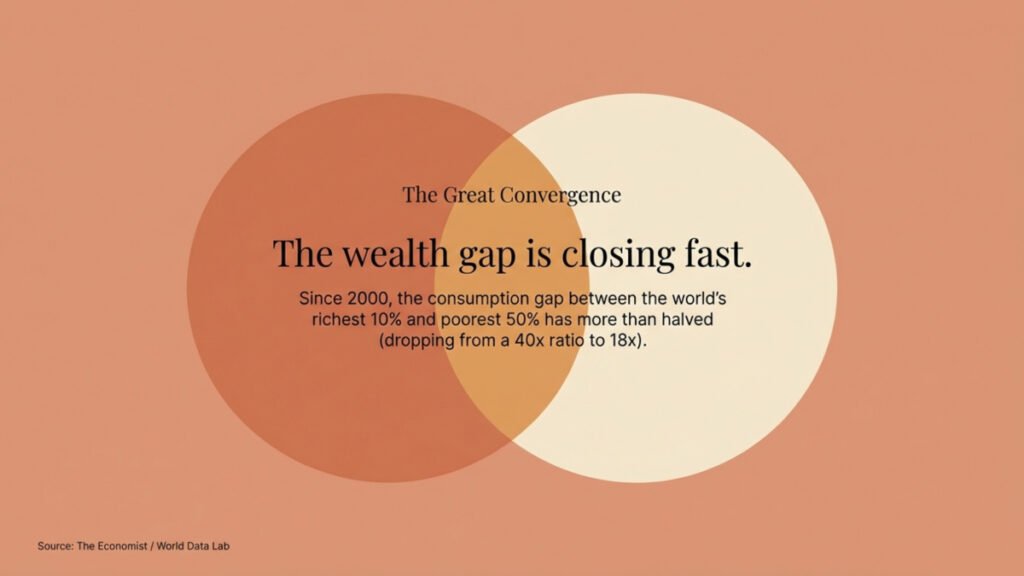
In the 21st century the world economy has kept getting more equal. Data covering 194 countries and economies, compiled by the World Data Lab, show that the ratio between spending by the world’s richest 10% and the poorest 50% has more than halved since 2000. Back then, the rich spent about 40 times more than the poor; today the figure is closer to 18. Over the same period, the richest 1% have also seen their share of consumption shrink.
Read that again. The gap between the richest and the poorest — globally — has more than halved in a single generation.
The shift is driven mostly by gains in low- and middle-income economies, rather than changes in rich countries. Poorer countries have grown faster than rich ones, and consumption has risen with incomes. The economic rise of China, India, Vietnam, Ethiopia, Bangladesh and dozens of other nations has been the greatest poverty-reduction event in human history, lifting hundreds of millions of people into the middle class in a timeframe that would have seemed impossible to previous generations.
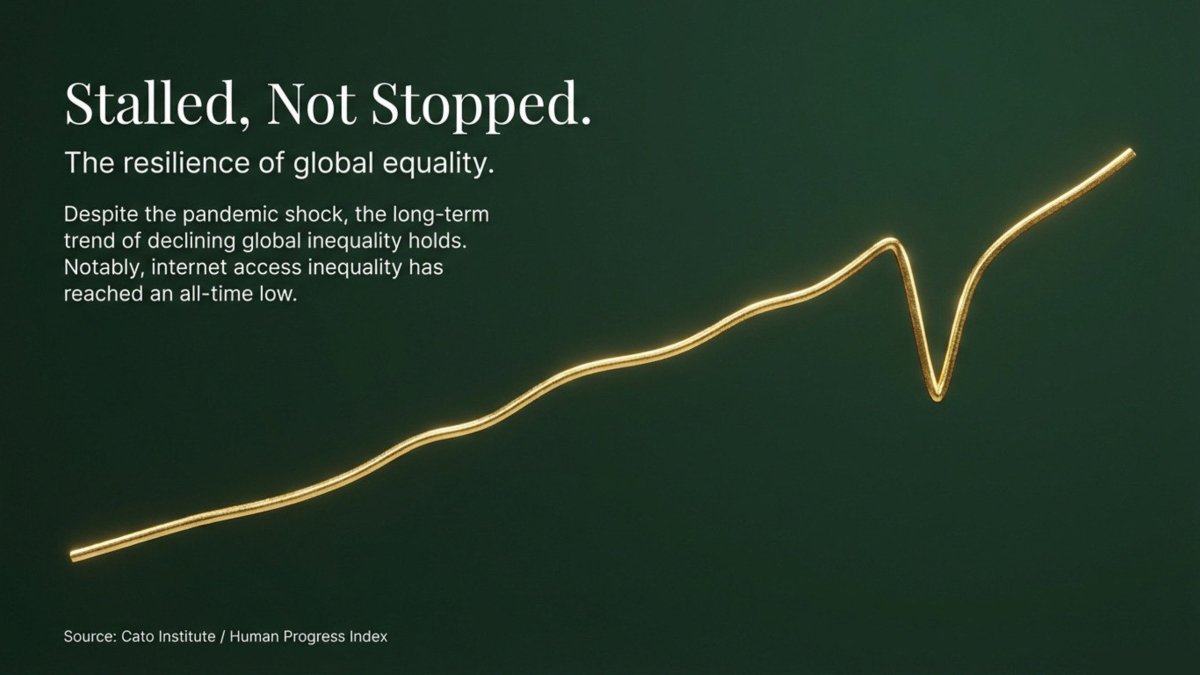
This broader picture is confirmed by the Inequality of Human Progress Index, which tracks global inequality across eight dimensions — not just income, but education, life expectancy, internet access, nutritional security, and political freedom. Across all but two of the dimensions analyzed, the world has become more equal since 1990. Worldwide equality has grown continuously since 1990 for life expectancy, internet access, and education. Global income inequality, while it worsened until the mid-2000s, has improved considerably since then. Overall, global inequality fell nearly 50% between 1990 and 2018.
None of this is an argument for complacency. Inequality within countries — particularly the UK, US, and across much of the developed world — has genuinely worsened, and the political and social consequences of that are real and serious. The concentration of wealth at the very top, and the way it translates into political influence, deserves sustained scrutiny. Two indicators still show trends toward more inequality globally: mortality from outdoor air pollution and infant mortality, reminders that progress is uneven and that the most vulnerable remain exposed in ways that statistics can obscure.
But the habit of reading global inequality solely through the lens of billionaire wealth misses a transformation of extraordinary scale and speed. When we conflate the valid concern about domestic inequality with the conclusion that the world as a whole is getting less fair, we risk losing sight of what’s actually working — and why it’s working. We are witnessing the first decline in inequality between world citizens since the Industrial Revolution.
The story of our time is not simply that the rich are getting richer. It’s also that billions of people who were desperately poor are no longer so. Both things are true. Holding them in tension, rather than letting one erase the other, is essential if we want to understand the world clearly enough to make it better.
This topic was covered in Great News podcast episode 31.

The Great News Podcast is your source for positive news, inspiring stories, and good news from around the world. We skip the doom and gloom of mainstream media to focus on scientific breakthroughs, environmental wins, and the inspiring news that proves the world is getting better. Join Andrew McGivern for a dose of optimism and uplifting stories that will change your perspective on human progress.
It is easy to find the
Keep looking for the good in the world, because it is not only there – its everywhere.
Today we’re diving into some truly groundbreaking advancements in biotechnology, sustainable energy, and global economics. What if we could actually reverse antibiotic resistance in bacteria instead of just trying to keep up with it?
Plus, we have packaging that grows itself from mushrooms, a giga-scale geothermal breakthrough in Utah, and new data showing the world is more equal than you might think.
- What If We Could Teach Bacteria to Forget How to Resist Antibiotics?
- Global Inequality Declines Substantially
- Geothermal Breakthrough
And don't forget to stick around for the speed round where we'll dive into even more great news.
- The Screen Time Panic May Be Missing the Point
- China grants commercial flying taxi licenses
- The Future of Hair Loss Treatment Might Just Be a Hat
- Your Immune System Could Be the Key to Slowing Ageing
- AI has identified 15 new magnetic materials
And don't forget to follow the Daily Quote
Source: Human Progress | The Economist