
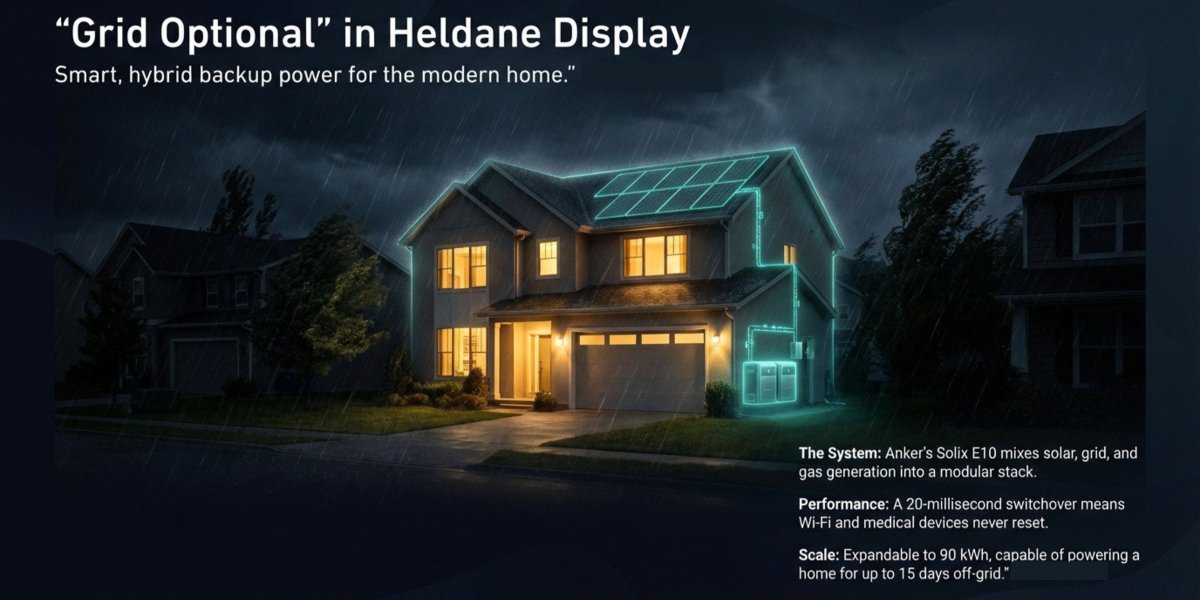
Power outages are more than an inconvenience — they’re a growing reality for millions of homeowners. Whether it’s a severe storm, an aging grid, or a wildfire-driven utility shutoff, the question of how to keep your home running has never been more pressing. Anker, the company best known for charging cables and portable power banks, thinks it has the answer — and it’s thinking on a much larger scale than a pocket-sized battery pack.
Meet the Anker Solix E10
Anker’s power solutions division, Solix, has unveiled what it’s calling the world’s first smart hybrid whole-home backup system: the Solix E10. It’s a bold claim, but the specs back up the ambition. Rather than protecting a single circuit or a handful of critical appliances, the E10 is designed to keep your entire house running — lights, refrigerator, HVAC, EV charger, and all — for days at a time.
The system brings together four core components: a battery inverter, modular battery packs, a tri-fuel generator, and either a Power Dock (for automatic switchover) or a Smart Inlet Box (for manual switchover). Together, they form a comprehensive energy ecosystem that draws from the grid, solar panels, and a generator to ensure you’re never without power.
The Technology Behind It
The real magic of the E10 is in how seamlessly it handles a grid failure. The Power Dock configuration switches over to backup power in just 20 milliseconds — fast enough that sensitive devices like Wi-Fi routers, medical equipment, and smart home systems won’t even reboot. For households where continuous power isn’t just a comfort but a necessity, that kind of reliability matters enormously.
Each battery pack holds 6 kWh, and up to five can be stacked in a single E10 module. Chain multiple modules together and you can reach up to 90 kWh of total storage — enough to power an average home for three full days at normal usage, or up to 15 days if you’re being conservative. The system accepts up to 9 kW of solar input per unit, and Anker has wisely made it compatible with any brand of solar panels, not just its own.
When solar and battery reserves run low, the tri-fuel generator kicks in automatically, running on gasoline, propane, or natural gas depending on what you have available. That fuel flexibility is a practical touch — during a prolonged outage, you may not be able to source a specific fuel type, and having options matters.
On the output side, a single E10 can deliver up to 37.2 kW — enough to start even a 5-ton central air conditioner. Stack two E10 units and you get up to 66 kW. There’s also a “turbo output” mode that provides up to 10 kW per unit for 90-minute bursts, useful for especially power-hungry appliances.
Built for Real-World Conditions
One often-overlooked problem with home battery systems is where and how they can actually be installed. The Solix E10 addresses this with weather-resistant, all-metal stackable enclosures rated to handle temperatures from -4°F to 131°F. Crucially, they can be wall-mounted, which means homeowners in flood-prone areas can keep the system safely elevated off the ground. It’s a detail that speaks to how seriously Anker has thought about deployment beyond the average dry suburban garage.
Pricing and Availability
The E10 launched in early February 2026. The entry-level configuration — inverter plus one battery pack — starts at $4,299. Adding the tri-fuel generator and the automatic Power Dock brings the total to $7,399. Pre-orders came with a $10 deposit and came with a $500 discount voucher, a 400-watt solar panel, and an extended three-year warranty.
Anker also offers professional installation services, which matters for a system of this complexity. Whole-home backup isn’t DIY territory, and having a clear, managed path from purchase to a working installation removes a major barrier for most homeowners.
Is It Worth It?
At $7,399 for the full base configuration, the E10 isn’t cheap — but it competes well against alternatives like the Tesla Powerwall or Generac’s PWRcell when you factor in the integrated generator, broad solar compatibility, and the ability to scale storage up to 90 kWh. For homeowners in areas with frequent outages, or those already investing in rooftop solar, this is a compelling and well-rounded package.
The bigger picture is hard to ignore. Home energy resilience is no longer a niche concern. As extreme weather events become more frequent and grid reliability comes under pressure, products like the Solix E10 are likely to shift from “nice to have” to genuinely essential. Anker has spent years building trust in the consumer electronics space — now it’s bringing that same approach to protecting your entire home.
This topic was featured in Great News podcast episode 30.

Because good news should be heard…
Today, we are exploring how artificial intelligence is moving medicine from a game of chance to a masterwork of design. Plus, we’ll look at a cooling system inspired by ancient beehives, a non-invasive nasal drop that could tackle the deadliest brain cancers, and a backup power system that ensures you’ll never even notice a blackout.
How AI Is Reinventing the AntibodyClay, Cool Air, and a 5,000-Year-Old IdeaNasal Nanodrops: A Promising New Weapon Against the Deadliest Brain CancerNever Get Caught in the Dark Again
And stay tuned for our speed round, where we’ll cover everything from quantum biological sensors to the ”switch” that might repair the human liver.

Source: New Atlas